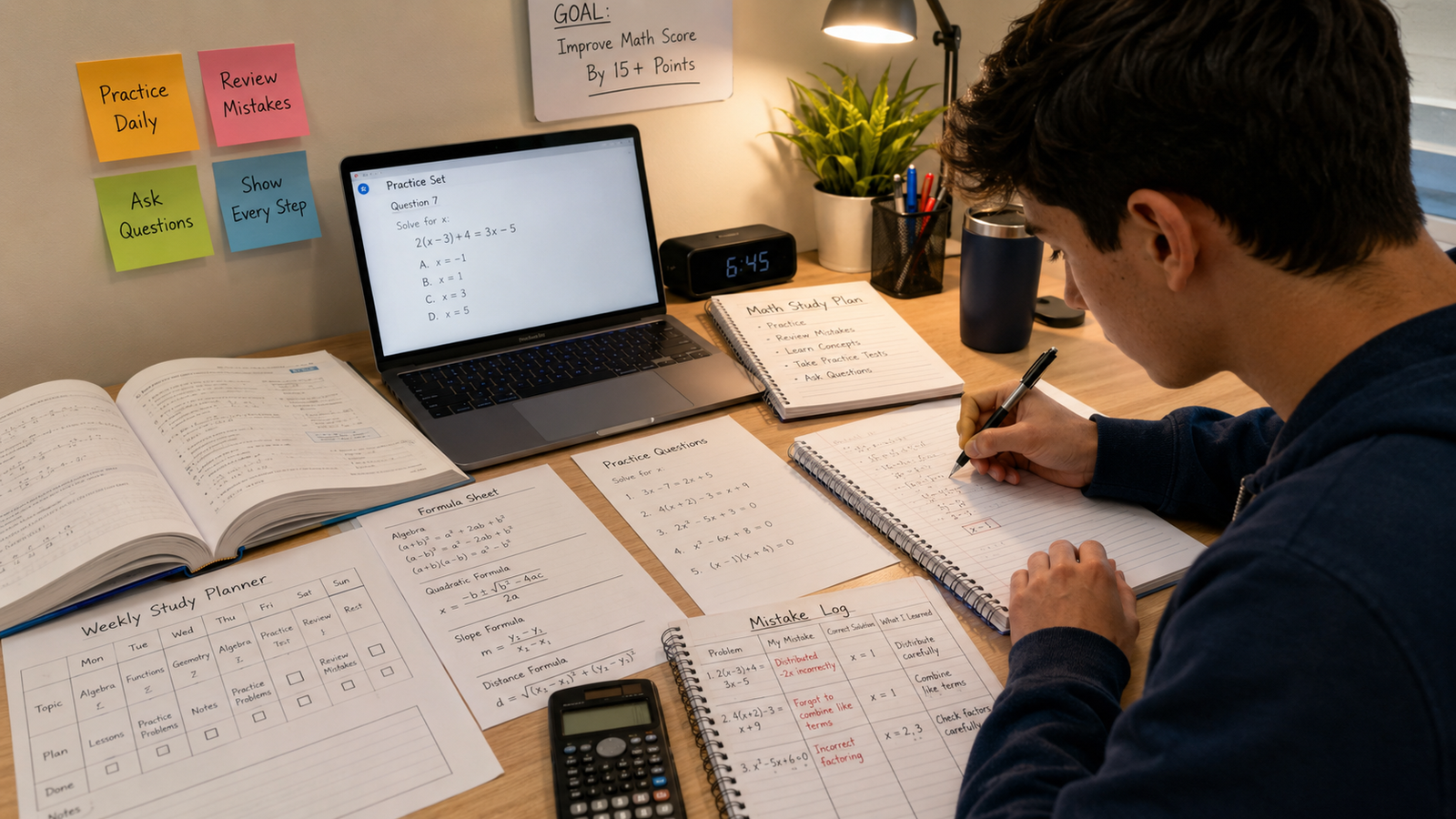
Math can feel frustrating when you understand a lesson in class but cannot solve the same type of problem later on your own. You may spend hours rereading notes, watching videos, or reviewing formulas and still freeze when the questions look slightly different.
The problem is often not effort. It is the way study time is being used.
Math is a skill-based subject. You improve by solving problems, checking your reasoning, correcting mistakes, and returning to weak topics regularly. Reading solutions may help you recognize a method, but recognition alone does not guarantee that you can use it during homework or an exam.
The most useful math study tips are therefore practical:
- Find the exact step where your understanding breaks down.
- Practice without copying a worked solution.
- Review mistakes instead of hiding them.
- Mix old and new problem types.
- Study across several days instead of cramming.
- Ask specific questions when you need help.
This guide explains how high school, college, and online students can study math more effectively, improve problem-solving skills, and prepare for tests with less confusion.
Why Does Studying Math Feel So Difficult?
Math topics build on one another. A weakness in fractions can later cause trouble with algebra. Weak algebra skills can make geometry, statistics, chemistry, economics, and calculus harder. Math also appears in subjects that students may not expect; for example, this guide explains whether psychology requires math and where statistics and research methods fit into the degree.
That is why students sometimes believe they are struggling with a new topic when the real problem started much earlier.
For example, a student may understand the idea behind a quadratic equation but still lose points because they struggle with:
- Negative signs
- Factoring
- Fractions
- Exponents
- Rearranging equations
- Substituting values correctly
Math also demands active decision-making. You must recognize which rule applies, decide what to do first, and check whether the result makes sense.
That is different from simply remembering a definition.
What Are the Best Math Study Tips?
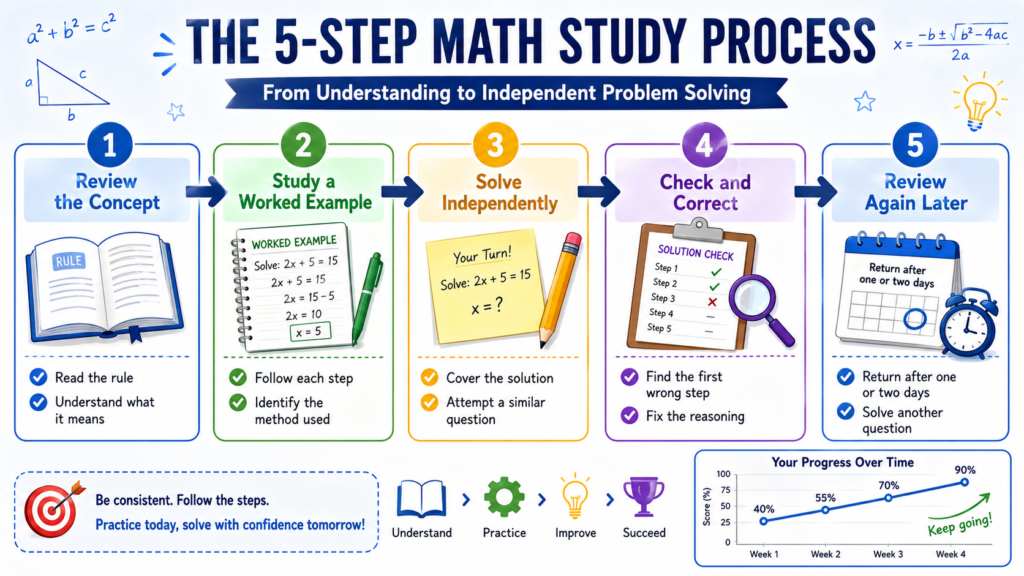
Strong math study habits usually include five parts:
- Review the concept.
- Study a worked example.
- Solve a similar problem independently.
- Check and correct your work.
- Return to the topic later.
The U.S. Department of Education’s study guidance recommends combining worked examples with problem-solving practice and using retrieval throughout the learning process.
This means students should not spend the entire session watching someone else solve questions. They need enough independent practice to prove that they can complete the steps themselves.
Begin With a Math Skills Audit
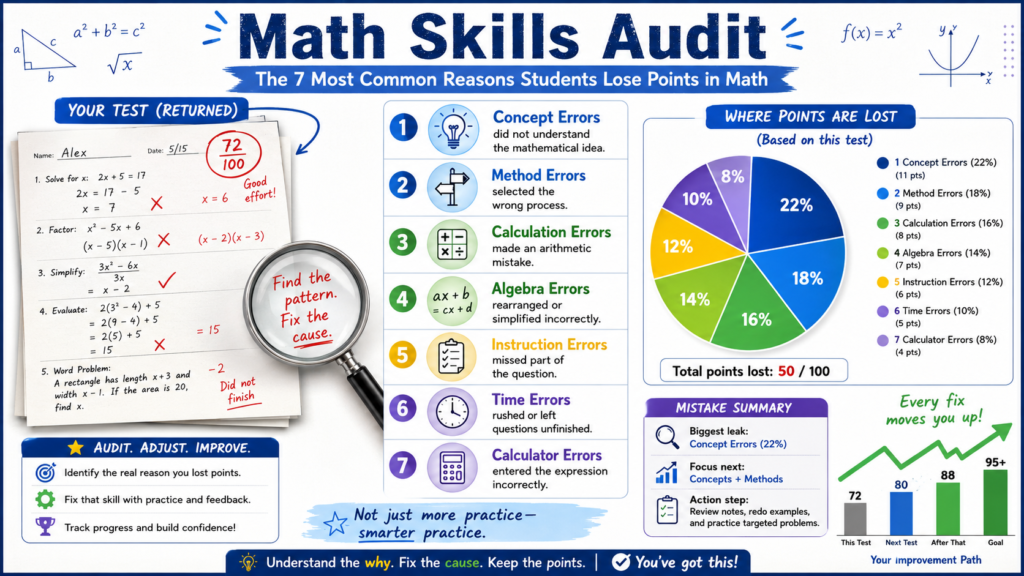
Before studying longer, identify what is actually lowering your scores.
Collect your recent:
- Homework
- Quizzes
- Tests
- Practice worksheets
- Teacher comments
- Online assignment results
Sort each mistake into a category.
Concept Errors
You did not understand the mathematical idea.
Example:
You do not understand why multiplying two negative numbers produces a positive result.
Method Errors
You understood the question but selected the wrong process.
Example:
You used the area formula when the problem asked for perimeter.
Calculation Errors
Your method was correct, but the arithmetic was wrong.
Example:
You wrote 7×8=547 \times 8 = 547×8=54.
Algebra Errors
You made a mistake while rearranging or simplifying.
Example:
You changed the sign incorrectly when moving a term.
Instruction Errors
You did not follow the complete task.
Example:
You found the value but did not show the required work.
Time Errors
You ran out of time or rushed the last section.
Calculator Errors
You entered the expression incorrectly or used the wrong mode.
Once you identify the largest category, your study plan becomes more focused. Students who need to rebuild weak foundations can follow this guide on how to get better at math for help with core skills, regular practice, and confidence.
Keep a Math Mistake Log
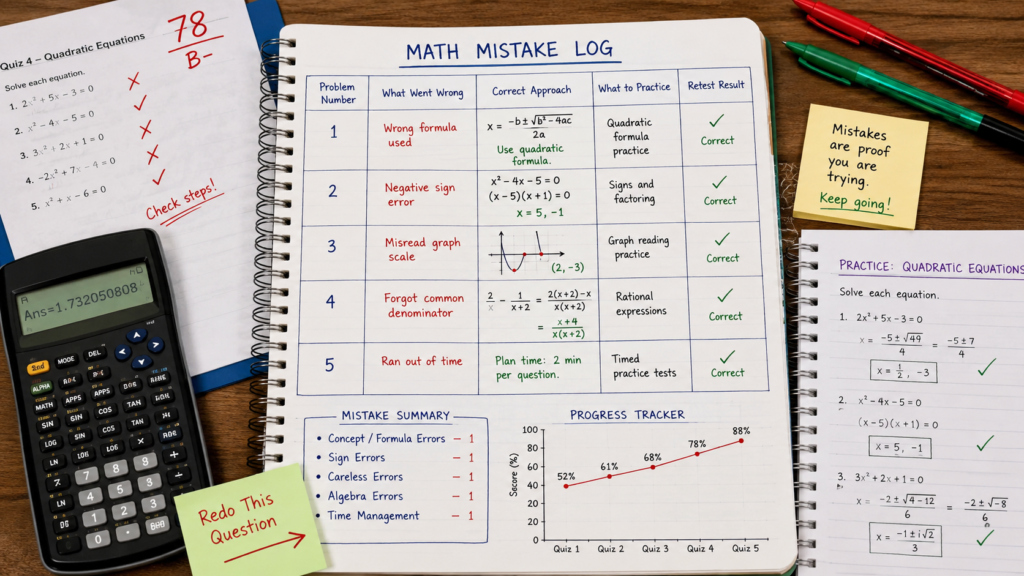
A mistake log turns incorrect answers into useful study material.
Use a table like this:
| Problem | What went wrong? | Correct approach | What should I practice? |
| Solving 3x+5=203x+5=203x+5=20 | Subtracted 5 incorrectly | Subtract 5 from both sides | Basic equation steps |
| Triangle area | Used perimeter formula | Use A=12bhA=\frac{1}{2}bhA=21bh | Choosing formulas |
| Fraction equation | Forgot common denominator | Rewrite fractions first | Fraction operations |
| Graph question | Misread the y-axis scale | Check intervals before answering | Graph interpretation |
Do not write only “careless mistake.” Be specific.
A useful mistake log answers:
- Where did the error begin?
- Why did I make it?
- What should I do next time?
- Which skill needs more practice?
Review the log before completing new homework and before each test.
Study Worked Examples the Right Way
Working examples can help students learn how a method is organized, especially when a topic is new. However, copying a solution line by line may create the illusion of understanding.
Use this four-step process.
Step 1: Read the Problem
Identify:
- What information is provided?
- What is the question asking?
- Which topic does it involve?
Step 2: Study the Solution
For every line, ask:
- What changed?
- Why was this step allowed?
- Which rule was used?
- Could another method work?
Step 3: Cover the Solution
Solve the same problem again without looking.
Step 4: Complete a Similar Problem
Change the values or attempt another question that uses the same method.
Guidance from the What Works Clearinghouse specifically recommends interleaving worked examples with independent problem-solving exercises.
The goal is not to memorize the exact example. It is to understand the process well enough to use it on a new question.
Practice Math Without Looking at the Answer
Students often check the solution too quickly.
When you look at the next step before attempting the problem, you remove the part of practice that requires you to think.
Try this sequence:
- Read the problem.
- Write what you know.
- Select a possible rule or formula.
- Attempt the first step.
- Continue until you become genuinely stuck.
- Check only the part you need.
- Close the solution.
- restart the problem independently.
This is more effective than copying a complete answer and assuming you will remember it later.
Use Active Recall for Math
Active recall means trying to retrieve information without looking at your notes.
For math, this can include:
- Writing formulas from memory
- Explaining a rule aloud
- Solving a question without an example
- Recreating a graph
- Listing the steps of a method
- Completing a closed-note quiz
- Identifying which formula fits a situation
Research-based study guidance supports retrieval practice because recalling information repeatedly makes it easier to access later.
Formula Recall Practice
Instead of rereading a formula sheet, cover it and write:
- The formula
- What each symbol means
- When the formula is used
- A short example
For instance, do not only memorize the distance formula. Be able to identify when a question requires it and what each coordinate represents.
Mix Different Types of Problems
Completing 15 identical problems can help you practice a procedure, but it may not teach you how to recognize when that procedure is needed.
Mixed practice, also called interleaving, combines different problem types.
Instead of practicing:
- 10 slope questions
- Then 10 distance questions
- Then 10 midpoint questions
Try a mixed set containing all three types.
Now you must decide which method applies before solving.
Research reviewed by the Institute of Education Sciences describes interleaved math practice as mixing problems that require different strategies rather than grouping all questions by one recently learned skill.
When Should You Use Blocked Practice?
Blocked practice is useful when you are first learning a new method.
A good sequence is:
- Complete several similar beginner problems.
- Add slightly harder versions.
- Mix the topic with older material.
- Attempt questions without labels telling you which method to use.
This helps you build the procedure first and then practice selecting it.
Space Math Practice Across Several Days
A long study session the night before a test may help you recognize familiar questions temporarily, but it gives you fewer opportunities to retrieve the method after forgetting some of it.
A spaced plan might look like this:
| Day | Study task |
| Monday | Learn the method and solve five guided questions |
| Tuesday | Solve five questions without notes |
| Thursday | Complete a mixed practice set |
| Saturday | Review mistakes and retest |
| Monday | Complete a timed quiz |
Spacing and interleaving are both supported in learning research as methods that can improve longer-term retention.
You do not need to study math for several hours every day. Short, repeated sessions are often easier to maintain.
Create a Consistent Math Study Schedule
Avoid writing “study math” in your planner. The task is too vague. Students balancing math practice with homework, activities, and other classes can use these time management activities for high school students to build a schedule that is easier to maintain.
Use specific goals.
Weak plan:
Study algebra for one hour.
Better plan:
Solve 12 linear-equation problems, review every error, and redo incorrect questions without notes.
Example Weekly Math Schedule
| Day | Task | Time |
| Monday | Review class examples and solve five similar problems | 35 minutes |
| Tuesday | Practice weak prerequisite skills | 30 minutes |
| Wednesday | Complete homework and mark confusing questions | 45 minutes |
| Thursday | Solve a mixed problem set | 40 minutes |
| Friday | Review mistake log and formulas | 25 minutes |
| Saturday | Complete a timed practice quiz | 45 minutes |
| Sunday | Correct the quiz and plan the next week | 30 minutes |
Adjust the length based on your course difficulty and workload.
Break Difficult Problems Into Smaller Steps
When a problem looks complicated, do not try to solve everything mentally. Students taking geometry or advanced mathematics can also learn how to write math proofs by organizing statements, reasons, and logical steps clearly.
Write down:
- What is known?
- What must be found?
- Which topic does this resemble?
- Which formula or rule might apply?
- What is the first possible step?
For word problems, identify:
- Quantities
- Units
- Relationships
- Unknown variable
- Required result
Example
Problem:
A car travels 180 miles in 3 hours. What is its average speed?
Write:
- Distance = 180 miles
- Time = 3 hours
- Speed = distance ÷ time
- 180÷3=60180 \div 3 = 60180÷3=60
Answer:
60 miles per hour
Writing these steps reduces mental overload and makes errors easier to locate.
Learn the Meaning Behind Formulas
Memorizing formulas is useful, but understanding them helps you choose and adjust them.
For every formula, learn:
- What it measures
- What each variable represents
- The required units
- When it applies
- When it does not apply
- How changing one value affects the result
For example, the area of a rectangle is:
A=lwA = lwA=lw
Do not stop at memorizing the letters.
Understand that:
- lll is length.
- www is width.
- Area measures the space inside the rectangle.
- The answer uses square units.
- Doubling one dimension doubles the area when the other remains unchanged.
This kind of understanding makes it easier to solve unfamiliar questions.
Explain Math Out Loud
Explaining a problem forces you to make each step clear.
Try speaking as though you are teaching another student:
First, I subtract 4 from both sides because I want to isolate the term containing xxx. Then I divide both sides by 3 because xxx is multiplied by 3.
When your explanation becomes unclear, you have found a gap.
You can explain math to:
- A classmate
- A tutor
- A family member
- Yourself
- An imaginary student
The listener does not need to be a math expert. The value comes from organizing your own reasoning.
Take Better Math Notes
Math notes should show how a solution develops, not only the final answer.
Include:
- Topic name
- Rule or formula
- Meaning of each symbol
- Worked example
- Explanation beside each step
- Common mistake
- One self-test question
Example Note Format
Topic: Solving Two-Step Equations
Rule: Undo operations in reverse order.
Example:
3x+5=203x + 5 = 203x+5=20
Subtract 5:
3x=153x = 153x=15
Divide by 3:
x=5x = 5x=5
Check:
3(5)+5=203(5) + 5 = 203(5)+5=20
Common mistake: Dividing before subtracting the constant.
This format is more useful for review than copying a board full of unexplained equations.
Review Notes Soon After Class
Spend five to ten minutes reviewing your math notes on the same day.
During that review:
- Fill in missing steps.
- Mark anything confusing.
- Add an explanation in your own words.
- Solve one similar problem.
- Write one question for your teacher.
Waiting several weeks may make incomplete notes difficult to understand.
Ask Specific Math Questions
A teacher or tutor can help more effectively when they know where your reasoning stopped.
Weak question:
I don’t understand this chapter.
Better questions:
- Why does the sign change in this step?
- How do I know which formula to use?
- Why is my answer wrong even though the method looks similar?
- Can you show me the first step without solving the whole problem?
- Where did my reasoning stop being correct?
- What prerequisite skill should I review?
Bring your attempted solution. It gives the instructor something specific to examine. Students who are falling behind in a difficult online math course can explore online class help for support with course organization, study planning, and understanding challenging topics.
Use Your Textbook More Effectively
Do not begin by reading every paragraph.
Use this process:
Preview the Section
Look at:
- Lesson objectives
- Formulas
- Example problems
- Diagrams
- Summary boxes
- Practice questions
Study One Example
Explain each step.
Solve the Next Question
Attempt it without looking back.
Check the Answer
Identify the first incorrect step.
Complete a Mixed Review
Return to older topics so you practice choosing methods.
Textbooks are most useful when they become practice tools, not just reading material.
Use Videos Without Watching Passively
Math videos can be helpful when a classroom explanation did not make sense, but watching several videos without solving problems may waste time.
Use this method:
- Watch one example.
- Pause before each step.
- Predict what happens next.
- Write the solution yourself.
- Close the video.
- Solve another problem independently.
Do not allow the video to become background entertainment.
Use Calculators as Checking Tools
A calculator can save time, but it should not replace understanding.
Use it to:
- Check arithmetic
- Evaluate complicated expressions
- Confirm graph behavior
- Verify approximate answers
- Compare your manual result
Be careful with:
- Parentheses
- Negative signs
- Fractions
- Exponents
- Degree versus radian mode
- Order of operations
When a calculator gives an unexpected answer, check how the expression was entered.
Practice Mental Math
Mental math helps students estimate and recognize unreasonable answers.
Practice:
- Multiplication facts
- Fractions and decimals
- Percentages
- Powers
- Simple roots
- Estimation
- Common conversions
Example:
If your calculator says that 19% of 200 is 380, mental estimation should alert you that the result is impossible because 20% of 200 is only 40.
Mental math is not about completing every problem without a calculator. It gives you a way to check whether the result is sensible.
Study for a Math Test in Stages
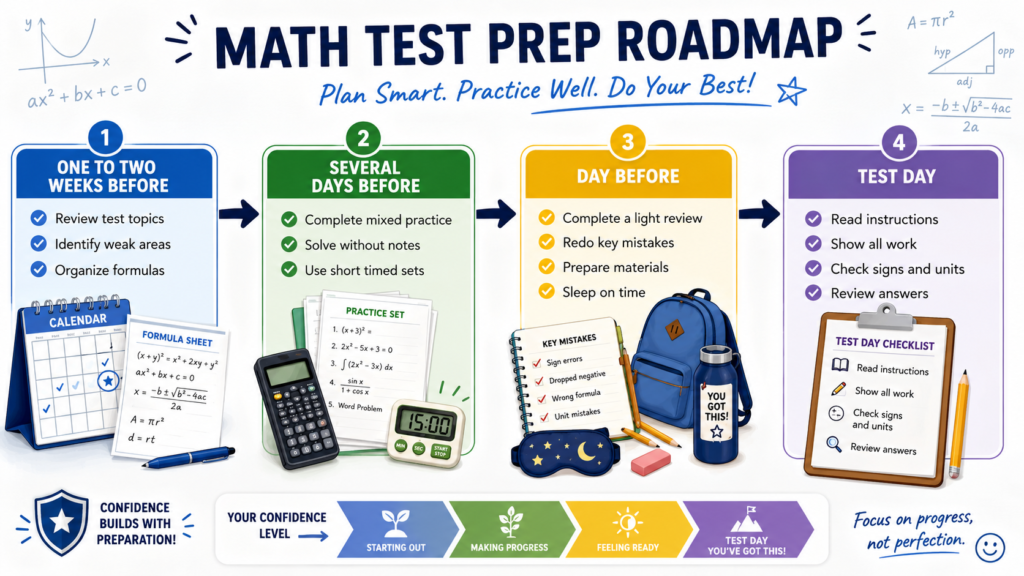
Do not wait until the night before the exam. For a complete revision schedule, use this student guide on how to study for a math test and organize your practice from the first review session through test day.
One to Two Weeks Before
- Review the test topics.
- Identify weak areas.
- Organize formulas.
- Redo homework mistakes.
- Ask questions.
Several Days Before
- Complete mixed practice.
- Solve questions without notes.
- Practice difficult topics.
- Use timed sets.
- Review the mistake log.
The Day Before
- Complete a short review.
- Check formulas.
- Redo several representative questions.
- Prepare the required materials.
- Avoid studying all night.
On Test Day
- Read every instruction.
- Write formulas you may forget.
- Begin with manageable questions.
- Mark difficult problems.
- Show your work.
- Check units and signs.
- Review unanswered parts.
Use Timed Math Practice
Students sometimes understand the content but lose points because they work too slowly.
Begin with untimed practice until the method is accurate. Then add time limits.
A useful progression is:
Stage 1: Untimed With Notes
Focus on understanding.
Stage 2: Untimed Without Notes
Focus on independent recall.
Stage 3: Timed Without Notes
Focus on accuracy and pace.
Stage 4: Full Practice Test
Match the real assessment as closely as possible.
Do not use timing too early. Speeding up an incorrect method only creates faster mistakes.
Review Every Practice Test
A practice score alone does not tell you what to study next.
After each test, separate the questions into:
- Correct and confident
- Correct but guessed
- Incorrect because of concept
- Incorrect because of method
- Incorrect because of calculation
- Incomplete because of time
Then redo every incorrect and guessed question. When math is only one of several subjects lowering your average, this guide on how to boost my grades can help you recover missed points, manage coursework, and improve your overall study routine.
Research and instructional guidance emphasize the value of feedback that helps students identify gaps and self-correct.
What Should You Do When You Get Stuck?
Getting stuck is part of learning math. The goal is to respond productively.
Use this sequence:
- Read the question again.
- Identify the topic.
- Write the known information.
- Draw a diagram when useful.
- Find a related example.
- Attempt one step.
- Check your notes.
- Ask a specific question.
Do not immediately search for the full answer.
Seeing the complete solution too early may help you finish the assignment without helping you solve the next problem independently.
How Can You Improve at Word Problems?
Word problems often feel harder because students must translate language into mathematics.
Use these steps:
Identify the Question
What must you find?
Mark the Information
Underline values, units, and relationships.
Define a Variable
For example:
x=number of tickets soldx = \text{number of tickets sold}x=number of tickets sold
Build the Equation
Translate the relationship into mathematical form.
Solve
Show every step.
Check the Meaning
Does the result answer the original question?
Include Units
A number without the correct unit may be incomplete.
Avoid relying only on keywords such as “total means add.” The same word can appear in problems requiring different operations. Focus on the relationship between quantities.
How Can You Overcome Math Anxiety?
Math anxiety can make it difficult to concentrate, remember steps, or begin a problem. It may develop after repeated low scores, negative classroom experiences, or pressure to work quickly.
Use practical actions rather than simply telling yourself not to worry.
Prepare Earlier
Uncertainty increases when you have not practiced enough problem types.
Begin With Familiar Questions
Complete several manageable problems before moving to harder ones.
Write Every Step
This reduces the amount you must hold in your head.
Use Timed Practice Gradually
Do not begin with a full high-pressure practice exam.
Replace Negative Predictions
Instead of:
I always fail math.
Use:
I am still weak in factoring, so I will practice five factoring questions and review each error.
The second statement identifies a problem that can be addressed.
Ask for Support Early
Speak with:
- Your teacher
- A tutor
- An academic support center
- A school counselor
- An accessibility office when appropriate
Difficulty with math is not a reason to wait silently until the final exam.
How Long Should You Study Math Each Day?
There is no single correct number of minutes.
The right amount depends on:
- Course level
- Current understanding
- Homework load
- Upcoming tests
- Number of weak topics
- Other responsibilities
For many students, a focused 30- to 45-minute session may be more productive than sitting with a textbook for two distracted hours.
A strong session has a measurable goal, such as:
- Complete 15 problems.
- Review five mistakes.
- Memorize and apply three formulas.
- Redo one quiz.
- Practice one weak topic.
Judge the session by what you completed and understood, not only by the time spent.
Should You Study Math Every Day?
Daily practice can help, especially in demanding courses, but the sessions do not need to be long.
A simple pattern is:
- Complete current homework.
- Review one older concept.
- Solve several mixed questions.
- Correct mistakes.
- Mark questions for help.
Consistency matters because math skills weaken when they are not used for long periods.
Should You Study Alone or With a Group?
Both can help.
Study Alone When You Need To:
- Learn a new method slowly
- Concentrate without interruption
- Complete timed practice
- Identify your own knowledge gaps
Use a Group When You Need To:
- Compare solution methods
- Explain ideas aloud
- Review for a test
- Discuss difficult questions
- Check reasoning
A study group becomes unhelpful when students spend most of the time talking, copying answers, or allowing one person to solve everything.
Every student should attempt the problem before discussing the solution.
Common Math Study Mistakes
Avoid these habits:
Rereading Without Solving
Reading creates familiarity, not necessarily independent skill.
Copying Worked Solutions
You may understand while looking at the steps but forget them later.
Practicing Only Easy Questions
Comfortable practice does not repair weak areas.
Ignoring Old Topics
Math exams often combine current and previous skills.
Checking Answers Too Early
Struggle briefly before viewing the next step.
Hiding Mistakes
Incorrect work reveals what to study.
Cramming
One long session gives you fewer opportunities to retrieve the method later.
Memorizing Without Understanding
You may know a formula but fail to recognize when it applies.
Skipping Steps
Mental shortcuts make errors harder to find.
Depending Completely on Technology
A calculator or app can provide an answer without building your reasoning.
A Seven-Day Math Study Plan
1: Review Your Current Position
- Check recent scores.
- Collect incorrect questions.
- Identify your two weakest topics.
- Create a mistake log.
2: Repair Prerequisite Skills
- Review the earlier skills needed for the weak topic.
- Solve five to ten basic questions.
- Correct every mistake.
3: Study Worked Examples
- Study two or three examples.
- Explain each step.
- Cover the solution.
- Recreate it independently.
4: Independent Practice
- Complete a closed-note problem set.
- Mark questions that caused difficulty.
- Review the first incorrect step.
5: Mixed Practice
- Combine new and old problem types.
- Identify the method before solving.
- Update the mistake log.
6: Timed Practice
- Complete a short timed test.
- Record which questions took too long.
- Review accuracy and pacing.
7: Correct and Retest
- Redo all incorrect questions.
- Explain the correct methods aloud.
- Complete a short follow-up quiz.
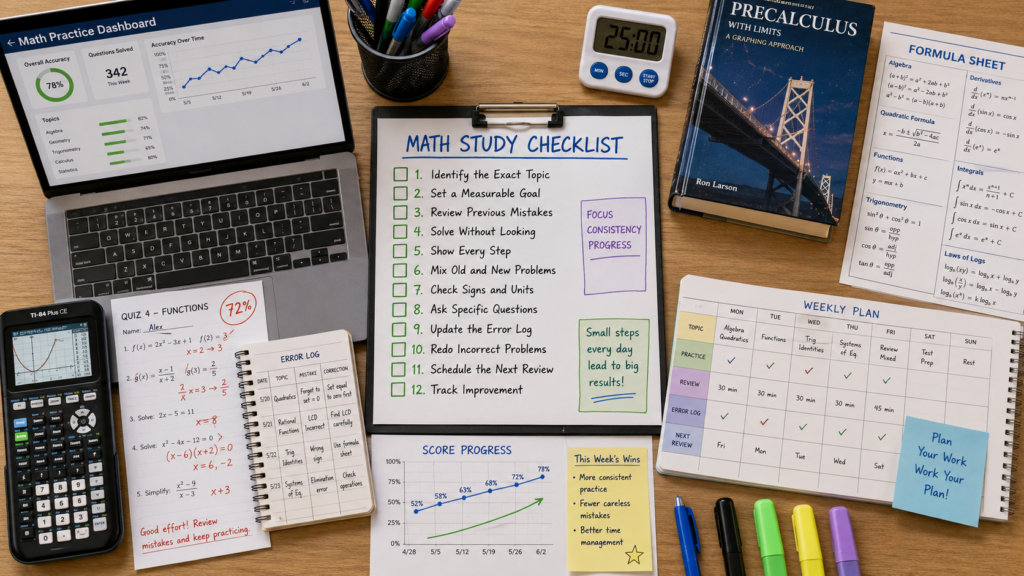
Math Study Checklist
Before Studying
- Identify the exact topic.
- Gather notes, textbook, and practice questions.
- Remove distractions.
- Set a measurable goal.
- Review the previous session’s mistakes.
During Studying
- Write every important step.
- Attempt questions before checking solutions.
- Explain methods aloud.
- Mix old and new problems.
- Mark questions that need help.
- Check units, signs, and labels.
After Studying
- Correct every mistake.
- Update the error log.
- Redo incorrect questions without notes.
- Write one question for the teacher.
- Schedule the next review.
- Record what improved.
Frequently Asked Questions
What are the best math study tips for students?
The most useful methods are solving problems independently, reviewing errors, spacing practice across several days, mixing problem types, studying worked examples, and asking specific questions when stuck.
How can I improve my math skills quickly?
Start with a skills audit. Find the prerequisite topic causing the problem, practice it directly, and correct every mistake. Improvement is usually faster when students target one clear weakness rather than reviewing an entire textbook randomly.
How do I study math when I do not understand anything?
Begin with the most recent step you do understand. Review the prerequisite skill, study one worked example, and solve a simpler version. Ask a teacher or tutor to identify where your understanding first breaks down.
Is reading math notes enough?
No. Notes can remind you of a method, but you need independent problem-solving practice to determine whether you can apply it.
Should I memorize math formulas?
Yes, when the course requires it, but also learn what each formula means, when it applies, and how the variables relate. Memorization without application may not help on unfamiliar questions.
Why do I understand math in class but forget it later?
You may be recognizing the teacher’s steps rather than retrieving and applying them independently. Practice without notes and return to the topic across several days.
How many math problems should I solve per day?
There is no universal number. A smaller set that you solve, check, and correct carefully may be more useful than a large set completed without reviewing mistakes.
Is it better to practice one topic or mix topics?
Use several similar problems when first learning a method. Once you understand it, mix it with older topics so you practice deciding which method is required.
How can I avoid careless mistakes in math?
Write steps clearly, check signs and units, estimate the answer, review calculator entries, and leave time to inspect your work. Track repeated mistakes in an error log.
How do I get faster at solving math problems?
Build accuracy first. Then complete short timed sets, identify slow steps, improve recall of formulas and basic facts, and practice choosing methods from mixed questions.
Can group study help with math?
Yes, when each student attempts the questions independently and the group compares reasoning. It is less useful when students simply copy one person’s work.
How should I prepare the night before a math test?
Complete a short review, check formulas, redo representative mistakes, prepare your calculator and materials, and sleep at a reasonable time. Avoid attempting to relearn the entire course overnight.
Final Thoughts
The best math study tips are not complicated, but they require active participation.
You improve at math by doing math.
Review the concept, study a useful example, solve questions independently, examine your mistakes, and return to the topic later. Mix different problem types so you learn how to choose a method instead of repeating the same procedure automatically.
Start with one clear change:
- Create a mistake log.
- Solve five questions without notes.
- Review an old topic.
- Ask one specific question.
- Complete a short timed practice set.
You do not need to become perfect in one study session. Focus on identifying where your reasoning breaks down and correcting that step. Repeated, focused practice can gradually improve your understanding, speed, confidence, and scores.