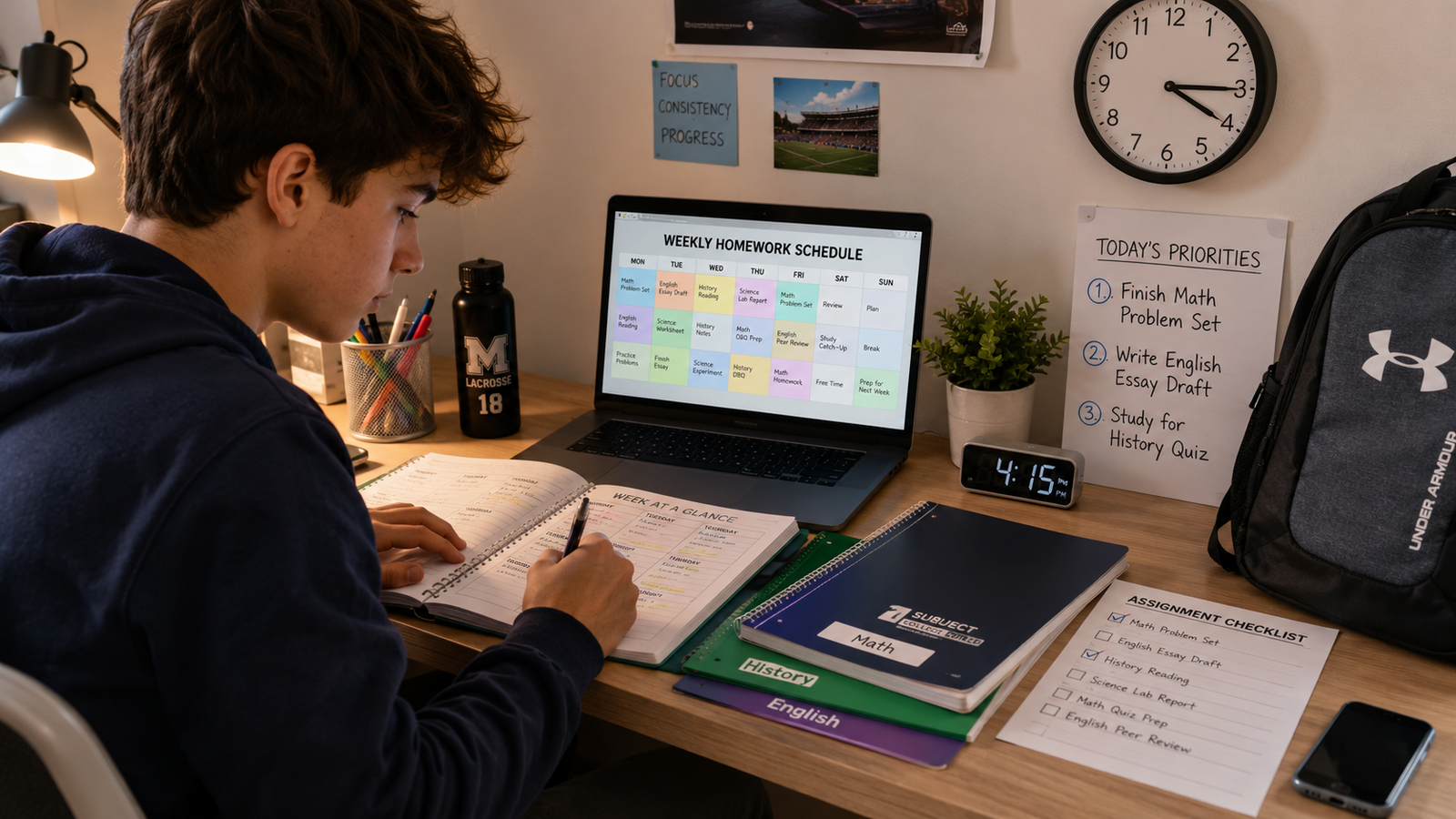
High school students rarely struggle because they have nothing to do. The real problem is deciding what deserves attention first.
Classes, homework, tests, sports, clubs, family responsibilities, friendships, and part-time jobs can all compete for the same limited hours. When assignments pile up, students may stay awake late, rush through important work, or spend so much time worrying that they struggle to begin.
Time management does not mean filling every minute with schoolwork. It means deciding what needs to be done, estimating how long it will take, protecting time for important tasks, and leaving enough room for sleep and personal life.
The following time management activities for high school students are practical exercises, not vague advice. Students can complete them independently, with parents, in advisory periods, or as part of a classroom lesson.
Quick Answer: What Are the Best Time Management Activities for High School Students?
The most useful time management activities help students practice planning, prioritizing, estimating task duration, controlling distractions, and reviewing their habits.
Effective activities include:
- Completing a 24-hour time audit
- Creating a weekly school schedule
- Ranking assignments by urgency and importance
- Breaking large projects into smaller steps
- Estimating and recording task completion times
- Using focused study blocks
- Preparing a three-task daily priority list
- Planning backward from test and project dates
- Setting up a distraction-free study session
- Reviewing the week and adjusting the next schedule
Students do not need to use every technique at once. Starting with one activity and repeating it for a week is usually more useful than creating a complicated schedule that is abandoned after one day.
Why Time Management Matters in High School
High school introduces more independence than students may have experienced in earlier grades. Teachers expect students to remember deadlines, prepare for tests, manage longer projects, and complete work across several subjects.
Time management helps students:
- Meet assignment deadlines
- Avoid last-minute study sessions
- Prepare for several classes at once
- Make room for sports and extracurricular activities
- Reduce forgotten tasks
- Protect time for sleep and rest
- Develop habits needed for college and work
A structured time-management intervention studied with high school students produced stronger improvements among participants who began with weaker time-management skills. This suggests that time management can be taught and practiced rather than treated as a natural ability that some students simply have.
The goal is not to create a perfect schedule. It is to help students make more intentional decisions about their time.
Activity 1: Complete a 24-Hour Time Audit
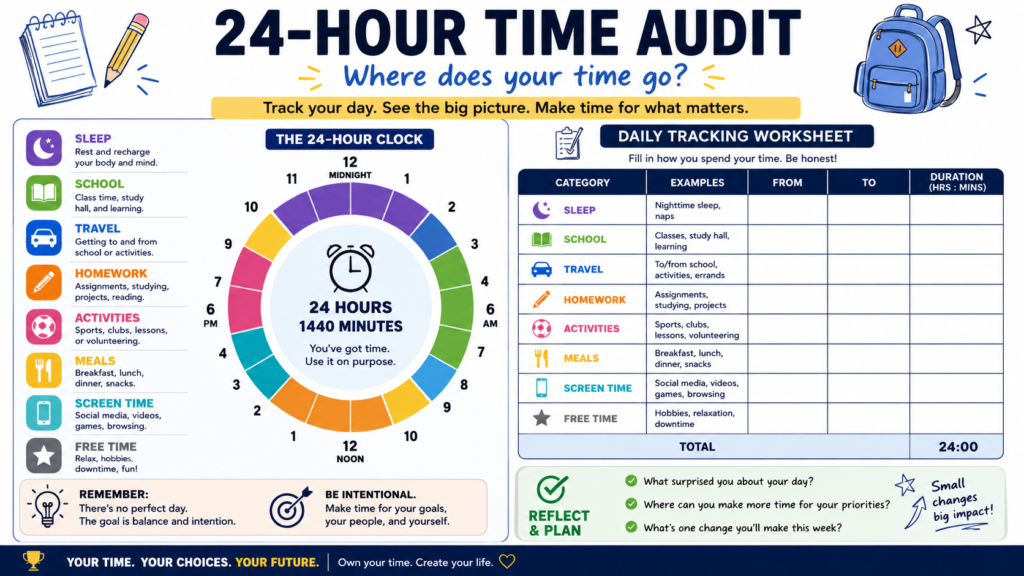
Many students say they do not have enough time, but they have never recorded where their hours actually go.
A time audit helps students compare how they think they use their time with what happens during a normal day.
How to Complete the Activity
For one weekday, record your activities in 30-minute blocks.
Include:
- Getting ready for school
- Travel
- Classes
- Lunch
- Sports or clubs
- Homework
- Social media
- Gaming
- Meals
- Family responsibilities
- Relaxation
- Sleep
Do not change your routine during the audit. The purpose is to gather honest information, not to create an ideal day.
Time-Audit Worksheet
| Time | Planned Activity | Actual Activity | Was It Necessary? |
| 3:30–4:00 p.m. | Start homework | Watched videos | No |
| 4:00–4:30 p.m. | Math practice | Math practice | Yes |
| 4:30–5:00 p.m. | Math practice | Texted friends | Partly |
| 5:00–5:30 p.m. | Dinner | Dinner | Yes |
At the end of the day, highlight:
- Time used well
- Time lost unintentionally
- Activities that took longer than expected
- Periods when you had the most energy
The purpose is not to remove every enjoyable activity. It is to identify time that disappeared without being consciously chosen.
Activity 2: Build a Realistic Weekly Schedule
A weekly schedule gives students a complete view of their responsibilities. It is more useful than planning one day at a time because assignments, practices, and tests often affect several days.
Start by adding fixed commitments:
- School hours
- Travel time
- Sports practices
- Club meetings
- Work shifts
- Appointments
- Family responsibilities
- Regular sleep time
Then add flexible activities:
- Homework
- Test preparation
- Projects
- Exercise
- Social time
- Relaxation
Example After-School Schedule
| Time | Monday | Tuesday | Wednesday | Thursday | Friday |
| 3:30–4:00 | Snack and break | Travel home | Snack and break | Travel home | Free time |
| 4:00–5:00 | Math homework | Soccer practice | Science project | Soccer practice | Weekly review |
| 5:00–6:00 | English reading | Soccer practice | Dinner | Soccer practice | Friends or hobbies |
| 6:00–7:00 | Dinner | Dinner | History review | Dinner | Dinner |
| 7:00–8:00 | Science study | English assignment | Free time | Test review | Flexible time |
| 8:00–9:00 | Prepare for school | Prepare for school | Prepare for school | Prepare for school | Relax |
A realistic schedule includes transition time. Students need time to travel home, eat, change clothes, and take short breaks. A schedule that assumes immediate concentration for five uninterrupted hours is unlikely to last.
Activity 3: Create a Three-Task Daily Priority List
Long to-do lists can make students feel busy without helping them decide what to do first.
For this activity, choose only three important tasks for the day.
Write Three Priorities
- Must complete: The task with the closest deadline or greatest consequence
- Should complete: An important task that supports upcoming work
- Could complete: A smaller task that can be finished if time remains
Example
Must complete: Submit English essay by 8:00 p.m.
Should complete: Review biology notes for 30 minutes
Could complete: Organize history folder
The list should be specific. “Work on school” is too broad. “Complete questions 1–15 from the algebra worksheet” gives the student a clear finish line.
This activity teaches students that being productive does not require completing everything at once. It requires protecting attention for the work that matters most.
Activity 4: Use the Urgent-and-Important Matrix
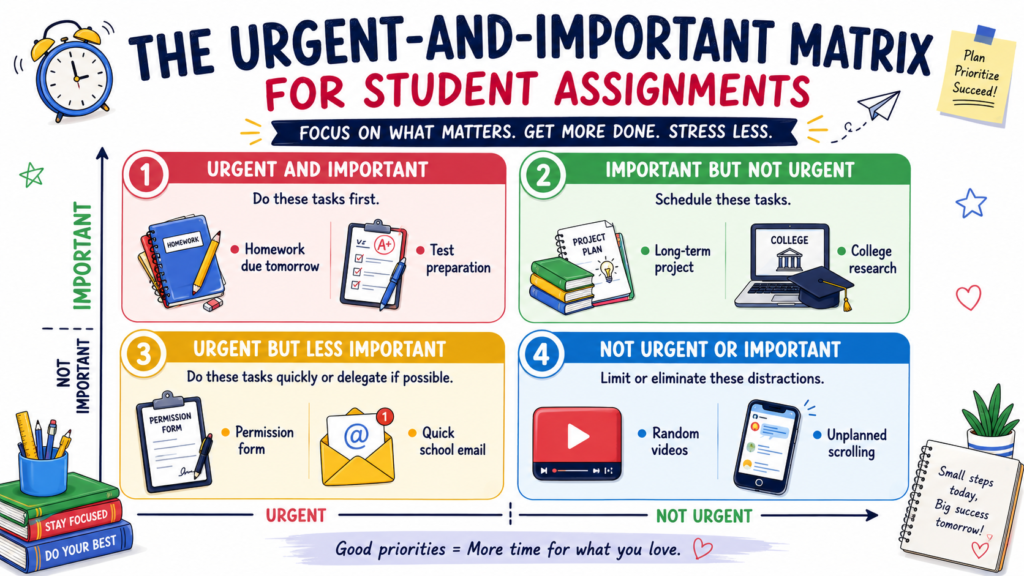
Students sometimes begin with the easiest task rather than the task that needs attention most.
An urgent-and-important matrix helps students sort responsibilities into four groups.
| Category | Meaning | Student Example |
| Urgent and important | Needs immediate attention | Assignment due tomorrow |
| Important but not urgent | Needs scheduled time | Studying for next week’s exam |
| Urgent but less important | Needs a quick response | Returning a permission form |
| Not urgent or important | Can wait or be limited | Watching random videos |
Try the Activity
Write every current task on a separate sticky note. Place each note into one of the four categories.
Students often discover that exam preparation belongs in the “important but not urgent” category. Ignoring that category causes important work to become an emergency later.
The goal is to complete urgent work while regularly scheduling important tasks before their deadlines become stressful.
Activity 5: Estimate How Long Tasks Take
A common scheduling problem is inaccurate time estimation.
A student may expect an essay to take 30 minutes when it actually requires research, outlining, drafting, editing, and formatting. Another student may avoid a worksheet because it feels like a two-hour task, even though it takes only 25 minutes.
Estimation Exercise
Before beginning a task, record:
- Your estimated completion time
- Your actual start time
- Your actual finish time
- The reason for any difference
| Task | Estimated Time | Actual Time | What Affected It? |
| Read one chapter | 30 minutes | 45 minutes | Took notes |
| Complete math problems | 60 minutes | 35 minutes | Understood the topic |
| Draft presentation | 45 minutes | 80 minutes | Spent too long choosing a design |
Repeat the activity for one week. Your estimates should gradually become more accurate.
Better estimates make schedules more reliable and reduce the habit of leaving too little time for difficult work.
Activity 6: Break One Large Project Into Smaller Steps
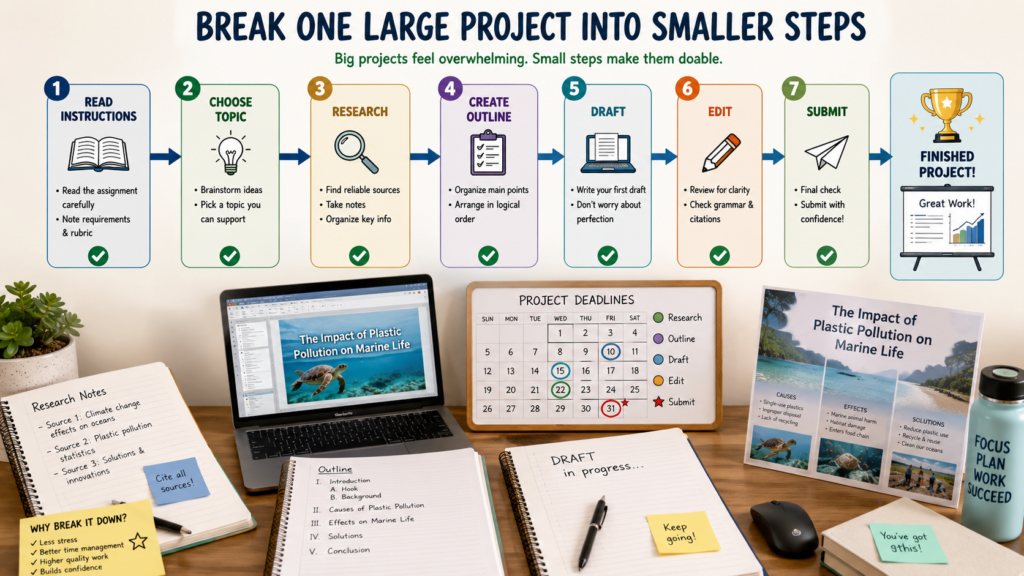
Large assignments are difficult to schedule because “complete project” does not describe a single action.
Choose one upcoming essay, presentation, research paper, or group project. Divide it into tasks that can each be completed during one work session.
Example: History Presentation
Instead of writing:
Finish history presentation
Break it into:
- Read the assignment instructions
- Select a topic
- Find three reliable sources
- Record key facts
- Create an outline
- Draft the slides
- Add citations and visuals
- Practice the presentation
- Make final corrections
Give each step its own deadline.
| Project Step | Personal Deadline |
| Select topic | Monday |
| Find sources | Tuesday |
| Create outline | Wednesday |
| Draft slides | Friday |
| Practice | Sunday |
This activity reduces procrastination because the first step feels manageable. Students who are under pressure with a writing assignment can also use a structured process for learning how to write an essay fast without skipping planning or revision.
Activity 7: Plan Backward From a Deadline
Backward planning begins with the final deadline and works toward the present.
It is especially useful for:
- Tests
- Research projects
- College applications
- Presentations
- Final exams
- Group assignments
Backward-Planning Example
Suppose a science test is scheduled for Friday.
Friday: Take the test
Thursday: Complete final review and sleep on time
Wednesday: Practice difficult questions
Tuesday: Review chapters three and four
Monday: Review chapters one and two
Sunday: Organize notes and identify weak areas
Backward planning prevents students from trying to learn every topic the night before a test. It also shows when preparation must begin.
Add extra time before major deadlines. Unexpected homework, illness, technology problems, or family responsibilities can interrupt even a good plan.
Activity 8: Try Focused Study Blocks
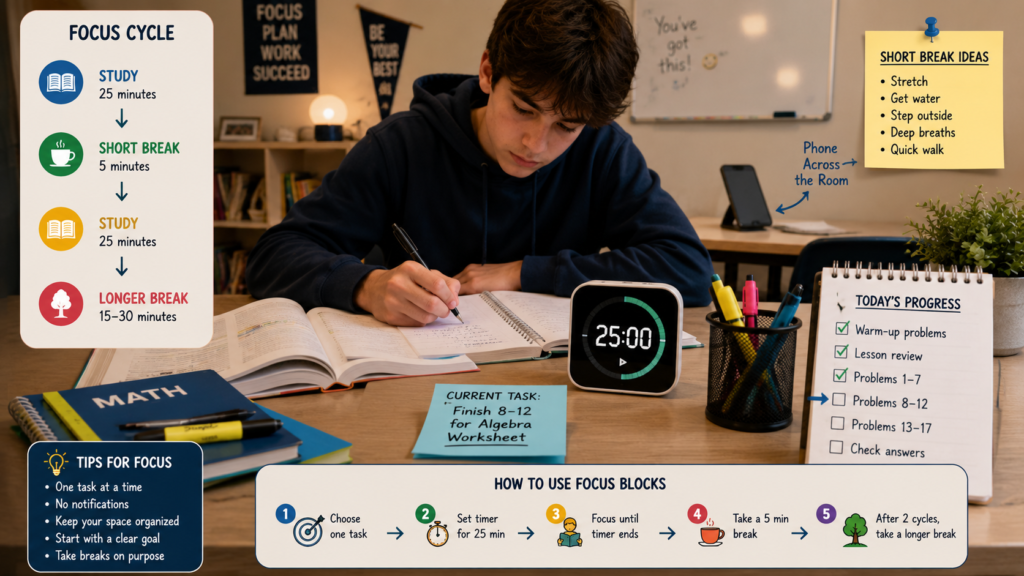
A focused study block is a short period dedicated to one defined task.
Students can begin with:
- 25 minutes of focused work
- A 5-minute break
- Another 25-minute work period
- A longer break after several rounds
The exact length can change. Some students work well for 20 minutes, while others prefer 40 or 50 minutes.
Before Starting a Study Block
Write down:
- The task you will complete
- The material you need
- The time the session will end
- What you will do during the break
Example:
From 6:00 to 6:30, I will complete algebra questions 1–12. My phone will remain in another room.
A timer creates a visible boundary. Students are not agreeing to study all evening. They are agreeing to focus until the timer ends.
Activity 9: Complete a Distraction Experiment
Students often blame themselves for lacking discipline when their environment is designed to interrupt them.
This activity compares two study sessions.
Session One: Normal Environment
Study for 20 minutes using your usual setup. Record every interruption:
- Phone notifications
- Messages
- Websites
- Television
- Conversations
- Getting up for supplies
- Switching between assignments
Session Two: Controlled Environment
For the second 20-minute session:
- Put the phone outside reach
- Close unrelated browser tabs
- Prepare water and supplies first
- Tell family members you are studying
- Work on one task only
Then compare:
- How much work was completed?
- How often did attention shift?
- Which session felt easier?
- Which distractions can be controlled regularly?
The lesson is not that students must avoid technology completely. It is that attention improves when unnecessary interruptions are removed before work begins.
Activity 10: Use a Phone Parking Spot
A phone parking spot is a designated place where the device stays during homework.
Possible locations include:
- A shelf across the room
- A kitchen counter
- A charging station
- A drawer
- A parent-supervised location
Before parking the phone:
- Tell important contacts you are studying.
- Set a timer on another device if possible.
- Gather required school materials.
- Decide when you will check messages.
Students who need the phone for school can activate focus settings and allow only necessary apps.
This activity works because it changes the environment instead of depending entirely on willpower.
Activity 11: Organize Tomorrow Before Bed
A short evening reset can prevent a rushed morning.
Set aside 10 minutes to:
- Check tomorrow’s schedule
- Pack books and assignments
- Charge necessary devices
- Prepare clothes
- Review transportation plans
- Place important forms by the door
- Write tomorrow’s three priorities
This activity protects time in two ways. It reduces forgotten items in the morning and helps the student begin the next day with a clear plan.
Keep the routine short. The goal is preparation, not beginning another long study session before bed.
Activity 12: Create an Assignment Dashboard
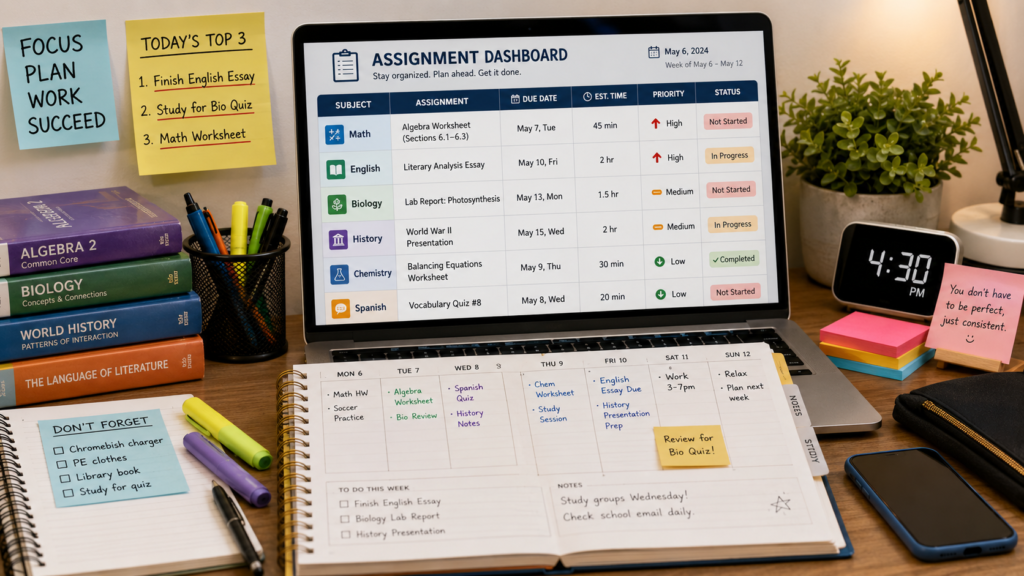
Students may receive deadlines through several channels:
- Classroom announcements
- Printed worksheets
- Learning-management systems
- Group chats
- Course calendars
An assignment dashboard brings the information into one place.
Use a notebook, spreadsheet, whiteboard, or planning app with these columns:
| Subject | Assignment | Due Date | Estimated Time | Status |
| English | Essay draft | Oct. 10 | 90 minutes | Started |
| Algebra | Worksheet | Oct. 8 | 40 minutes | Not started |
| Biology | Lab report | Oct. 12 | 2 hours | Research complete |
Update the dashboard at the end of each school day.
The dashboard should include only useful information. Spending an hour decorating the system instead of completing assignments defeats its purpose.
Activity 13: Match Tasks to Your Energy Level
Not every hour provides the same level of concentration.
For three days, record when you feel:
- Highly focused
- Moderately focused
- Tired
- Restless
- Creative
- Social
Then match work to your energy.
High-Energy Tasks
- Solving difficult math problems
- Writing an essay
- Studying unfamiliar material
- Preparing for a test
Lower-Energy Tasks
- Organizing folders
- Formatting a document
- Packing a backpack
- Reviewing flashcards
- Checking deadlines
A student who concentrates best immediately after school might complete difficult work before dinner. Another student may need a short break first.
The goal is to work with your natural patterns while still meeting school and family responsibilities.
Activity 14: Design a Balanced School-Day Pie Chart
Time management should protect health and personal life, not remove them.
Draw a circle representing 24 hours. Divide it into sections for:
- Sleep
- School
- Travel
- Homework
- Activities
- Meals
- Family
- Friends
- Exercise
- Free time
Add the total hours. If the chart exceeds 24 hours, something must change.
Teenagers between ages 13 and 17 are generally recommended to get 8–10 hours of sleep each day. Adequate sleep supports concentration, attention, health, and school performance.
A schedule that depends on regularly sleeping four or five hours is not an effective time-management plan. It is an overloaded plan.
Activity 15: Hold a Five-Minute Weekly Review
Weekly reflection helps students improve their system instead of repeating the same mistakes.
At the end of the school week, answer:
- Which tasks did I complete on time?
- Which assignments took longer than expected?
- What distracted me most?
- When did I focus best?
- Which deadline is coming next?
- What should I change next week?
- What went well?
The review should not become a session for criticizing yourself. Its purpose is to collect information.
Example:
I kept delaying chemistry because I did not understand the instructions. Next week, I will ask the teacher questions before leaving class.
This turns a general problem into a specific action.
Activity 16: Create a Procrastination Starting Ritual
Procrastination often continues because beginning feels uncomfortable.
A starting ritual is a repeated set of actions that signals it is time to work.
A simple ritual may be:
- Clear the desk.
- Put the phone away.
- Get water.
- Open the correct assignment.
- Write the first small task.
- Set a 10-minute timer.
- Begin.
The student does not need to feel motivated before starting. The first goal is only to work for 10 minutes.
After 10 minutes, the student may continue or take a short planned break. Beginning often becomes easier when the task has a small entry point.
Activity 17: Use the “First Five Minutes” Rule
Choose a task you have been avoiding and identify what can be completed in five minutes.
Examples:
- Open the document and write the title
- Read the assignment instructions
- Solve the first math problem
- Find one research source
- Create headings for the presentation
- Put study dates on the calendar
Five minutes may not complete the assignment, but it removes the barrier between thinking about the task and working on it.
This activity is especially useful when students feel overwhelmed by homework. Poor planning can contribute to pressure, rushed work, and emotional stress, as explained in this guide to how homework can cause stress.
Activity 18: Run a One-Week Time-Management Challenge
Students who do not know where to begin can follow this seven-day activity plan.
| Day | Activity |
| Monday | Complete a time audit |
| Tuesday | Create a three-task priority list |
| Wednesday | Study using two focused work blocks |
| Thursday | Break one large project into steps |
| Friday | Organize assignments and materials |
| Saturday | Plan the following week |
| Sunday | Review results and choose one habit to continue |
At the end of the challenge, ask:
- Which activity saved the most time?
- Which activity felt difficult?
- Which habit can I maintain?
- What needs to be simplified?
The best system is not the one with the most tools. It is the one a student can use consistently.
Time Management Activities for Different Types of Students
Students have different schedules, attention patterns, and responsibilities. A strategy that works for one student may need adjustment for another.
Students With Sports or Extracurricular Activities
Use practice and meeting times as fixed schedule blocks. Plan demanding schoolwork on lighter days and use short periods for reading, flashcards, or review.
Students With Part-Time Jobs
Record work shifts before planning study periods. Communicate early when major exams or school deadlines are approaching.
Students Taking Advanced Classes
Plan backward from major tests and projects. Avoid placing preparation for every difficult subject on the same night.
Students Taking Online Classes
Create a fixed weekly login routine and keep digital deadlines in one calendar. Students taking several courses may also need reliable online course help with scheduling, study organization, and course navigation while remaining responsible for their own learning.
Students With Family Responsibilities
Build flexibility into the schedule. Use shorter work sessions and identify backup study periods in case responsibilities change.
Students Who Struggle With Attention
Reduce visible distractions, use shorter work periods, keep instructions in sight, and complete one defined task at a time. Persistent attention difficulties may require support from a parent, teacher, school counselor, or qualified professional.
What Parents and Teachers Can Do
Adults can support time management without controlling every minute of a student’s day.
Helpful support includes:
- Asking students to estimate task time
- Helping them compare plans with actual results
- Keeping family schedules visible
- Providing a consistent homework area
- Encouraging sleep and breaks
- Teaching planning tools directly
- Discussing missed deadlines without immediate blame
- Allowing students to make manageable decisions
Instead of saying:
You always waste time.
Ask:
What made it difficult to begin, and what could make starting easier tomorrow?
The second question helps the student identify a solution.
Common Time-Management Mistakes
Creating an Overloaded Schedule
A schedule should include meals, travel, breaks, and unexpected delays.
Planning Every Minute
Students need flexibility. A schedule that is too rigid can collapse after one interruption.
Beginning With Easy Tasks Only
Small tasks feel productive, but they can delay important work.
Ignoring Task Difficulty
Thirty minutes of vocabulary review is not equal to thirty minutes of difficult problem-solving.
Using Too Many Planning Tools
One calendar and one assignment list are often enough.
Sacrificing Sleep
Studying later does not automatically mean learning more. Teen students generally need 8–10 hours of daily sleep, and insufficient sleep can affect focus, behavior, well-being, and school performance.
Waiting for Motivation
Students can begin with a five- or ten-minute action even when they do not feel ready.
Treating One Bad Day as Failure
Time management is a skill. Plans should be reviewed and adjusted rather than abandoned after one difficult day.
A Simple Daily Time-Management Routine
Students can use this short routine on regular school days.
Before School
- Review the day’s schedule
- Confirm important deadlines
- Bring necessary materials
After School
- Take a short planned break
- Review assignments
- Choose three priorities
- Begin the most important task
During Homework
- Work on one task at a time
- Use focused study blocks
- Take planned breaks
- Record unfinished work
Before Bed
- Prepare the backpack
- Check tomorrow’s schedule
- Set out required materials
- Protect enough time for sleep
The routine should take only a few minutes outside the actual study periods.
Time Management Checklist for High School Students
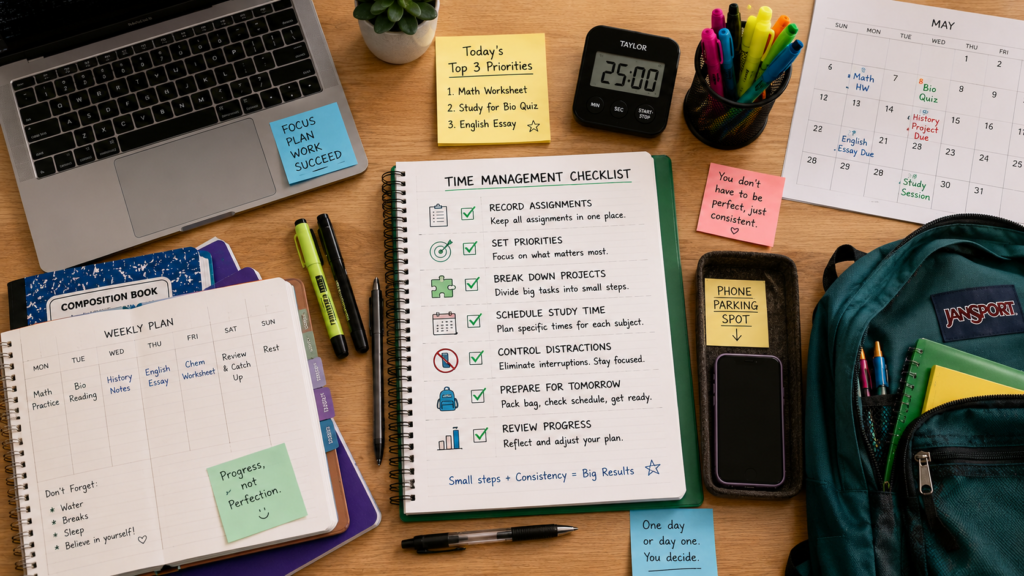
Planning
- I record every assignment in one place.
- I check upcoming deadlines each day.
- I plan major projects before the final week.
- I include sports, work, and family responsibilities.
- I leave extra time for unexpected problems.
Prioritizing
- I identify the most important task.
- I separate urgent work from future preparation.
- I avoid spending all my time on easy assignments.
- I choose three realistic daily priorities.
Studying
- I break large assignments into smaller actions.
- I use focused study sessions.
- I prepare materials before beginning.
- I remove unnecessary distractions.
- I ask for help when instructions are unclear.
Balance
- I schedule meals and breaks.
- I leave time for family and hobbies.
- I avoid planning more than one day can hold.
- I protect a consistent bedtime.
- I adjust my schedule when responsibilities change.
Reviewing
- I compare estimated and actual task times.
- I review unfinished assignments.
- I notice when and where I focus best.
- I change plans that are not working.
- I recognize progress instead of focusing only on mistakes.
Frequently Asked Questions
What are time management activities for high school students?
Time management activities are practical exercises that help students plan schedules, prioritize assignments, estimate task duration, manage distractions, prepare for deadlines, and review how they use their time.
What is the best time-management activity for beginners?
A 24-hour time audit is a strong starting activity because it shows where time is currently being used. Students can then make changes based on their real routine rather than guessing.
How can a high school student create a daily schedule?
Start with fixed commitments such as school, transportation, practices, meals, and sleep. Add homework and study sessions around them, including breaks and extra time for unexpected delays.
How many hours should high school students study each day?
There is no single number that works for every student. Study time depends on course difficulty, assignments, upcoming tests, learning needs, and extracurricular responsibilities. Students should focus on completing clearly defined tasks rather than reaching an arbitrary number of hours.
How can students stop procrastinating?
Students can reduce procrastination by making the first step smaller, removing distractions, setting a short timer, breaking assignments into manageable actions, and beginning before they feel fully motivated.
What is the three-task method?
The three-task method requires students to choose one task they must complete, one they should complete, and one they could complete. It prevents long to-do lists from hiding the most important work.
How can students manage school and extracurricular activities?
Add fixed practice, meeting, and travel times to a weekly calendar first. Then schedule academic priorities during the remaining periods, using lighter days for demanding assignments.
Should students schedule breaks?
Yes. Short, planned breaks can make longer homework sessions easier to manage. Breaks should have clear start and end times so they do not unintentionally replace the study session.
How can parents teach teenagers time management?
Parents can help students create schedules, estimate task time, review missed deadlines, and reduce distractions. The goal should be to teach decision-making rather than planning every minute for the student.
Why is sleep part of time management?
Sleep uses a significant part of the daily schedule and supports attention, concentration, health, and academic performance. Teenagers generally need 8–10 hours of sleep each day.
Final Thoughts
Good time management does not require a perfect planner, an expensive app, or a schedule packed with study sessions.
It begins with a few practical questions:
- What must I complete?
- When is it due?
- How long will it probably take?
- What could interrupt me?
- When will I begin?
Students can start by completing one time audit, choosing three priorities, and planning one assignment backward from its deadline. Those activities provide immediate information about what is working and what needs to change.
The aim is not to make every day perfectly productive. It is to build a routine that helps students complete important work, prepare before deadlines and still have time for sleep, relationships and life outside school.