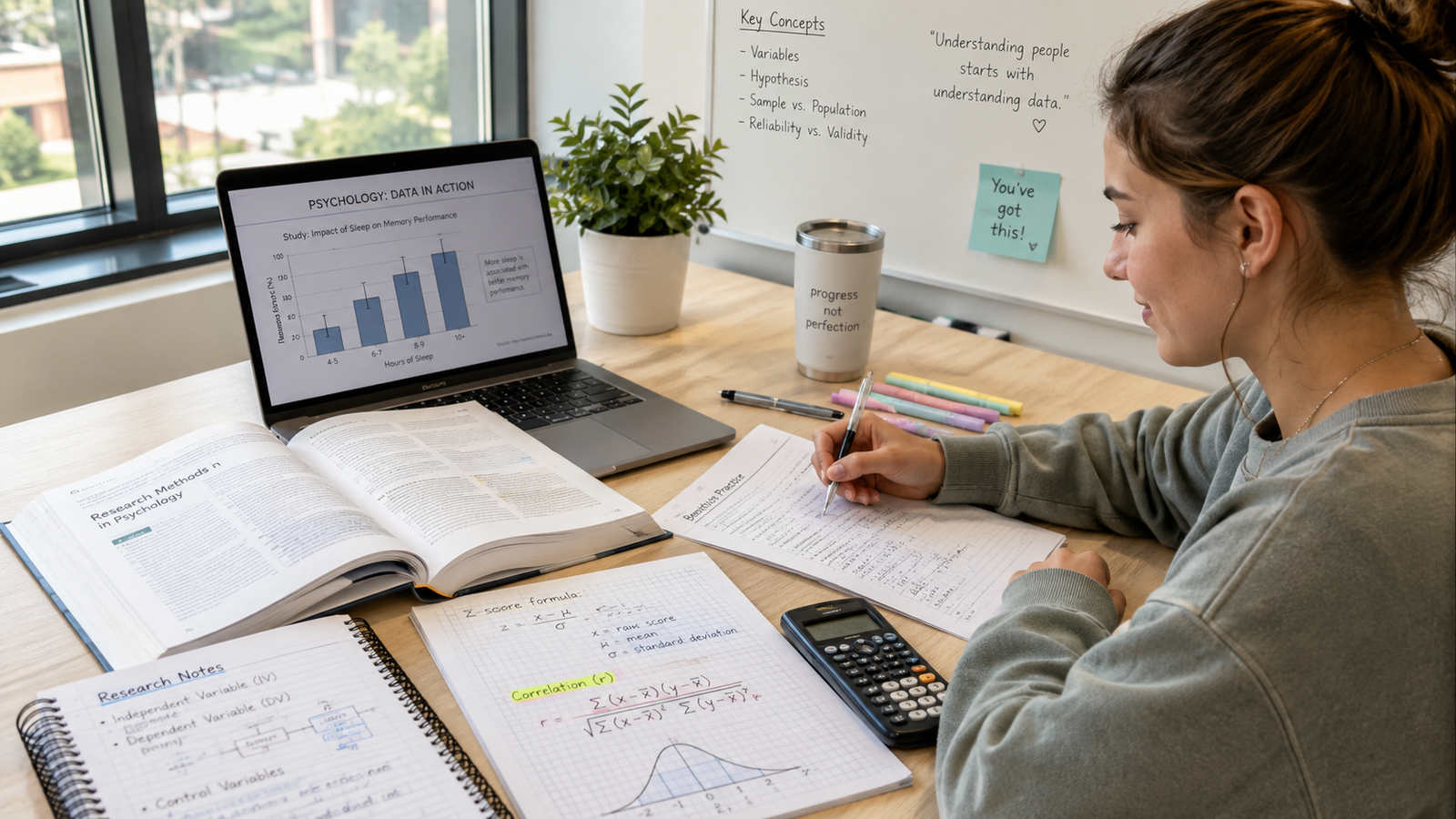
Psychology is often associated with human behavior, emotions, personality, relationships, and mental health. Because of this, many students assume that a psychology degree involves little or no math.
That assumption is not completely accurate.
Psychology does require some math, but most students will not face the same level of mathematics found in engineering, physics, or advanced computer science programs. The main mathematical requirement is usually statistics, along with research methods, data interpretation, graphs, percentages, probability and basic algebra.
The exact amount of math depends on your college, degree type, specialization, and career goals. A student planning to become a counseling psychologist may use less advanced quantitative analysis than someone entering experimental psychology, neuroscience, psychometrics, or academic research.
You do not need to be naturally gifted at math to study psychology. However, you should be prepared to understand how researchers collect data, analyze results, test claims and decide whether evidence supports a conclusion.
Quick Answer: Does Psychology Require Math?
Yes, psychology requires math, but most psychology students mainly use statistics, basic algebra, percentages, probability, graphs and research-related calculations.
A psychology major commonly includes:
- An introductory statistics course
- A psychology statistics course
- Research methods
- Data interpretation
- Graphs and tables
- Mean, median, and mode
- Standard deviation
- Correlation
- Probability
- Hypothesis testing
Some Bachelor of Science programs may require additional mathematics, biology, chemistry, or laboratory courses. Bachelor of Arts programs often include fewer advanced science and math requirements, although both degree paths usually require statistics.
Psychology is a scientific discipline, so students must be able to understand evidence. The American Psychological Association’s undergraduate guidelines emphasize research methods, statistical reasoning, interpretation of data, and the evaluation of psychological claims.
How Much Math Is Required for Psychology?
The amount of math required depends on the program.
Most undergraduate psychology students complete at least one statistics course and one research-methods course. Some colleges combine statistics and research methods, while others teach them separately.
A typical psychology program may involve:
| Course or Topic | Math Level | What Students Do |
| General education math | Basic to intermediate | Complete a college math requirement |
| Statistics | Intermediate | Analyze data and calculate results |
| Research methods | Applied math | Design studies and interpret findings |
| Experimental psychology | Applied statistics | Compare groups and evaluate evidence |
| Biological psychology | Limited calculation | Read scientific data and graphs |
| Psychological testing | Moderate statistics | Study scores, reliability, and validity |
| Advanced research | Moderate to advanced | Use statistical software and larger datasets |
The course titles and prerequisites differ among institutions. Students should review the curriculum of the specific college they plan to attend rather than assuming every psychology program has the same requirements.
For example, the University of Wisconsin–Madison psychology program includes statistics and research-methods options within its degree requirements, illustrating how quantitative coursework is built into undergraduate psychology education.
Why Does Psychology Use Math?
Psychologists study questions that cannot be answered through opinion alone.
They may investigate:
- Whether a treatment reduces anxiety
- How sleep affects memory
- Whether social media use is associated with well-being
- How children develop language
- Whether workplace stress affects performance
- How personality relates to decision-making
To answer these questions, researchers collect information from participants and analyze it.
Math helps psychologists determine whether an observed result is meaningful or could have happened by chance. It also helps them summarize large amounts of information, compare groups, measure relationships and communicate findings accurately.
Without statistics, a researcher might observe that one group performed better than another but would not know whether the difference was reliable.
What Type of Math Is Used in Psychology?
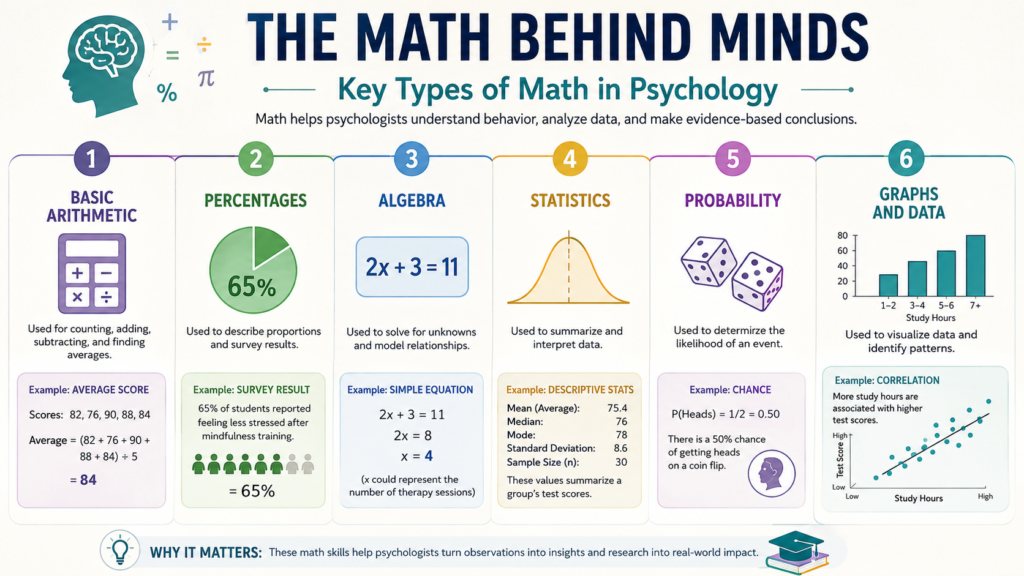
Psychology students usually encounter applied math rather than abstract mathematical theory.
1. Basic Arithmetic
Students use addition, subtraction, multiplication and division when working with scores and datasets.
Examples include:
- Calculating totals
- Finding averages
- Comparing scores
- Converting values
- Determining percentages
These skills form the foundation for more advanced statistical work.
2. Fractions, Decimals, and Percentages
Psychology research often presents results as percentages or proportions.
A student may need to calculate:
- The percentage of participants who selected an answer
- The dropout rate in a study
- Changes in assessment scores
- The proportion of a sample belonging to a group
For example, if 45 out of 60 students report feeling nervous before an exam, the percentage is:
45 ÷ 60 × 100 = 75%
The calculation is simple, but students must understand what the result means and whether the sample represents a larger population.
3. Basic Algebra
Psychology students may use algebra to rearrange formulas, solve for missing values, and work with statistical equations.
Common algebra skills include:
- Following the correct order of operations
- Working with positive and negative numbers
- Substituting values into formulas
- Solving simple equations
- Understanding variables
You generally will not spend every psychology class solving algebra problems. However, basic algebra makes statistics much easier to understand.
4. Descriptive Statistics
Descriptive statistics summarize information collected from a group.
Psychology students commonly study:
Mean
The mean is the arithmetic average.
Add all scores and divide by the number of scores.
Median
The median is the middle value when scores are arranged in order.
Mode
The mode is the value that appears most often.
Range
The range is the difference between the highest and lowest values.
Standard Deviation
Standard deviation shows how spread out scores are around the mean.
A small standard deviation indicates that scores are relatively close together. A large one indicates greater variation.
These measures help researchers describe participants and results before conducting more advanced analyses.
5. Probability
Probability helps students understand how likely an event or result is to occur.
In psychology, probability is connected with questions such as:
- Could this result have occurred by chance?
- How confident are we in the finding?
- Is the observed relationship statistically meaningful?
- How accurately does a sample reflect a population?
Students do not usually need advanced probability theory in an introductory psychology degree, but they must understand its role in research conclusions.
6. Correlation
Correlation measures the direction and strength of a relationship between two variables.
Examples might include the relationship between:
- Study time and exam performance
- Sleep duration and attention
- Stress and job satisfaction
- Exercise and reported mood
A positive correlation means the variables tend to increase together. A negative correlation means one tends to decrease as the other increases.
A correlation does not prove that one variable caused the other. Understanding this distinction is a major part of psychological reasoning.
7. Inferential Statistics
Inferential statistics help researchers use sample data to make cautious conclusions about a wider population.
Students may encounter:
- T-tests
- Chi-square tests
- Analysis of variance
- Regression
- Confidence intervals
- Significance testing
Introductory courses focus on why and when these tests are used. More advanced psychology programs may expect students to perform and interpret them in greater detail.
8. Graphs and Data Visualization
Psychology students must learn to read and sometimes create:
- Bar graphs
- Line graphs
- Histograms
- Scatterplots
- Frequency tables
- Distribution curves
Students are often graded not only on performing a calculation but also on explaining what the data shows.
Do You Need Calculus for Psychology?
Most psychology undergraduate programs do not require psychology majors to complete advanced calculus.
However, calculus may be required or recommended when:
- The college has a broader quantitative general-education requirement
- The student is earning a Bachelor of Science
- The program includes neuroscience or computational psychology
- The student plans to pursue advanced research
- A graduate program lists calculus as a prerequisite
- The student is combining psychology with another science major
A student interested in quantitative psychology, mathematical psychology, cognitive science, or data-heavy research may benefit from calculus even when it is not a basic degree requirement.
Always check the curriculum and graduate-school prerequisites before selecting courses.
Do You Need Statistics for Psychology?
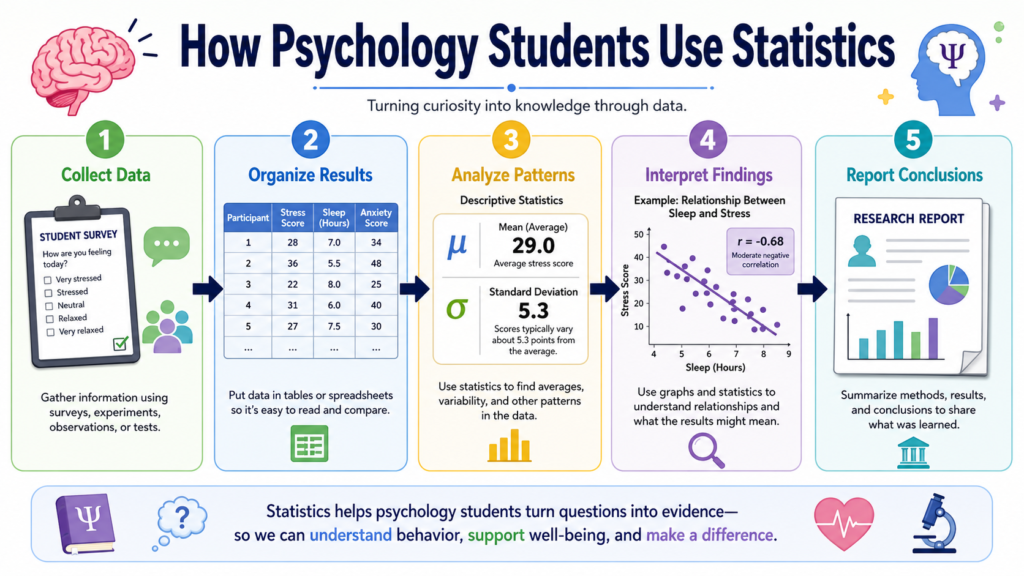
In most psychology programs, statistics is the most important math course.
Statistics allows students to:
- Organize research data
- Summarize participant responses
- Compare experimental groups
- Test hypotheses
- Identify patterns
- Evaluate published studies
- Report findings accurately
APA undergraduate psychology guidelines emphasize scientific inquiry, research design, data interpretation, and statistical reasoning as central parts of psychology education.
Students who avoid statistics may still understand psychological theories, but they will have difficulty evaluating whether research evidence actually supports those theories.
Is Psychology Considered a STEM Subject?
Psychology is commonly classified as a social science, although parts of the field overlap with natural science, health science, neuroscience, and data science.
Some psychology programs and research areas are more quantitatively focused than others.
Areas with stronger STEM connections include:
- Cognitive neuroscience
- Behavioral neuroscience
- Experimental psychology
- Quantitative psychology
- Psychometrics
- Human factors
- Industrial-organizational psychology
- Computational psychology
Clinical, counseling, developmental, educational, and social psychology also rely on scientific research, although daily professional work may not always involve advanced calculations.
Math Requirements for a BA vs. BS in Psychology
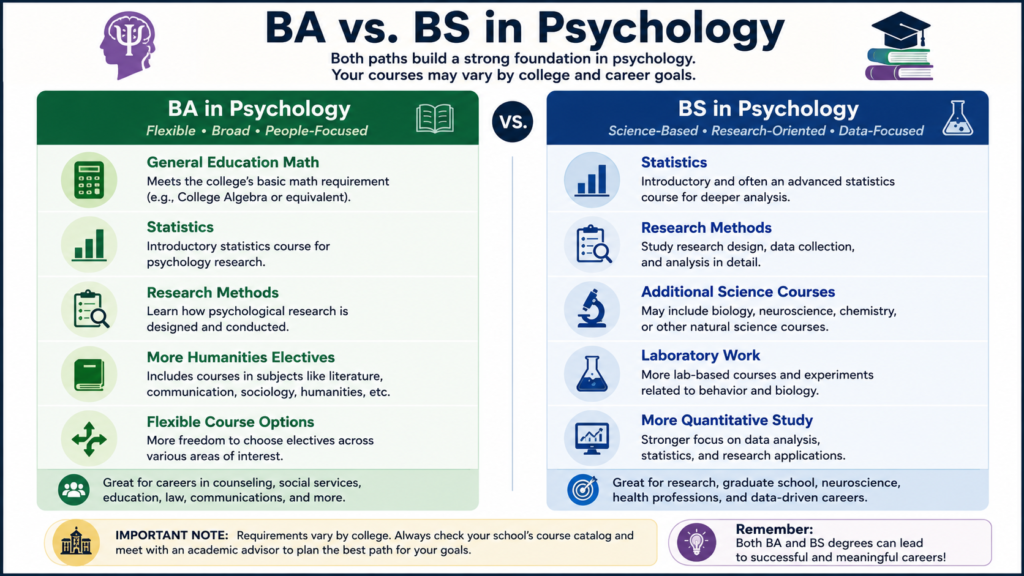
Students can often choose between a Bachelor of Arts and a Bachelor of Science in psychology.
The differences depend on the university, but the following comparison is common.
| BA in Psychology | BS in Psychology |
| Often includes more humanities or language courses | Often includes more science and quantitative courses |
| Usually requires statistics | Usually requires statistics |
| May have fewer laboratory requirements | May include more laboratory work |
| Suitable for many counseling, social service, and general career paths | Useful for research, neuroscience, healthcare, or graduate science study |
| May offer greater elective flexibility | May have a more structured science curriculum |
A BS is not automatically better than a BA. The right choice depends on your goals.
A student considering research, medicine, neuroscience, or advanced quantitative study may prefer a BS. A student interested in counseling, human services, communication, education, or flexible electives may prefer a BA.
Graduate schools usually look at the courses completed, research experience, grades, recommendations, and preparation for the program not only whether the degree says BA or BS.
Which Psychology Courses Involve the Most Math?
Some psychology courses involve more quantitative work than others.
Statistics for Psychology
This is usually the most calculation-heavy required course. Students learn how to summarize data, test hypotheses, and interpret statistical output.
Research Methods
Research methods may include fewer manual calculations than statistics, but it requires quantitative reasoning.
Students may design studies, define variables, evaluate sampling, and interpret results.
Experimental Psychology
Students may conduct experiments, collect data, perform analysis, and write reports.
Psychological Testing and Measurement
This course may cover:
- Standardized scores
- Reliability
- Validity
- Percentiles
- Normal distributions
- Test construction
Quantitative Psychology
This specialization uses advanced statistical and mathematical methods to study behavior and improve research tools.
Psychometrics
Psychometrics focuses on measuring psychological traits, abilities, attitudes, and performance.
It can involve substantial statistics, particularly at the graduate level.
Industrial-Organizational Psychology
Students may work with employee surveys, performance measures, selection tests, workplace data, and organizational research.
Cognitive and Behavioral Neuroscience
These areas may involve data analysis, experimental design, biological measurements, and computer-based research.
Which Psychology Courses Usually Have Less Math?
Courses that generally involve less direct calculation include:
- Introduction to psychology
- Abnormal psychology
- Personality psychology
- Developmental psychology
- Social psychology
- Counseling theories
- History of psychology
- Psychology of relationships
- Multicultural psychology
However, students may still read research studies containing tables, graphs, statistical results, and scientific terminology.
“Less math” does not mean “no data.”
Does Clinical Psychology Require Math?
Clinical psychology requires statistics and research methods during college and graduate education.
Clinical psychologists need to understand:
- Research evidence
- Psychological assessments
- Test scores
- Treatment outcomes
- Reliability and validity
- Evidence-based practice
A clinical psychologist may not perform manual statistical calculations every day, but quantitative understanding is important for evaluating assessments and treatment research.
Clinical and counseling psychologists generally require advanced graduate education and must meet state licensing requirements. The precise education and licensing route varies by location.
Does Counseling Psychology Require Math?
Counseling psychology usually requires statistics during undergraduate and graduate study.
Daily counseling work may involve less calculation than experimental research, but professionals must still understand:
- Assessment results
- Research on treatment approaches
- Client progress measures
- Program outcomes
- Ethical use of psychological tests
Students should not assume that choosing counseling eliminates all quantitative coursework.
Does Forensic Psychology Require Math?
Forensic psychology combines psychology with legal and criminal-justice settings.
Students may use math when studying:
- Crime statistics
- Assessment scores
- Risk estimates
- Research findings
- Survey data
- Reliability of evidence
The amount of quantitative work depends on whether the role focuses on direct assessment, research, correctional systems, policy, or academic work.
Does Industrial-Organizational Psychology Require Math?
Industrial-organizational psychology can require more statistics than many people expect.
Professionals may analyze:
- Employee performance
- Hiring assessments
- Job-satisfaction surveys
- Training outcomes
- Workplace productivity
- Turnover
- Organizational change
Students interested in this area should become comfortable with statistics, spreadsheets, data visualization, and research software.
Does Child Psychology Require Math?
Child and developmental psychology programs generally require statistics and research methods.
Researchers may analyze:
- Language development
- Learning
- Memory
- Social behavior
- Parent-child relationships
- Development across age groups
Professionals working directly with children may use less daily calculation, but they still need to interpret assessment scores and scientific research.
Does Social Psychology Require Math?
Social psychology may involve a significant amount of research and statistics, particularly in academic settings.
Researchers study topics such as:
- Group behavior
- Attitudes
- Social influence
- Bias
- Relationships
- Decision-making
They often use experiments, surveys, statistical comparisons, and large datasets.
Does Neuroscience Require More Math Than Psychology?
Neuroscience generally requires stronger preparation in science and quantitative reasoning.
Depending on the program, students may need:
- Biology
- Chemistry
- Physics
- Statistics
- Calculus
- Computer programming
Students who enjoy psychology but want to study the brain, nervous system, or biological processes should carefully review the science prerequisites.
Does AP Psychology Require Math?
AP Psychology is not usually viewed as a math-heavy high school course.
Students may encounter:
- Research methods
- Graphs
- Experimental design
- Correlation
- Basic statistical reasoning
- Interpretation of evidence
The College Board presents scientific inquiry and research methods as foundational elements of AP Psychology.
Students generally do not need advanced high school math to enroll, although prerequisites are determined by individual schools.
Can You Major in Psychology If You Are Bad at Math?
Yes.
Many psychology students begin college feeling uncomfortable with math. That does not mean they cannot complete the degree.
Statistics is a skill that can be learned through:
- Clear explanations
- Repeated practice
- Worked examples
- Visual interpretation
- Tutoring
- Office hours
- Study groups
- Statistical software
Students often find statistics easier when they see how it answers real psychological questions.
For example, calculating a standard deviation may feel abstract at first. It becomes more meaningful when used to understand how much anxiety scores differ across a group of students.
The goal is not necessarily to love math. The goal is to develop enough confidence to use it accurately.
How Difficult Is Psychology Statistics?
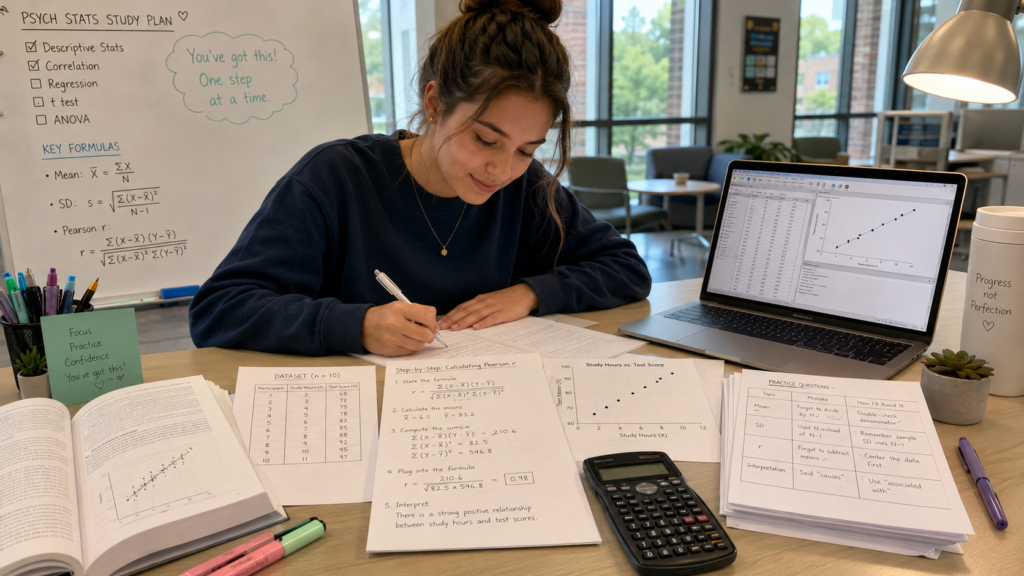
The difficulty depends on your background, instructor, study habits and course design.
Psychology statistics can feel challenging because students must learn three things at once:
- New mathematical ideas
- New research vocabulary
- How to interpret results in context
A student might correctly calculate a correlation but still lose marks for interpreting it incorrectly.
The following topics often require extra practice:
- Standard deviation
- Probability
- Normal distributions
- Statistical significance
- Choosing the correct statistical test
- Interpreting software output
- Distinguishing correlation from causation
Students preparing for a statistics test can use a structured approach similar to this guide on how to study for a math test by reviewing concepts, practicing problems, checking errors, and spacing study sessions across several days.
Do Psychology Students Calculate Statistics by Hand?
Introductory courses may require manual calculations so students understand how a statistical method works.
Later courses commonly use software such as:
- SPSS
- R
- Jamovi
- JASP
- Excel
- SAS
- Python
Software performs calculations, but students must still know:
- Which test to select
- Whether the data meets the test’s assumptions
- How to read the output
- What the result means
- How to report it correctly
Pressing a button is not the same as understanding the analysis.
What Math Skills Should You Review Before Studying Psychology?
Students do not need to master advanced mathematics before beginning a psychology degree.
The most useful skills to review are:
Fractions and Decimals
Practice converting between fractions, decimals, and percentages.
Percentages
Learn how to calculate increases, decreases, proportions, and percentage differences.
Negative Numbers
Statistics often includes values below zero, particularly with correlations and standardized scores.
Order of Operations
Review parentheses, exponents, multiplication, division, addition, and subtraction.
Simple Equations
Practice inserting values into formulas and solving for a missing variable.
Graph Reading
Be able to identify trends, compare values, and understand labels and scales.
Averages
Review mean, median, mode, and range.
Basic Probability
Understand likelihood, proportions, and chance.
How to Make Psychology Math Easier
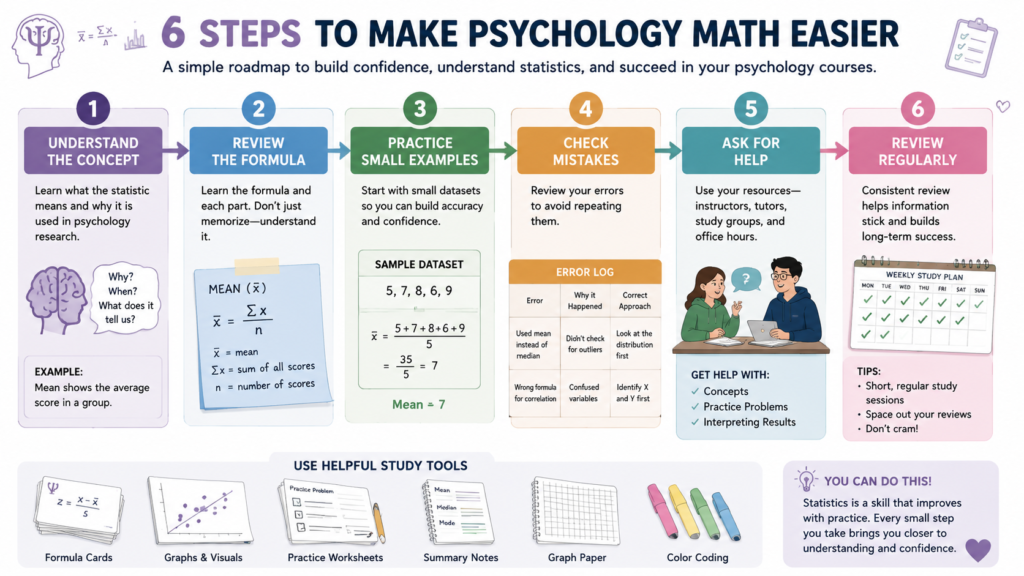
1. Learn the Meaning Before the Formula
Do not begin by memorizing symbols.
First ask:
- What question does this statistic answer?
- When is it used?
- What would a high or low result mean?
- What does the result tell us about behavior?
Once the purpose is clear, the formula becomes easier to remember.
2. Practice With Small Datasets
A dataset of five or six values is easier to understand than a spreadsheet containing hundreds of scores.
Use small examples to learn:
- Mean
- Median
- Range
- Variance
- Standard deviation
Then move to larger datasets and software.
3. Create a Formula Sheet
For each formula, record:
- The formula name
- What it measures
- What each symbol means
- When to use it
- One worked example
Do not create a sheet containing formulas with no explanations.
4. Draw the Problem
Use:
- Tables
- Number lines
- Distribution curves
- Scatterplots
- Simple diagrams
Visuals can make relationships and distributions easier to understand.
5. Complete Practice Problems Regularly
Reading a statistics chapter is not enough.
Work through problems without looking at the answer, then check:
- Where did the error begin?
- Did you use the wrong formula?
- Did you misunderstand the question?
- Did you make an arithmetic mistake?
- Did you interpret the result incorrectly?
6. Keep an Error Log
Create a table like this:
| Error | Why It Happened | Correct Approach |
| Used mean instead of median | Did not notice an extreme score | Check the distribution first |
| Reversed correlation meaning | Focused only on the number | Check the positive or negative sign |
| Chose wrong test | Did not identify the variables | Write variable type before choosing |
An error log helps students correct patterns rather than repeating them.
7. Attend Office Hours Early
Do not wait until the week before the final exam.
Bring specific questions, such as:
- Why is this test appropriate?
- How do I interpret this output?
- Where did my calculation go wrong?
- What does this symbol represent?
Specific questions make academic support more useful.
8. Use a Study Group Carefully
A good study group:
- Solves problems independently first
- Compares methods
- Explains concepts aloud
- Corrects misunderstandings
- Stays focused on the course
A group is less useful when one student completes every calculation while everyone else copies.
9. Separate Calculation From Interpretation
For each problem, use two steps:
Calculation: What is the numerical result?
Interpretation: What does the result mean in this psychological context?
This habit prepares students for exams and research reports.
10. Start Assignments Early
Statistics assignments often take longer than expected because one misunderstanding can affect every later step.
Students balancing several online courses can seek legitimate online class help for scheduling, tutoring, course organization, and concept review while remaining responsible for their own submitted work.
A Simple Psychology Statistics Study Plan
Use this seven-day plan before an exam.
| Day | Main Task |
| Day 1 | List the topics and organize class notes |
| Day 2 | Review definitions and purposes of each test |
| Day 3 | Practice basic calculations |
| Day 4 | Interpret graphs and statistical output |
| Day 5 | Complete mixed practice questions |
| Day 6 | Review mistakes and weak areas |
| Day 7 | Complete a short final review and rest |
Avoid spending all seven days rereading the textbook. Psychology statistics requires active problem-solving.
Math Used in Different Psychology Careers
| Psychology Career | Typical Math Use |
| Clinical psychologist | Assessment scores and research interpretation |
| Counseling psychologist | Outcome measures and evidence evaluation |
| School psychologist | Standardized testing and progress data |
| Forensic psychologist | Assessment, research, and risk information |
| Industrial-organizational psychologist | Surveys, performance data, and statistics |
| Experimental psychologist | Research design and statistical analysis |
| Quantitative psychologist | Advanced statistics and mathematical modeling |
| Neuropsychologist | Test scores, brain-behavior data, and research |
| Professor or researcher | Study design, analysis, and publication |
| Behavioral analyst | Behavior tracking and progress measurement |
The daily use of math varies. Research-heavy roles generally require more quantitative work than direct service roles.
Should You Avoid Psychology Because of Math?
You should not reject psychology solely because statistics makes you nervous.
Instead, ask:
- Am I willing to practice basic quantitative skills?
- Can I ask for help when I do not understand?
- Am I interested enough in psychology to complete one or more statistics courses?
- Which psychology specialization fits my strengths?
- Does my target program offer tutoring or academic support?
Most students do not need to become mathematicians. They need to become informed users of data.
However, psychology may not be a good match if you strongly dislike research, evidence, data interpretation, and scientific reasoning not simply arithmetic.
How to Check a College’s Psychology Math Requirements
Before applying or registering, review the official degree plan.
Look for:
- General education math requirements
- Statistics prerequisites
- Psychology statistics
- Research methods
- Laboratory courses
- Calculus requirements
- Biology or chemistry requirements
- BA and BS differences
- Graduate-school prerequisites
Do not rely only on the program summary. Open the full course catalog and read the prerequisite chain.
For example, a psychology statistics course may require college algebra first. A research-methods course may require statistics. Missing one prerequisite can delay graduation.
Students planning their education can also use a broader career development process to compare degree requirements, skills, career options, and graduate pathways before committing to a program.
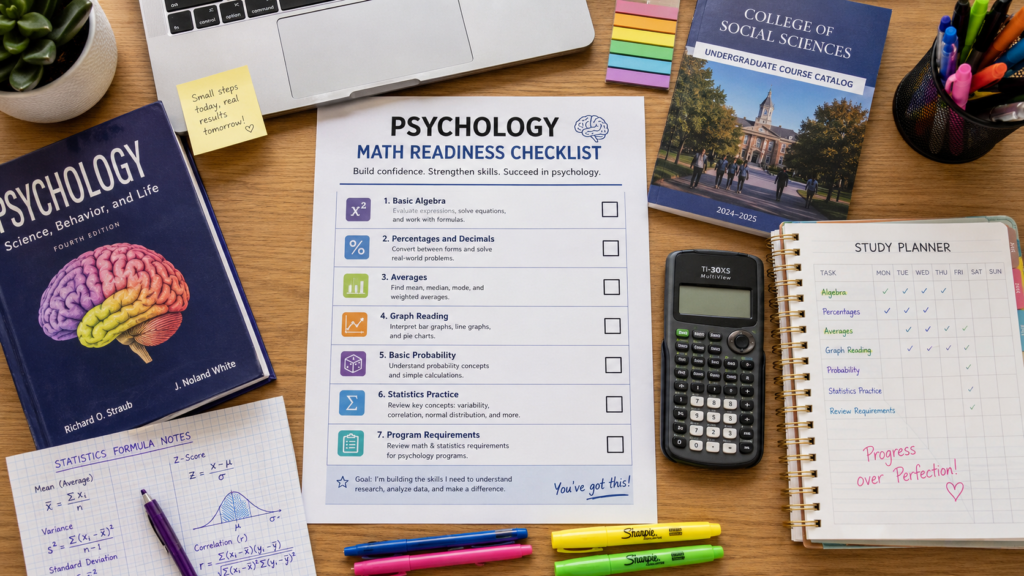
Psychology Math Readiness Checklist
Basic Skills
- I can work with fractions and decimals.
- I understand percentages.
- I can follow the order of operations.
- I can solve simple equations.
- I can interpret positive and negative values.
Data Skills
- I can calculate an average.
- I can read a table.
- I can interpret a basic graph.
- I understand the difference between a sample and a population.
- I know that correlation does not automatically prove causation.
Study Habits
- I practice problems instead of only reading.
- I check why an answer is wrong.
- I ask questions before falling behind.
- I divide difficult topics into smaller parts.
- I review statistics more than once per week.
Program Research
- I reviewed the psychology degree requirements.
- I compared the BA and BS options.
- I checked statistics prerequisites.
- I reviewed graduate-school requirements.
- I know which campus support services are available.
Frequently Asked Questions
Does a psychology major require a lot of math?
A psychology major normally requires some math, especially statistics and research methods. It generally involves less advanced math than engineering, physics, or mathematics degrees, but quantitative requirements vary by college and specialization.
What math classes do psychology majors take?
Common requirements include general education math, introductory statistics, psychology statistics, and research methods. Some BS, neuroscience, or research-focused programs may require calculus or additional science courses.
Can I study psychology if I am not good at math?
Yes. Students can improve through regular practice, tutoring, office hours, study groups, and worked examples. Psychology math is usually applied to real research questions rather than taught as abstract mathematics alone.
Is statistics difficult in psychology?
Statistics can be challenging because students must perform calculations and interpret what the results mean. It becomes more manageable when students practice regularly and understand the purpose of each method.
Do therapists use math?
Therapists may not perform complex calculations every day, but they can use assessment scores, progress measures, billing information, research findings, and outcome data.
Does clinical psychology require calculus?
Calculus is not universally required for clinical psychology. Requirements depend on the undergraduate program and graduate school. Statistics and research methods are much more commonly required.
Does psychology require algebra?
Psychology statistics often uses basic algebra. Students may substitute numbers into formulas, work with variables, calculate percentages, and interpret positive and negative values.
Does a BA in psychology require math?
Most BA psychology programs require at least general education math and statistics. The exact number of quantitative courses depends on the institution.
Does a BS in psychology require more math?
A BS often includes more science, laboratory, or quantitative coursework than a BA, but this varies by college. Students should compare the official degree plans.
Is psychology easier than a math major?
Psychology normally involves less advanced mathematics than a math degree. However, psychology includes other demanding areas, such as research design, scientific writing, theory, biological processes, and data interpretation.
Can I become a psychologist without taking statistics?
It is unlikely. Statistics and research methods are standard parts of psychology education because psychologists must understand and evaluate scientific evidence.
Which psychology field uses the most math?
Quantitative psychology, psychometrics, experimental psychology, cognitive neuroscience, and research-focused industrial-organizational psychology commonly involve more advanced statistics and data analysis.
Final Thoughts
Psychology requires math, but the requirement is usually manageable for students who are willing to practice.
Most psychology majors use:
- Basic arithmetic
- Algebra
- Percentages
- Probability
- Descriptive statistics
- Inferential statistics
- Graphs
- Research data
Statistics is important because psychology is not based only on theories or personal observations. Psychologists use evidence to study behavior, evaluate treatments, compare groups, and test claims.
You do not need to enter college already knowing every formula. Start by reviewing basic algebra, averages, percentages, and graph interpretation. Check the requirements of your chosen program, use academic support early, and practice statistics in short, regular sessions.
Being nervous about math does not automatically mean psychology is the wrong major. It simply means quantitative preparation should be part of your plan.