
Studying for a math test is different from preparing for an exam in history, English, or biology. You cannot become test-ready by rereading a chapter, highlighting a few definitions, and hoping the information stays in your memory. Math requires you to recognize problem types, choose the correct method, complete each step accurately, and check whether your answer makes sense.
The best way to study for a math test is to combine short, focused review sessions with active problem-solving. Start by identifying what the test covers, diagnose your weak areas, practice without looking at examples, review every mistake, and complete at least one timed practice session before test day.
Whether you are preparing for an Algebra I quiz, a college statistics midterm, an AP Calculus exam, or the SAT Math section, the process is largely the same: understand the concepts, practice retrieving the methods, and learn to apply them under realistic testing conditions.
Key Takeaways
- Start studying several days before the test whenever possible.
- Spend most of your study time solving problems, not rereading notes.
- Practice a mixture of easy, moderate, and challenging questions.
- Keep an error log and redo missed problems without looking at the solution.
- Learn when and why to use a formula instead of memorizing symbols alone.
- Complete timed practice under conditions similar to the real exam.
- Check your calculator policy and practice with the permitted tools.
- Get a good amount of sleep the night before instead of studying until morning.
- Use breathing and grounding techniques if math anxiety affects your performance.
- On test day, solve simple, high-scoring problems first, then return to difficult problems later.
Why Do Students Struggle With Math Tests?
Students don’t always struggle with math because they are not good at it. Usually, it’s because the way they study doesn’t match what a math test measures.
Even after seeing a solved example in class, a student might not be able to start a similar problem on their own. Another student may understand the method but lose points through sign errors, skipped steps, poor time management, or incorrect calculator input.
Math Skills Build on Earlier Skills
Math is cumulative. A weakness in fractions can create difficulties with algebraic equations. Weak algebra skills can then affect geometry, statistics, trigonometry, chemistry, physics, and calculus.
For example, a calculus student may understand derivatives but still lose points because of errors when simplifying fractions or factoring expressions. The immediate problem appears to be calculus, but the underlying weakness is algebra.
Before preparing for a test, ask:
- Which skills does this unit depend on?
- Can I do those steps without looking at my notes?
- Do I know why the method works?
- Can I tell when the method should be used?
Students who repeatedly struggle with prerequisite concepts may benefit from first reviewing a broader guide on how to get better at math.
Passive Review Creates False Confidence
Reading a completed solution can make the steps feel familiar. Familiarity, however, is not the same as independent recall.
You may understand every line while looking at an example and then go blank when the example disappears. That gap occurs because the brain has been recognizing information rather than retrieving and applying it.
A stronger method is:
- Study one worked example.
- Cover the solution.
- Solve a similar problem independently.
- Explain why each step is valid.
- Check your work only after finishing.
Math Anxiety Uses Up Attention
Some students understand the material during homework but freeze during a test. Worrying about failing, running out of time, or believing they are “bad at math” consumes attention that should be used for problem-solving.
Physical signs may include:
- Rapid breathing
- Sweaty hands
- A racing heartbeat
- Difficulty reading the question
- Forgetting familiar formulas
- Repeatedly checking the clock
- Going blank on the first difficult problem
Anxiety does not prove that you are unprepared. It means you need both academic preparation and a plan for managing stress.
What Is the Best Way to Study for a Math Test?
The best method is a five-part cycle:
- Diagnose: Identify math test topics or procedures you do not understand or need to practice.
- Review: Learn the relevant concept or method.
- Practice: Solve questions without copying a model.
- Correct: Analyze mistakes and reattempt the problems.
- Simulate: set a timer, and try to solve different math problems within the set time.
According to research, the most effective math preparation follows two habits:
- Spaced Practice: Distributing your study sessions over time instead of cramming.
- Interleaved Practice: Mixing different types of problems instead of practicing just one topic at a time. This seems harder because the correct method is not immediately obvious, but that difficulty trains you to select an appropriate strategy independently.
How Far in Advance Should You Start Studying?
For a normal chapter or unit test, begin about five to seven days before the exam. For a cumulative midterm, final, AP exam, placement test, or standardized test, begin several weeks in advance.
The correct timeline depends on:
- How much material is included
- Your current grade
- The number of weak topics
- Whether the test is cumulative
- The difficulty of the course
- How many other assignments or exams you have
Recommended Math Test Preparation Timeline
| Time Available | Best Approach |
| 2–4 weeks | Review foundations, work by topic, then complete cumulative practice tests |
| 7 days | Diagnose weak areas, review one or two topics daily, and finish with timed practice |
| 3 days | Prioritize the highest-value weaknesses and complete mixed problem sets |
| 1 day | Review formulas, error logs, representative problems, and test procedures |
| 1 hour | Focus only on common errors, essential formulas, and a few confidence-building problems |
Starting early does not mean studying for hours every day. Thirty to sixty focused minutes across several days are generally more useful than one exhausting session the night before.
How to Create a Math Study Schedule

A useful math study schedule should tell you exactly what to do. “Study math for two hours” is vague. “Complete ten quadratic-equation problems, review incorrect answers, and practice three word problems” is measurable.
Step 1: Confirm What the Test Covers
Use your:
- Syllabus
- Review sheet
- Textbook chapters
- Homework assignments
- Quizzes
- Lecture notes
- Learning-management system
- Teacher or professor’s announcements
Clarify the test format as well. Find out whether it includes multiple-choice questions, free-response problems, proofs, graphing, word problems, or calculator and non-calculator sections.
Step 2: Make a Test Map
Create a table listing each topic, your confidence level, and the action you need to take.
| Topic | Confidence | Evidence | Next Action |
| Linear equations | High | 9 of 10 correct | Brief review |
| Systems of equations | Medium | Slow but accurate | Timed practice |
| Quadratic formula | Low | Formula errors | Relearn and drill |
| Word problems | Low | Cannot form equations | Practice translation |
| Graph interpretation | Medium | Miss labels and units | Review error patterns |
Do not rate a topic as “strong” simply because it looks familiar. Use actual performance on practice questions.
Step 3: Prioritize by Value
Start with topics that are:
- Frequently tested
- Worth many points
- Necessary for later questions
- Weak but realistically improvable
- Repeatedly missed on homework or quizzes
Do not spend half your study time perfecting a rare challenge problem while neglecting common question types.
Step 4: Use Focused Study Blocks
A 50-minute session could look like this:
- 5 minutes: Recall formulas or rules from memory
- 10 minutes: Review one concept
- 25 minutes: Solve problems without notes
- 5 minutes: Check answers and label errors
- 5 minutes: Redo one missed problem
High school students balancing classes, sports, work, and extracurricular activities can also use structured time-management activities to protect regular study periods.
A Seven-Day Math Test Study Plan
Day 7: Diagnose Your Current Level
- Collect the test topics.
- Complete a short set of problems without notes.
- Mark topics as strong, developing, or weak.
- Build your test map.
- Ask your instructor about anything unclear.
Day 6: Fix the Basics
Review the skills you need to know before moving on to the new material. This could include fractions, negative numbers, exponent rules, equation solving, graph reading, or algebraic manipulation.
Do not attempt twenty advanced questions if you keep on making the same basic mistakes. Fix your basics first.
Day 5: Practice the First Half of the Material
Solve sample problems from previous subjects. Start with simple examples and work your way up to more complex ones.
After each set, you should not only write down the score but also write down what mistakes you made and how you can solve them.
Day 4: Practice the Second Half
Repeat the same process with the remaining topics. Include at least a few questions that require explanation, graphing, modeling, or interpretation rather than calculation alone.
Day 3: Mix the Topics
Stop practicing topics in a predictable order. Mix equations, graphs, word problems, formulas, and conceptual questions.
Mixed practice forces you to answer an important question: “What kind of problem is this, and which method fits it?”
Day 2: Complete a Timed Practice Test
Simulate the real testing environment:
- Use the same time limit.
- Follow the calculator rules.
- Put away notes.
- Work without interruptions.
- Show all required steps.
- Mark uncertain answers without immediately checking them.
Review the practice test afterwards and create a final correction list.
Day 1: Review, Organize, and Rest
Complete a light review of:
- Essential formulas
- Previously missed problems
- Calculator procedures
- Common careless errors
- Test-day materials
Avoid beginning a major new topic unless it is essential. Your goal is to stabilize what you know, not overwhelm yourself.
Math Study Techniques That Actually Work
Solve Problems Before Looking at the Solution
When you get stuck, resist the urge to reveal the full answer immediately.
Try this sequence:
- Write down the information provided by the question.
- Write what it asks you to find.
- Identify the relevant concept.
- Draw a diagram or graph.
- Attempt one possible first step.
- Consult only a small hint if necessary.
- Complete on your own.
Productive struggle helps you discover where your understanding ends.
Use Blank-Page Recall
Take a blank sheet and write everything you remember about one topic:
- Definitions
- Formulas
- Graph shapes
- Conditions
- Typical steps
- Common exceptions
- Example problem types
Then compare your page with your notes. Cornell University describes a similar approach as “blank page testing,” a form of retrieval practice that exposes what a student can and cannot recall independently.
Mix Different Types of Problems
When you do blocked practice, you do a lot of questions that are identical to each other. This is helpful when you’re learning a procedure but can make you think you are better at it because you are always doing the same thing.
Interleaved practice is different. You do kinds of questions. For example: Solve an equation, then factor an equation, and next look at a graph, then go back to the equation, but this time it is part of a word problem. This is like a real test, where you do not know what kind of question you will get.
Explain the Method Out Loud
Pretend you are teaching the problem to a classmate. Explain:
- What the problem is asking
- Why did you select a method to solve this problem
- What each symbol represents
- Why is each algebraic step allowed
- How do you know the answer is reasonable
If you cannot explain a step, you may be copying a procedure without understanding it.
Use Worked Examples Correctly
Worked examples are valuable when they are used as training tools rather than reading material.
Try example fading:
- Study a fully solved problem.
- Complete a similar problem with a few steps removed.
- Complete another with only the first step provided.
- Solve the final problem entirely independently.
Create an Error Log
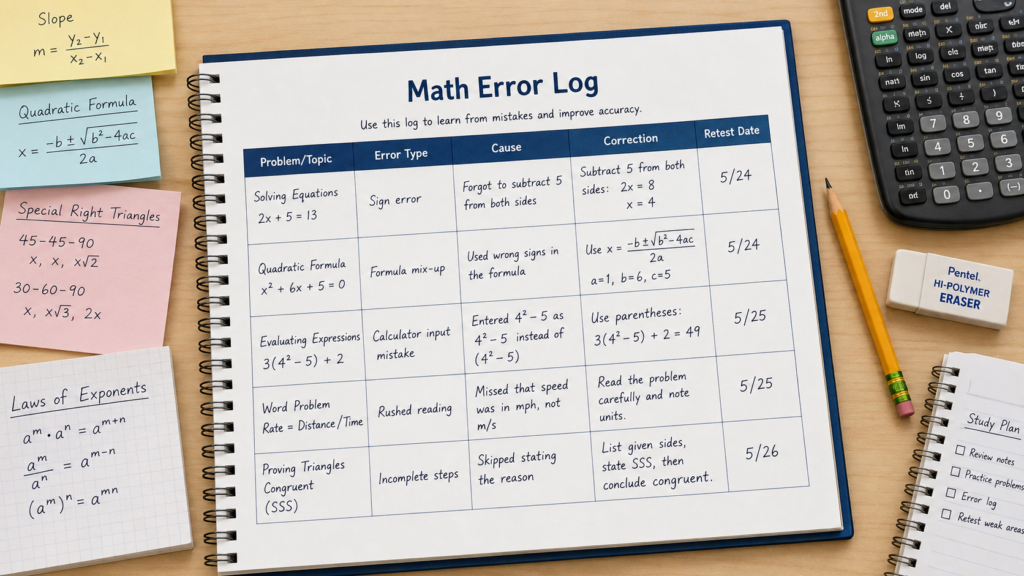
An error log is one of the most useful tools in a math test study guide.
Record:
- The problem or topic
- Your incorrect answer
- The correct answer
- The type of error
- Why did the error happen
- What you will do differently
- The date you successfully redid it
Common error categories include:
| Error Type | Example | Corrective Action |
| Concept error | Used the wrong theorem | Review when the theorem applies |
| Procedure error | Reversed a step | Write a numbered method |
| Calculation error | Multiplied incorrectly | Slow down and estimate |
| Sign error | Lost a negative sign | Circle negatives during work |
| Reading error | Found diameter instead of radius | Underline what is requested |
| Calculator error | Entered parentheses incorrectly | Practice exact keystrokes |
| Time error | Spent too long on one question | Use a skip-and-return rule |
Redo each missed problem later without viewing the correction. Understanding a solution after seeing it is not the same as being able to reproduce it.
How to Memorize Math Formulas
Formula memorization works best when it follows understanding.
For every formula, learn five things:
- Meaning: What relationship does the formula describe?
- Variables: What does each symbol represent?
- Conditions: When is the formula valid?
- Units: What units should the answer have?
- Application: What type of problem requires it?
Build Formula Cards
On the front, write:
- The formula name
- A visual cue
- A question asking when it is used
On the back, write:
- The formula
- Variable definitions
- Conditions
- One short example
- One common mistake
Derive Formulas When Practical
You do not need to derive every formula during the test, but understanding its origin makes recall easier.
For example, connecting the distance formula to the Pythagorean theorem gives you a logical route back to the formula if your memory fails.
Use Units as Memory Clues
Units can reveal whether a formula or answer is valid.
- Length is measured in units.
- Area is measured in square units.
- Volume is measured in cubic units.
- Speed may be measured in miles per hour.
- Probability should generally fall between 0 and 1, or 0% and 100%.
Practice Formula Selection
When you practice, do not just write down formulas from memory. You should also practice figuring out which formula to use for a problem.
Being able to pick the formula is usually more important than being able to remember it.
How to Use Practice Tests Effectively
A practice test should do more than predict your score. It should reveal how your knowledge performs under pressure.
Match the Real Conditions
Use:
- The official or expected time limit
- The correct calculator rules
- The same formula sheet, if one is provided
- A quiet location
- No notes or solution websites
- The same answer format
Separate Accuracy From Speed
First, make sure you can solve the problems correctly when you have all the time you need. Then try to solve them
Practicing incorrect methods quickly under time pressure only makes the incorrect habit more automatic. First, get the methods right, then test them with time.
Review Every Question
For correct answers, ask:
- Did I use an efficient method?
- Was I certain or did I guess?
- Could I explain the solution?
- Did I rely on an accidental shortcut?
Retest Missed Questions
Wait several hours or until the following day, then redo the missed questions from a clean page. Continue until you can solve them accurately and explain the method.
Subject-Specific Math Test Strategies
Algebra Study Tips
Focus on:
- Order of operations
- Fractions and negative signs
- Solving and checking equations
- Factoring
- Exponent rules
- Function notation
- Graph interpretation
- Translating words into expressions
Always substitute your answer back into the original equation when time permits.
Geometry Test Preparation
Prepare by:
- Memorizing essential definitions and theorems
- Drawing and labeling diagrams
- Marking congruent sides and angles
- Writing units
- Distinguishing area, surface area, and volume
- Practicing proof structure where required
Do not trust a diagram to be drawn to scale unless the question says it is.
Calculus Exam Tips
Practice moving among:
- Equations
- Graphs
- Tables
- Verbal descriptions
Know what derivatives and integrals mean, not only how to calculate them. Pay attention to domain restrictions, endpoints, units, notation, and whether a problem asks for a value, rate, approximation, or interpretation.
Students taking AP Calculus should prepare separately for calculator and non-calculator tasks. The 2026 AP Calculus AB exam, for example, includes parts where graphing calculators are not permitted and parts where they are required for some questions.
Statistics Exam Preparation
Practice:
- Choosing appropriate procedures
- Checking assumptions and conditions
- Interpreting results in context
- Identifying association from causation
- Writing conclusions in complete sentences
- Using correct statistical notation
- Entering data accurately into a calculator
An accurate answer with no interpretation may not earn full credit on a statistics exam.
SAT Math Preparation
SAT preparation should include official-style questions, timed modules, word-problem translation, algebra, advanced math, data analysis, geometry, and effective use of the built-in Desmos calculator.
The digital SAT allows calculator use throughout the Math section, but College Board no longer permits calculators with computer algebra system functionality. Students should verify the latest policy before test day and practice with the same approved tool they plan to use.
For a test-specific strategy, review the complete SAT Math tips guide rather than treating SAT preparation like an ordinary classroom test.
How to Use a Calculator Without Becoming Dependent on It
A calculator is a tool, not a substitute for mathematical reasoning.
Practice the Exact Functions You Need
Before test day, know how to:
- Enter fractions
- Use parentheses
- Change between decimal and fraction form
- Evaluate exponents and roots
- Graph an equation
- Find intersections or zeros
- Use statistical functions
- Store or recall values where permitted
Estimate Before Calculating
An estimate helps you catch:
- Incorrect decimal placement
- Sign errors
- Wrong calculator modes
- Mistyped expressions
- Impossible answers
If you expect an answer near 20 and the calculator returns 2,000, stop and inspect the input.
Check the Test Policy
Calculator rules vary by teacher, institution, course, and exam. Some tests allow calculators throughout, some allow them only in specific sections, and others prohibit them.
For AP exams, the rules also vary by subject and section, so students should verify the current College Board policy rather than assuming that every graphing calculator is permitted everywhere.
Common Math Study Mistakes
Rereading Instead of Solving
Reading notes feels productive but does not test whether you can perform the skill independently.
Practicing Only Easy Problems
Easy questions build fluency, but difficult and unfamiliar problems build adaptability. Use both.
Copying the Answer Too Soon
Looking at the solution after thirty seconds teaches recognition rather than problem-solving.
Ignoring Wrong Answers
Every repeated mistake is evidence that the correction process was incomplete.
Memorizing Steps Without Conditions
A procedure is not useful if you cannot recognize when it applies.
Studying One Topic for Too Long
Overtraining one method can make it difficult to switch strategies during a mixed exam.
Depending Completely on a Calculator
Students who cannot estimate or recognize mathematical structure may accept incorrect calculator output without question.
Sacrificing Sleep to Cram
Adequate sleep supports concentration and academic performance. The CDC reports that insufficient sleep is also associated with attention difficulties and poorer school performance among students.
How to Reduce Math Test Anxiety
Replace Vague Fear With a Written Plan
“I am going to fail” is difficult to act on. “I miss quadratic word problems because I cannot translate the wording” gives you a specific problem to address.
Practice Under Mild Pressure
Use a timer for short sets before attempting a full practice exam. Gradually becoming familiar with time pressure can make the real test feel less threatening.
Use a Reset Routine
When anxiety rises:
- Put down your pencil.
- Place both feet on the floor.
- Inhale slowly.
- Exhale longer than you inhaled.
- Relax your shoulders.
- Read only the first sentence of the problem.
- Write one fact you know.
The American Psychological Association recommends self-calming approaches such as deep breathing for students experiencing anxiety.
Change Your Internal Language
Replace:
- “I never understand math.”
With:
- “I do not understand this step yet.”
Replace:
- “I have to get every answer right.”
With:
- “I will collect the points I can and show my reasoning.”
Seek Appropriate Support
Ask for help before confusion becomes a crisis. Depending on your situation, support may come from:
- Your teacher or professor
- Office hours
- A school tutoring center
- A classmate
- An academic-success center
- A licensed counselor
- A reputable online math resource
Students dealing with overlapping deadlines may also use an online course assistance service for legitimate scheduling, tutoring, or study support, but submitted academic work and test responses must remain the student’s own.
What to Do the Night Before a Math Test
The night before should be used for light revision, not panic-driven learning.
Complete a Final Review
Review:
- Your formula sheet
- Your error log
- Three to five representative problems
- Calculator procedures
- Frequently confused rules
- Required definitions or theorems
Prepare Your Materials
Depending on the test, prepare:
- Pencils or pens
- Eraser
- Approved calculator
- Spare batteries or charging cable
- Student ID
- Admission ticket
- Ruler or other permitted tools
- Water, where allowed
Set a Stopping Time
Choose a reasonable time to stop studying. A rested brain is more valuable than another hour of unfocused rereading.
Teenagers generally need adequate hours of sleep, and insufficient sleep is common among U.S. high school students. A well-rested brain helps you to focus during exams..
Last-Minute Math Study Tips
When only a few hours remain, do not attempt to master the entire course.
Prioritize:
- The most frequently tested problem types
- Essential formulas and conditions
- Problems you almost know how to solve
- Common mistakes in your error log
- Test format and calculator rules
Use a three-round review:
- Round 1: Solve five easy problems to build fluency.
- Round 2: Solve five moderate problems from important topics.
- Round 3: Review formulas and redo two previously missed problems.
Avoid spending your final hour on one extremely difficult question.
What to Do on Math Test Day
Before the Test
- Eat something familiar if possible.
- Arrive or log in early.
- Check your calculator.
- Review only a few key reminders.
- Avoid comparing preparation levels with anxious classmates.
During the Test
Read the Instructions
Confirm:
- How many questions are there
- Whether all questions are required
- Whether partial credit is available
- Which sections allow a calculator
- How answers should be entered
Scan the Test
Get a quick sense of the length and difficulty. Do not spend too much time previewing, but identify where longer questions appear.
Collect Easier Points First
Answer questions you can solve confidently. This builds momentum and preserves time for harder problems.
Show Your Work
Written steps may earn partial credit and make it easier to find errors.
Use a Skip-and-Return Rule
If you do not know how to start after a reasonable attempt:
- Write any useful formula or observation.
- Mark the question.
- Move forward.
- Return after completing easier items.
Check Reasonableness
Ask:
- Is the sign correct?
- Is the size realistic?
- Are the units correct?
- Does the graph match the answer?
- Does the solution satisfy the original equation?
- Did I answer the exact question?
Recommended Online Math Resources
Use online resources to practice and understand, not merely to obtain answers.
Helpful categories include:
- Official course materials and practice tests
- Khan Academy lessons and exercises
- Desmos graphing tools
- GeoGebra visualizations
- Paul’s Online Math Notes
- College or university tutoring-center guides
- Teacher-provided review systems
- Textbook companion platforms
When using a solution tool, attempt the problem first. Then compare methods, locate your first error, close the solution, and solve the problem again independently.
Common Myths About Studying Math
Myth 1: Some People Are Simply Not Math People
Students may begin at different levels, but mathematical performance can improve through instruction, feedback, and deliberate practice.
Myth 2: More Hours Always Produce Better Results
Two focused sessions with correction and retrieval can be more valuable than several distracted hours.
Myth 3: Memorizing Every Formula Is Enough
Formulas only help when you know what they mean, when they apply, and how to use them.
Myth 4: Getting a Practice Problem Right Means You Mastered It
You may have remembered the example or guessed correctly. Retest the skill later in a mixed set.
Myth 5: Fast Students Are Always Better at Math
Speed can help, but careful reasoning, accuracy, interpretation, and communication are also important.
Myth 6: Last-Minute Cramming Is the Fastest Way to Learn
Cramming may create brief familiarity, but spaced sessions are more reliable for lasting retention and flexible application.
Math Test Preparation Checklist
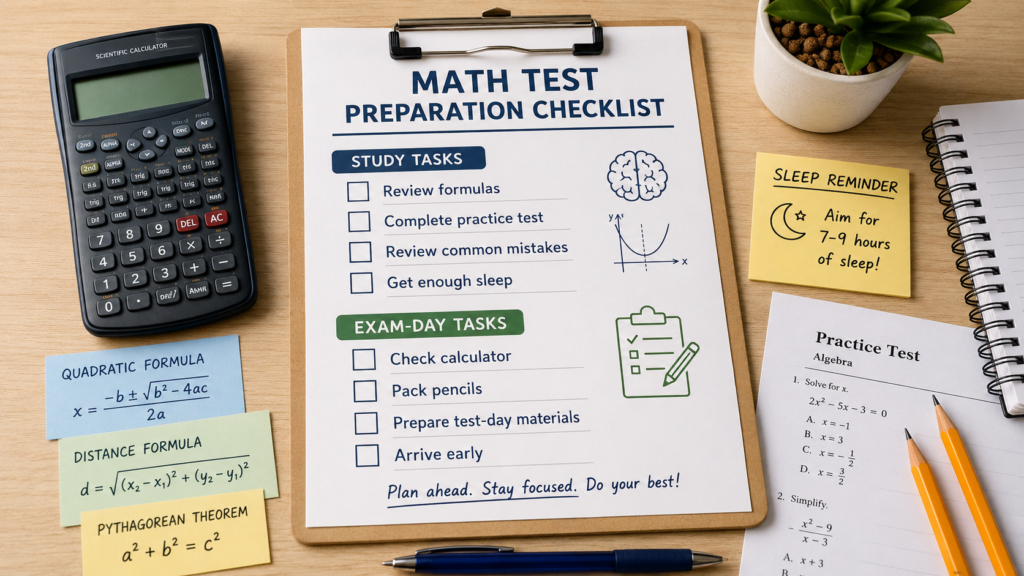
One Week Before
- Confirm the tested topics.
- Confirm the question format.
- Check the calculator policy.
- Complete a diagnostic problem set.
- Identify weak prerequisite skills.
- Create a seven-day schedule.
- Collect notes, quizzes, and review materials.
During the Week
- Solve problems without notes.
- Mix different problem types.
- Review formulas from memory.
- Maintain an error log.
- Redo missed questions.
- Ask for help with unresolved concepts.
- Complete at least one timed practice set.
The Night Before
- Review essential formulas.
- Review your most common errors.
- Complete a few representative problems.
- Prepare approved materials.
- Set alarms.
- Stop studying at a reasonable time.
- Get adequate sleep.
During the Test
- Read all directions.
- Note the time limit.
- Start with manageable questions.
- Show your work.
- Label graphs and units.
- Skip and return when necessary.
- Check signs, calculations, and reasonableness.
- Leave time to review.
Final Thoughts
Learning how to study for a math test is not about finding a secret trick. It is about turning preparation into a repeatable system.
Start by identifying exactly what the exam covers. Measure your current performance with real problems. Work on the weaknesses that prevent progress. Practice without notes, mix question types, analyze every error, and simulate the actual test before exam day.
A strong math study plan does more than improve one’s score. It develops habits that support algebra, geometry, statistics, calculus, standardized tests, and future college courses.
Begin today with one practical action: choose five problems from the upcoming test material, solve them without notes, and use the results to decide what your next study session should cover.
Students who want to build stronger year-round habits can also review these additional math study tips after the test.
Frequently Asked Questions
The number of hours depends on the test length, your current understanding, and how much material is included. For a normal unit test, five to seven sessions of 30–60 minutes may be more effective than one long cram session. Cumulative finals and standardized exams usually require several weeks of preparation.
The best way to study math is to solve problems without notes, mix different question types, review mistakes, and revisit topics across several days. Reading examples can introduce a method, but independent practice is what develops test-ready skills.
Begin by identifying the specific skills causing difficulty. Review basic concepts, practice common question types, keep an error log, and ask for help early. Avoid labeling yourself as “bad at math,” because that description does not identify what needs to be fixed.
Use a diagnostic quiz to avoid reviewing material you already know. Focus on high-value weaknesses, solve representative problems, check your work in batches, and track recurring mistakes. Studying faster should mean removing wasted effort, not rushing through solutions.
Memorize essential formulas, but also learn what each variable means, when the formula applies, and how the formula connects to a diagram or concept. Practice selecting the correct formula from an unlabeled problem.
The best time is when you are consistently alert and can work without interruptions. The schedule matters less than the quality and regularity of the practice. Avoid late-night sessions that reduce sleep before the exam.
List the tested topics, identify the highest-value weaknesses, review essential formulas, complete a mixed set of representative problems, and correct every mistake. Finish with a short timed set and stop early enough to sleep.
Write one step per line, circle negative signs, use parentheses carefully, label units, estimate before calculating, and save time for checking. Keep a record of repeated careless errors so you know exactly what to inspect.
Yes. Practice tests reveal whether you can select and apply methods under realistic conditions. They are most useful when you review every question, classify errors, and redo missed problems later without looking at the solution.
Pause, take a slow breath, relax your shoulders, and write down what the problem gives you. Identify the requested value and write any related formula or diagram. If you still cannot begin, mark the question and return after collecting easier points.