
A professor assigns a research paper, but the instructions do not simply say, “Find sources and write about the topic.” Instead, the prompt asks you to analyze a problem, compare two approaches, evaluate existing studies, defend a position, or report original findings.
These instructions matter because not all research papers serve the same purpose.
A paper that argues for a policy change needs a clear claim, supporting evidence, counterarguments, and a recommendation. A literature review needs synthesis, patterns, disagreements, and research gaps. An experimental paper must explain how data were collected and analyzed. A historical paper may rely heavily on primary documents and chronological interpretation.
Understanding the main types of research papers helps you choose the correct structure, research method, source material, and writing style before you begin drafting.
In most college courses, the common types include:
- Argumentative research papers
- Analytical research papers
- Expository research papers
- Compare-and-contrast research papers
- Cause-and-effect research papers
- Problem-solution research papers
- Literature reviews
- Experimental or empirical research papers
- Survey research papers
- Case studies
- Historical research papers
- Interpretive research papers
- Theoretical or conceptual research papers
- Methodological research papers
- Systematic reviews and meta-analyses
Some assignments combine several types. For example, a student may analyze a problem, compare possible solutions, and then argue for the strongest option.
This guide explains what each research paper type does, how it is structured, what evidence it uses, and how to recognize the type your instructor expects.
Quick Answer: What Are the Main Types of Research Papers?
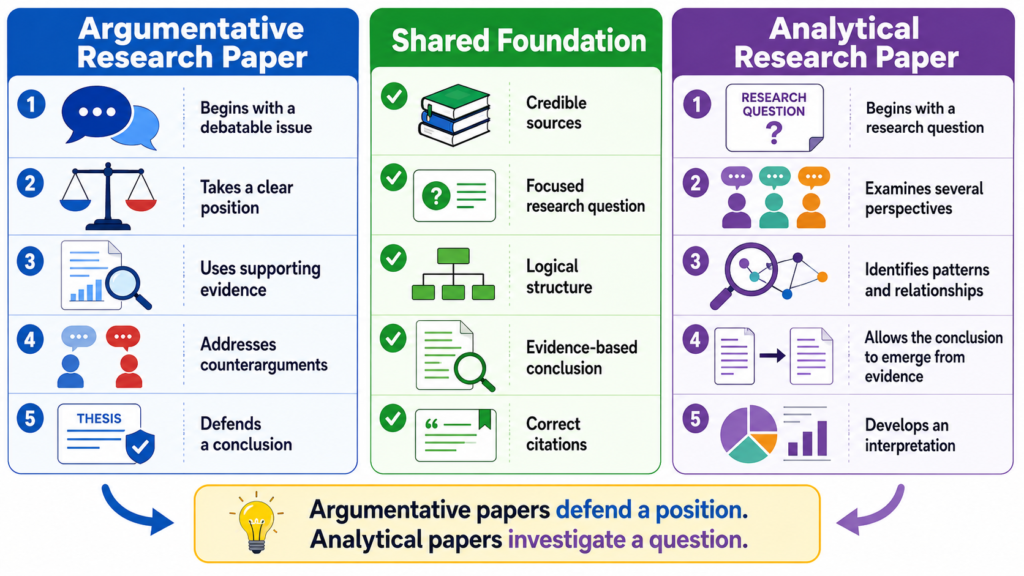
The two broad research-paper categories students encounter most often are argumentative and analytical.
An argumentative research paper takes a defensible position and uses evidence to persuade readers that the position is reasonable. An analytical research paper investigates a question, examines evidence from several perspectives, and develops an interpretation or conclusion based on the research.
Purdue OWL distinguishes these two forms by explaining that an argumentative paper makes a claim about a debatable topic, while an analytical paper begins with a research question and evaluates information without requiring the writer to start from a fixed position.
However, college assignments may also require explanatory papers, literature reviews, case studies, experimental reports, theoretical papers, historical analyses, and other specialized formats.
The correct choice depends on:
- The assignment verb
- The research question
- The course subject
- Whether original data are required
- Whether the student must defend a position
- The intended audience
- The required evidence
- The instructor’s formatting expectations
What Is a Research Paper?
A research paper is an academic document that investigates a focused question or problem by locating, evaluating, organizing, and interpreting evidence.
It is not simply a collection of quotations or a summary of several websites.
A strong research paper usually:
- Defines a focused topic
- Presents a research question or thesis
- Uses credible sources
- Organizes evidence logically
- Explains relationships between sources
- Distinguishes evidence from opinion
- Acknowledges limitations or alternative views
- Reaches a supported conclusion
- Cites borrowed ideas and information
George Mason University’s Writing Center defines a research paper as an essay that analyzes multiple sources within a field and develops an argument or interpretation from that information.
The word “research” can also refer to original investigation. Once you identify the correct paper type, learning how to write an outline for a research paper can help you organize the required sections, evidence, methods, and conclusion before drafting. In those assignments, students do more than study existing publications. They may collect survey responses, conduct interviews, perform experiments, analyze datasets, observe behavior, or examine archival materials.
Research is therefore both a writing process and a method of inquiry.
Why Do Research Papers Have Different Types?
Research papers vary because academic questions require different approaches.
Consider these questions:
Should public colleges provide free digital textbooks?
This question invites an argumentative paper because the writer must evaluate competing positions and defend a recommendation.
How do textbook costs affect participation during the first weeks of college?
This question may lead to an analytical, survey-based, or empirical paper.
What does existing research say about open educational resources and student performance?
This question is suitable for a literature review.
How did textbook-access policies change between 2000 and 2025?
This question may require a historical research paper.
The topic may remain similar, but the purpose changes the entire paper.
The research type affects:
- What sources you need
- Whether you collect original data
- How you write the thesis
- Which headings you use
- How evidence is presented
- Whether counterarguments are required
- What the conclusion should accomplish
How Can You Identify the Required Research Paper Type?
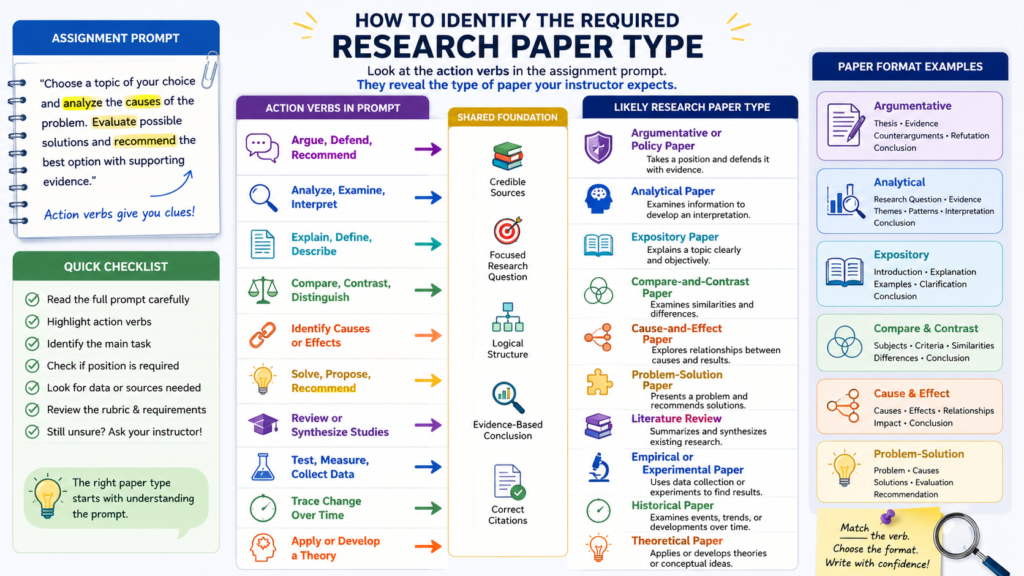
Start by examining the assignment prompt.
Look for instructional verbs.
| Assignment verb | Likely paper type |
| Argue, defend, persuade, recommend | Argumentative |
| Analyze, examine, interpret, evaluate | Analytical |
| Explain, describe, define, summarize | Expository |
| Compare, contrast, distinguish | Comparative |
| Identify causes, examine effects | Cause-and-effect |
| Propose, solve, recommend | Problem-solution |
| Review the scholarship, synthesize studies | Literature review |
| Test, measure, investigate, collect data | Empirical or experimental |
| Trace, examine development over time | Historical |
| Apply a theory, develop a model | Theoretical or conceptual |
| Evaluate a method, propose a procedure | Methodological |
| Study one organization, event, group, or situation | Case study |
Do not rely only on the paper’s title.
A project called “Social Media and College Students” could become:
- An argumentative paper about campus phone policies
- An analytical paper about attention and study habits
- A literature review about social media and mental health
- A survey paper about student usage patterns
- A case study of one university’s digital-wellness program
Read the complete prompt, rubric, and required sections before selecting a structure.
1. Argumentative Research Paper
An argumentative research paper takes a clear position on a debatable issue and uses research to show why that position is reasonable.
The goal is not to become aggressive or dismiss opposing views. The writer should investigate the issue, evaluate evidence, acknowledge credible objections, and defend a qualified claim.
Purdue OWL explains that argumentative writing requires students to investigate a topic, collect and evaluate evidence, and establish a position concisely.
Main Features
An argumentative research paper usually includes:
- A debatable research question
- A clear thesis
- Several supporting claims
- Credible evidence
- Explanation of how the evidence supports the thesis
- Counterarguments
- Responses to opposing evidence
- A conclusion or recommendation
Example Research Question
Should public colleges require first-year students to complete a financial-literacy course?
Example Thesis
Public colleges should include a financial-literacy course in first-year programs because it can help students understand borrowing, create realistic budgets, and evaluate long-term financial decisions.
Basic Structure
I. Introduction
Background, problem, research question, and thesis
II. First Supporting Claim
Evidence and explanation
III. Second Supporting Claim
Evidence and explanation
IV. Third Supporting Claim
Evidence and explanation
V. Counterargument
Opposing evidence and valid concerns
VI. Response
Refutation, qualification, or compromise
VII. Conclusion
Final position and significance
Best Sources
Useful sources may include:
- Peer-reviewed studies
- Government reports
- Policy documents
- Reliable statistics
- Expert analysis
- Case studies
- Credible opposing research
Common Mistake
Students sometimes choose a topic that is factual rather than debatable. Students who still need a defensible issue can explore these argumentative research paper topics and choose a question with credible evidence on more than one side.
Weak topic:
The history of online education
Debatable topic:
Should universities offer students the option to complete most general education requirements online?
2. Analytical Research Paper
An analytical research paper begins with a focused question and examines evidence to reach an interpretation.
The writer does not need to decide the answer before researching. Instead, the conclusion should develop from patterns, comparisons, contradictions, and limitations in the evidence.
Main Features
An analytical paper usually:
- Begins with a research question
- Examines multiple perspectives
- Breaks the subject into parts
- Compares evidence
- Identifies patterns or relationships
- Avoids oversimplified conclusions
- Develops an interpretation
Example Research Question
How does late-night social media use affect the study routines of first-year college students?
Possible Conclusion
The research may show that the effect depends on notification settings, total screen time, course schedules, personal habits, and the purpose of social media use.
The conclusion is more nuanced than:
Social media is bad.
Basic Structure
I. Introduction
Topic, problem, scope, and research question
II. Background
Important terms and existing context
III. First Theme or Factor
Evidence from several sources
IV. Second Theme or Factor
Evidence from several sources
V. Third Theme or Factor
Evidence from several sources
VI. Discussion
Patterns, disagreements, and limitations
VII. Conclusion
Answer to the research question
Common Mistake
Students may accidentally turn an analytical paper into a series of source summaries.
Weak structure:
- Summary of Article A
- Summary of Article B
- Summary of Article C
Stronger structure:
- Effects on sleep, using Articles A and C
- Effects on concentration, using Articles B and D
- Differences among student groups, using Articles A, C, and E
Organize the paper around ideas rather than sources.
3. Expository Research Paper
An expository research paper explains a topic clearly and objectively.
Its purpose is usually to inform rather than persuade.
Purdue OWL describes expository writing as a genre that investigates an idea, evaluates evidence, and explains the subject clearly.
Main Features
An expository paper may:
- Define a concept
- Explain a process
- Describe how a system works
- Present important categories
- Summarize current knowledge
- Clarify a difficult subject
- Use examples and evidence
Example Topics
- How credit scores are calculated
- How vaccines produce an immune response
- How the Electoral College operates
- How online learning platforms track student progress
- How coastal erosion changes shorelines
Basic Structure
I. Introduction
Definition, context, and controlling idea
II. First Part of the Explanation
III. Second Part of the Explanation
IV. Third Part of the Explanation
V. Examples or Applications
VI. Conclusion
Thesis Example
A credit score is calculated from several parts of a borrower’s credit history, including payment behavior, debt levels, account age, credit mix, and recent applications.
This thesis previews an explanation rather than defending a controversial position.
Common Mistake
A student may present information without organizing it around a central idea.
An expository paper still needs a focused thesis and logical progression. It should not read like disconnected encyclopedia entries.
4. Compare-and-Contrast Research Paper
A compare-and-contrast research paper evaluates two or more subjects using shared criteria.
The writer may compare:
- Policies
- Historical periods
- Theories
- Educational methods
- Technologies
- Literary works
- Healthcare systems
- Business strategies
Example Research Question
How do synchronous and asynchronous online courses differ in flexibility, student interaction, and instructor feedback?
Main Features
A strong comparison paper:
- Defines the subjects clearly
- Uses the same criteria for each subject
- Explains meaningful similarities
- Explains meaningful differences
- Evaluates why those differences matter
- Reaches a comparative conclusion
Point-by-Point Structure
I. Introduction
II. Flexibility
A. Synchronous courses
B. Asynchronous courses
C. Comparison
III. Interaction
A. Synchronous courses
B. Asynchronous courses
C. Comparison
IV. Feedback
A. Synchronous courses
B. Asynchronous courses
C. Comparison
V. Conclusion
Block Structure
I. Introduction
II. Synchronous Courses
A. Flexibility
B. Interaction
C. Feedback
III. Asynchronous Courses
A. Flexibility
B. Interaction
C. Feedback
IV. Direct Comparison
V. Conclusion
The point-by-point structure is often clearer for longer academic comparisons because readers can evaluate both subjects under each criterion.
Common Mistake
Students sometimes compare unrelated features.
Weak comparison:
- Cost of Program A
- Teaching style of Program B
Both subjects should be evaluated using the same standards.
5. Cause-and-Effect Research Paper
A cause-and-effect research paper investigates why something happens, what results from it, or both.
Possible Purposes
The paper may examine:
- One cause with several effects
- Several causes of one outcome
- A chain of causes and effects
- Immediate and long-term effects
- Direct and indirect causes
- Contributing factors rather than one simple cause
Example Research Question
What factors contribute to college students delaying major writing assignments?
Possible Sections
- Unclear instructions
- Low confidence
- Competing deadlines
- Perfectionism
- Digital distractions
- Poor time estimates
- Consequences for sleep and performance
Basic Structure
I. Introduction
Research problem and thesis
II. Background
III. First Cause or Effect
IV. Second Cause or Effect
V. Third Cause or Effect
VI. Interaction Between Factors
VII. Conclusion
Important Caution
Correlation does not automatically prove causation.
When two variables appear together, additional evidence is needed before claiming that one directly caused the other.
Use careful wording such as:
- Is associated with
- May contribute to
- Is linked with
- Appears to influence
- May partly explain
Avoid claiming certainty when the evidence supports only a relationship.
6. Problem-Solution Research Paper
A problem-solution paper defines a meaningful problem, investigates its causes, evaluates possible responses, and recommends one or more solutions.
Example Research Question
How can community colleges improve textbook access for students during the first week of class?
Main Features
A strong problem-solution paper explains:
- What the problem is
- Who is affected
- Why the problem matters
- What causes or maintains it
- What solutions already exist
- What each solution costs
- What limitations each option has
- Which response is most practical
Basic Structure
I. Introduction
II. Definition and Scope of the Problem
III. Causes or Contributing Factors
IV. Existing Responses
V. Evaluation Criteria
VI. Recommended Solution
VII. Limitations and Implementation
VIII. Conclusion
Useful Evaluation Criteria
Possible solutions may be compared according to:
- Cost
- Effectiveness
- Fairness
- Feasibility
- Time required
- Public acceptance
- Long-term sustainability
- Unintended consequences
Common Mistake
Students often recommend a solution before proving that it addresses the actual cause.
For example, a time-management workshop may not solve missed assignments if the main problem is unreliable internet access.
The recommendation must match the evidence.
7. Literature Review
A literature review examines and synthesizes existing scholarship on a focused topic.
It does not simply describe one article after another.
The writer identifies:
- Major themes
- Areas of agreement
- Areas of disagreement
- Common methods
- Important theories
- Research limitations
- Gaps in current knowledge
- Directions for future study
USC’s research guide explains that literature reviews focus on a specific research problem and examine how existing scholarship has addressed it. When one academic database does not provide enough relevant studies, these Google Scholar alternatives for students can help you search subject-specific databases, open-access journals, government research, and scholarly repositories.
Example Research Question
What does current research show about the relationship between remote learning and student engagement in undergraduate courses?
Basic Structure
I. Introduction
Topic, scope, and organization
II. Search or Selection Approach
When required
III. Theme One
IV. Theme Two
V. Theme Three
VI. Methodological Differences
VII. Research Gaps
VIII. Conclusion
Ways to Organize a Literature Review
Thematically
Group studies by recurring idea.
Example:
- Flexibility
- Interaction
- Motivation
- Technology access
Chronologically
Show how research changed over time.
Methodologically
Compare studies using:
- Surveys
- Interviews
- Experiments
- Observations
- Administrative data
Theoretically
Organize research according to competing models or theories.
Common Mistake
Weak literature review:
Smith studied engagement. Jones studied engagement. Lee also studied engagement.
Stronger synthesis:
Survey-based studies often report lower participation in asynchronous discussions, while interview studies show that some students value the additional time available to formulate responses.
The stronger version explains a pattern across studies.
8. Experimental Research Paper
An experimental research paper reports a controlled investigation designed to test a hypothesis.
This format is common in:
- Biology
- Chemistry
- Psychology
- Education
- Medicine
- Engineering
- Environmental science
Main Features
An experimental paper usually includes:
- Research question
- Hypothesis
- Variables
- Participants or materials
- Procedure
- Data analysis
- Results
- Interpretation
- Limitations
Common Structure: IMRaD
Introduction
What problem was investigated and why?
Methods
How was the study conducted?
Results
What did the data show?
Discussion
What do the results mean?
The methodology section should explain how data were collected or generated and how they were analyzed so that readers can evaluate the study’s reliability.
Example Research Question
Does studying with phone notifications disabled improve quiz performance among first-year students?
Possible Variables
Independent variable: Notification condition
Dependent variable: Quiz performance
Control variables: Study duration, material difficulty, and testing conditions
Common Mistake
Students sometimes mix results and interpretation.
Results:
The notification-disabled group scored an average of 8.4 out of 10.
Discussion:
This difference may indicate that reducing interruptions improves short-term concentration.
Report what happened before explaining what it means.
9. Empirical Research Paper
An empirical research paper presents findings based on observed or measured evidence.
An experiment is one form of empirical research, but empirical studies can also use:
- Surveys
- Interviews
- Observations
- Existing datasets
- Field research
- Content analysis
- Focus groups
- Archival records
Quantitative Empirical Research
Quantitative studies use numerical data.
Examples:
- Test scores
- Survey ratings
- Attendance records
- Response times
- Enrollment statistics
- Frequency counts
Qualitative Empirical Research
Qualitative studies examine experiences, meanings, language, or behavior.
Examples:
- Interviews
- Open-ended responses
- Classroom observations
- Diary entries
- Focus-group discussions
- Document analysis
Mixed-Methods Research
Mixed-methods studies combine quantitative and qualitative evidence.
Example:
A researcher may analyze course-completion rates and interview students about why they withdrew.
Basic Structure
I. Introduction
II. Literature Review
III. Research Questions or Hypotheses
IV. Methods
V. Results or Findings
VI. Discussion
VII. Limitations
VIII. Conclusion
10. Survey Research Paper
A survey research paper collects information from a selected group through questionnaires or structured responses.
It can examine:
- Attitudes
- Experiences
- Preferences
- Behaviors
- Self-reported knowledge
- Satisfaction
- Beliefs
Example Research Question
What study-planning methods do first-year online students report using most frequently?
Important Elements
A survey paper should explain:
- Who participated
- How participants were selected
- How many responses were collected
- How questions were designed
- Whether responses were anonymous
- How data were analyzed
- What limitations affect interpretation
Common Mistakes
Leading Questions
Weak:
How much has our excellent tutoring program improved your grades?
Neutral:
How, if at all, has tutoring affected your academic performance?
Overgeneralization
If 80 students from one college respond, the results should not automatically be presented as the opinion of all college students.
Treating Self-Reports as Objective Measurements
A student’s reported study time may differ from the actual number of minutes studied.
Survey research remains useful, but its limits should be stated clearly.
11. Case Study Research Paper
A case study investigates one bounded example in depth.
The case may be:
- One person
- One classroom
- One school
- One company
- One program
- One policy
- One event
- One community
- One legal dispute
- One organizational change
Example Research Question
How did one community college implement a first-day digital-textbook program?
Possible Evidence
- Interviews
- Internal reports
- Policy documents
- Enrollment data
- Observations
- Emails or announcements
- Student surveys
- Budget records
- Media coverage
Basic Structure
I. Introduction
II. Background of the Case
III. Research Problem
IV. Evidence and Methods
V. Findings
VI. Analysis
VII. Limitations
VIII. Lessons or Implications
Strength
A case study can provide detailed context that broad statistical studies may miss.
Limitation
Findings from one case may not apply automatically to every institution or population.
The writer should explain what may be transferable and what is unique to the selected case.
12. Historical Research Paper
A historical research paper investigates past events, decisions, movements, institutions, or changes over time.
It may ask:
- What happened?
- Why did it happen?
- How did people at the time understand it?
- Which forces shaped the outcome?
- How have later historians interpreted it?
- What changed and what remained consistent?
Evidence
Historical research may use primary sources such as:
- Letters
- Diaries
- Speeches
- Government records
- Photographs
- Newspapers from the period
- Meeting minutes
- Court documents
- Maps
- Interviews
- Artifacts
Primary sources are direct records connected to the subject or period being studied, although whether a source is primary depends on how it is used.
Secondary sources include later scholarly interpretations.
Example Research Question
How did public attitudes toward distance education change between the 1990s and the COVID-19 pandemic?
Basic Structure
The paper may be:
- Chronological
- Thematic
- Cause-and-effect
- Comparative
- Biographical
- Focused on a turning point
Common Mistake
A historical paper should do more than list events by date.
The writer must interpret significance, relationships, and competing explanations.
13. Interpretive Research Paper
An interpretive research paper develops an evidence-based interpretation of a text, image, speech, film, cultural practice, or historical document.
It is common in:
- Literature
- Film studies
- Art history
- Cultural studies
- Philosophy
- Religious studies
- Communication
Example Research Question
How does the use of isolation in Frankenstein shape the novel’s treatment of responsibility?
Possible Evidence
- Language
- Imagery
- Structure
- Symbols
- Characterization
- Narrative perspective
- Historical context
- Relevant critical scholarship
Basic Structure
I. Introduction and Interpretive Thesis
II. First Pattern or Feature
III. Second Pattern or Feature
IV. Third Pattern or Feature
V. Alternative Interpretation
VI. Conclusion
Common Mistake
An interpretation should not be based only on personal reaction.
Weak:
I think the character is lonely.
Stronger:
Repeated descriptions of physical distance, interrupted communication, and concealed identity frame loneliness as a consequence of rejected responsibility.
The second claim can be tested against evidence.
14. Theoretical or Conceptual Research Paper
A theoretical paper examines, applies, compares, critiques, or develops theories and concepts.
It may not involve new data collection.
A theoretical framework provides the concepts through which a research problem is understood and analyzed.
Possible Purposes
A theoretical paper may:
- Apply a theory to a new problem
- Compare two theories
- Identify weaknesses in an existing model
- Develop a conceptual framework
- Clarify an academic concept
- Propose relationships between concepts
- Integrate ideas from several fields
Example Research Question
How can self-determination theory explain motivation differences between optional and required online discussion activities?
Basic Structure
I. Introduction
II. Definition of the Problem
III. Explanation of the Theory
IV. Application to the Problem
V. Competing Theory or Limitation
VI. Proposed Framework
VII. Implications
VIII. Conclusion
Common Mistake
Students may describe a theory without using it.
A theoretical paper should show what the theory helps explain, predict, question, or reinterpret.
15. Concept Analysis Paper
A concept analysis paper examines the meaning, characteristics, uses, boundaries, and implications of a concept.
Common subjects include:
- Resilience
- Burnout
- Equity
- Engagement
- Motivation
- Leadership
- Privacy
- Well-being
Possible Questions
- How is the concept defined across disciplines?
- Which features are essential?
- Which related concepts are different?
- How has the meaning changed?
- How can the concept be measured?
- What misunderstandings surround it?
Basic Structure
I. Introduction
II. Definitions
III. Historical Development
IV. Essential Characteristics
V. Related and Contrasting Concepts
VI. Applications
VII. Measurement Challenges
VIII. Conclusion
16. Methodological Research Paper
A methodological paper studies the methods used to conduct research.
It may:
- Introduce a new method
- Improve an existing procedure
- Compare research tools
- Test a measurement instrument
- Evaluate reliability or validity
- Explain a data-analysis technique
- Identify weaknesses in common research practices
Example Research Question
Which method provides a more reliable measure of college students’ daily screen time: self-reported estimates or device-generated records?
Basic Structure
I. Research Problem
II. Existing Methods
III. Proposed or Selected Method
IV. Evaluation Criteria
V. Testing Process
VI. Results
VII. Strengths and Limitations
VIII. Recommendations
Common Mistake
A methods paper should not simply describe how the student completed an assignment.
It must explain why the method matters and how it affects the quality of the research.
17. Systematic Review
A systematic review answers a focused question by using a planned and transparent process to search for, select, evaluate, and synthesize existing studies.
It is more structured than a traditional literature review.
Main Features
A systematic review usually includes:
- A focused research question
- Search databases
- Search terms
- Inclusion criteria
- Exclusion criteria
- Screening process
- Quality assessment
- Evidence synthesis
- Limitations
Example Research Question
Among undergraduate students, what is the relationship between smartphone-restriction interventions and classroom attention?
Difference From a Traditional Literature Review
A traditional literature review may select and discuss important scholarship without documenting every search decision.
A systematic review attempts to make the selection process explicit and reproducible.
Students should not label an assignment a systematic review unless they have followed the required systematic procedure.
18. Meta-Analysis
A meta-analysis statistically combines results from multiple compatible quantitative studies.
It may estimate an overall effect that is difficult to see from one study alone.
Possible Elements
- Study-selection criteria
- Effect-size calculation
- Statistical model
- Study weighting
- Heterogeneity analysis
- Publication-bias assessment
- Sensitivity analysis
Difference From a Systematic Review
A systematic review may summarize evidence narratively.
A meta-analysis uses statistical techniques to combine study findings.
A project can be:
- A systematic review without meta-analysis
- A meta-analysis conducted within a systematic review
- A review that includes both narrative and statistical synthesis
Meta-analysis usually requires advanced statistical knowledge and may not be appropriate for a standard undergraduate paper.
19. Position Paper
A position paper presents a clear stance on an issue and supports it with research.
It resembles an argumentative paper but is often written for:
- Policy discussions
- Professional organizations
- Academic conferences
- Model United Nations
- Public debates
- Institutional decision-making
Main Features
- Clear position
- Background
- Supporting evidence
- Response to objections
- Proposed action
- Practical recommendations
Example
Universities should establish transparent rules for the use of generative tools in coursework rather than relying on course-by-course assumptions.
A position paper is usually more direct and recommendation-focused than a broad analytical research paper.
20. Policy Research Paper
A policy paper investigates a public or institutional problem and recommends a course of action.
Common Sections
Executive Summary
Problem Definition
Background
Stakeholders
Policy Options
Evaluation Criteria
Recommended Policy
Implementation
Risks and Limitations
Policy writing should consider not only which option appears ideal but also which option can realistically be implemented.
Possible Criteria
- Effectiveness
- Cost
- Legality
- Fairness
- Administrative feasibility
- Political feasibility
- Public acceptance
- Long-term consequences
How Are Research Paper Types Different From Research Methods?
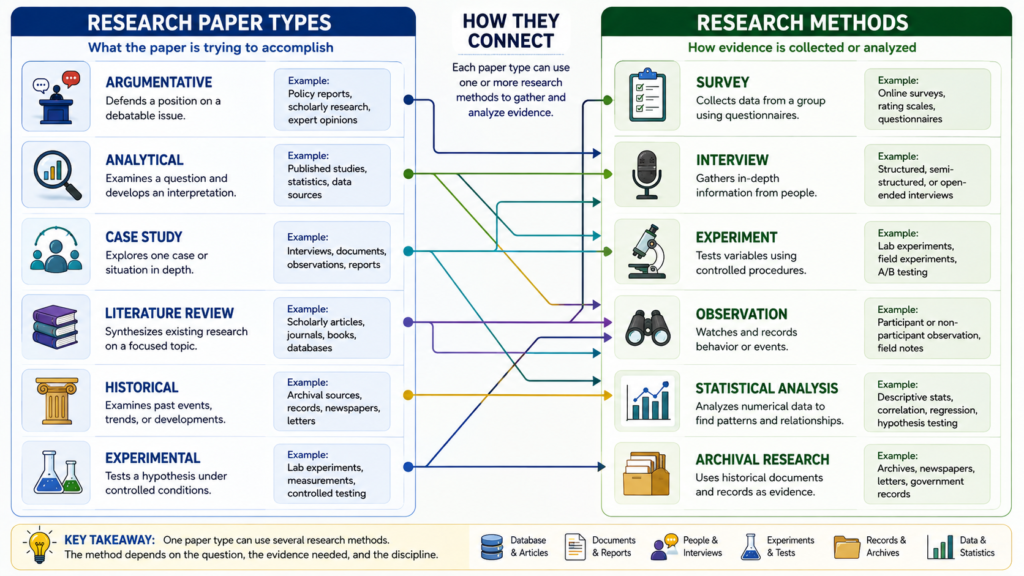
A research paper type describes the paper’s purpose and form.
A research method describes how evidence is collected or analyzed.
For example, an analytical research paper may use:
- Interviews
- Survey data
- Published studies
- Historical documents
- Statistical analysis
An argumentative paper may rely entirely on existing sources or may include original survey findings.
A case study may use qualitative, quantitative, or mixed methods.
Do not confuse these categories:
| Paper type | Research method |
| Argumentative | Literature research, interviews, policy analysis |
| Analytical | Statistical analysis, synthesis, textual analysis |
| Case study | Interviews, observations, document review |
| Experimental | Controlled testing |
| Historical | Archival research |
| Literature review | Database searching and synthesis |
| Survey paper | Questionnaire data |
| Interpretive | Close reading and contextual analysis |
Primary vs. Secondary Research Papers
Another useful distinction is whether the paper presents primary or secondary research.
Primary Research
Primary research involves original evidence collected or examined directly by the writer.
Examples:
- Surveys
- Interviews
- Experiments
- Observations
- Focus groups
- Original dataset analysis
- Archival document analysis
Secondary Research
Secondary research analyzes evidence that has already been published or collected by others.
Examples:
- Scholarly articles
- Books
- Government reports
- Existing datasets
- Literature reviews
- Historical analyses
A paper may combine both.
For example, a student may review existing research and conduct ten interviews to explore how local students experience online classes.
Qualitative vs. Quantitative Research Papers
Research papers may also be categorized by the type of data they use.
Qualitative Research Paper
Qualitative research examines meaning, experience, interpretation, and context.
Common evidence:
- Interviews
- Open-ended responses
- Observations
- Documents
- Images
- Conversations
- Field notes
The findings may be organized into themes or recurring patterns.
Quantitative Research Paper
Quantitative research examines numerical relationships or measurable differences.
Common evidence:
- Scores
- Counts
- Percentages
- Ratings
- Frequencies
- Statistical relationships
- Experimental outcomes
Mixed-Methods Paper
A mixed-methods paper uses both.
Example:
A student could analyze survey ratings about homework stress and interview selected participants to understand why certain assignments felt overwhelming.
How Do You Choose the Right Type of Research Paper?
Use this five-step process.
Step 1: Identify the Assignment Verb
Does the prompt ask you to:
- Argue?
- Analyze?
- Explain?
- Compare?
- Evaluate?
- Review?
- Test?
- Recommend?
- Interpret?
The verb is one of the strongest clues. Students who understand the assignment type but have not selected a subject can review these good research paper topics to find a focused, researchable idea that fits the required format.
Step 2: Determine Whether You Need a Position
Ask:
Must I defend a claim, or can the conclusion emerge from the research?
A required position suggests an argumentative or policy paper.
An open investigation suggests an analytical paper.
Step 3: Confirm Whether Original Data Are Required
Look for instructions involving:
- Participants
- Surveys
- Experiments
- Interviews
- Observations
- Datasets
- Methods
- Results
These indicate empirical research.
Step 4: Identify the Required Sources
The assignment may require:
- Peer-reviewed studies
- Primary historical sources
- Government reports
- Literary texts
- Statistical datasets
- Policy documents
- Interviews
The source requirements often reveal the expected type.
Step 5: Check the Required Sections
Required headings provide major clues.
Methods, Results, and Discussion
Likely an empirical or experimental paper.
Themes, Research Gaps, and Future Research
Likely a literature review.
Policy Options and Recommendation
Likely a policy paper.
Counterargument and Rebuttal
Likely an argumentative paper.
Historical Context and Primary Sources
Likely a historical paper.
Can a Research Paper Combine Several Types?
Yes.
Many strong papers are hybrids.
A policy paper may:
- Explain the problem.
- Analyze its causes.
- Compare possible solutions.
- Argue for one recommendation.
A historical paper may compare two periods and defend an interpretation.
A literature review may identify a problem and propose a theoretical model.
A case study may combine survey data, interviews, and document analysis.
When an assignment combines types, decide which purpose is primary.
Ask:
What must the paper ultimately accomplish?
The main purpose should guide the thesis and structure. Other elements support it.
Research Paper Type Examples Using One Topic
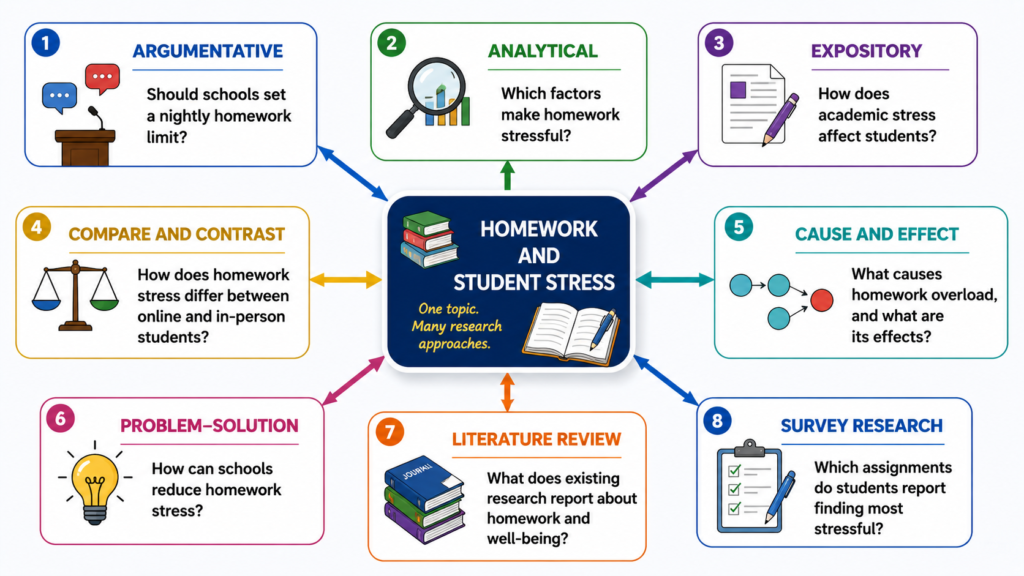
Consider the broad topic:
Homework and student stress.
The guide explaining how homework causes stress provides useful background on workload, deadlines, sleep, motivation, and academic pressure that could support several of these research-paper approaches.
Here is how it changes across paper types.
Argumentative
Should high schools establish a maximum nightly homework limit?
Analytical
Which factors make homework stressful for high school students?
Expository
How does academic stress affect students’ sleep and concentration?
Compare-and-Contrast
How does homework stress differ between online and in-person students?
Cause-and-Effect
What causes students to experience homework overload, and how does it affect sleep?
Problem-Solution
How can schools reduce homework-related stress without removing meaningful practice?
Literature Review
What does existing research report about homework volume and adolescent well-being?
Survey Research
How many hours do students report spending on homework, and which assignments cause the most stress?
Case Study
How did one high school’s no-homework-weekend policy affect student experiences?
Historical
How have attitudes toward homework changed since the early twentieth century?
Theoretical
How can cognitive-load theory explain stress caused by complex homework assignments?
The subject remains the same, but each paper asks a different question.
Common Mistakes When Selecting a Research Paper Type
Ignoring the Assignment Verb
A student may write a general report when the prompt asks for evaluation and argument.
Choosing a Position Before Researching
A writer may search only for evidence supporting an initial opinion.
Begin with neutral search terms and examine competing evidence.
Confusing Summary With Analysis
Summary explains what a source says.
Analysis explains:
- Why it matters
- How it relates to other evidence
- What assumptions it makes
- What limitations it has
- How it supports the paper’s conclusion
Using a Type That Is Too Advanced
A student may call a paper a “systematic review” or “meta-analysis” without following the required methods.
Use accurate labels.
Collecting Data Without Permission
Research involving people may require instructor approval, institutional review, informed consent, or privacy protections.
Do not begin interviews, experiments, or surveys until you understand the course and institutional requirements.
Using the Wrong Structure
An experimental paper should not hide its methods. A literature review should not be organized as isolated article summaries. An argumentative paper should not ignore opposing evidence.
Treating the Type as a Rigid Formula
Research-paper categories guide your decisions, but disciplines use different conventions.
Always prioritize:
- Assignment instructions
- Instructor guidance
- Disciplinary standards
- General online templates
Research Paper Planning Template
Use this template before drafting.
Assignment
Course:
Due date:
Required length:
Citation style:
Minimum sources:
Required sections:
Paper Type
Primary type:
Secondary type, if any:
Research Focus
Broad topic:
Focused problem:
Research question:
Working thesis or purpose:
Evidence
Primary sources needed:
Secondary sources needed:
Original data required: Yes / No
Main databases:
Possible limitations:
Structure
Introduction:
Background:
Main section one:
Main section two:
Main section three:
Counterargument or limitation:
Conclusion:
Types of Research Papers Checklist
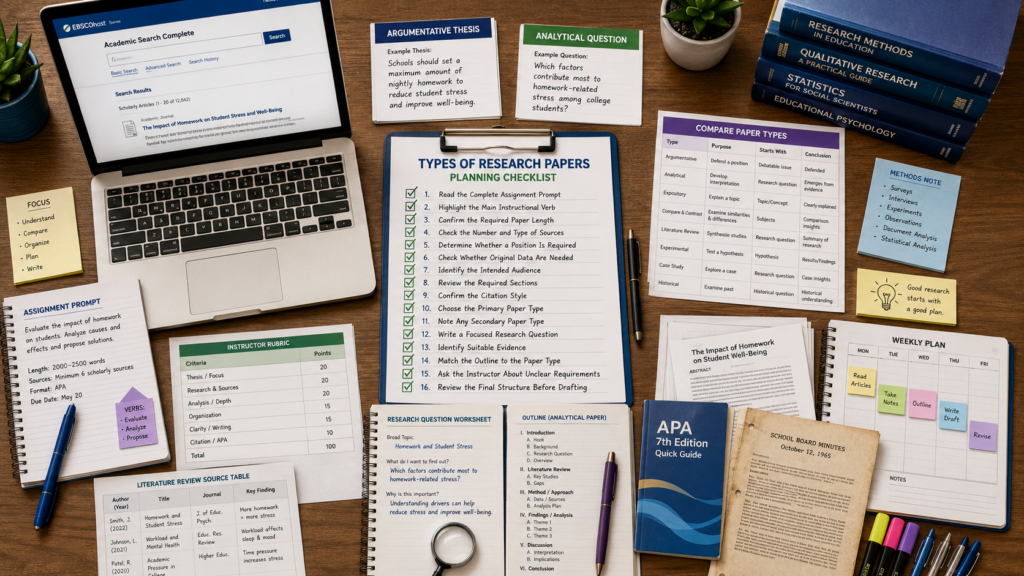
Understanding the Assignment
- I read the complete prompt.
- I identified the main instructional verb.
- I checked the required paper length.
- I confirmed the number and type of sources.
- I checked whether original data are required.
- I reviewed the rubric.
- I confirmed the required citation style.
Selecting the Paper Type
- I know whether the paper must argue or analyze.
- I know whether the assignment requires explanation or comparison.
- I know whether I need methods and results sections.
- I know whether the project is a literature review.
- I know whether primary sources are required.
- I selected a type that fits the research question.
- I asked the instructor when the expectations were unclear.
Planning the Research
- I wrote a focused research question.
- I identified the affected group, setting, or time period.
- I searched for credible academic evidence.
- I examined more than one perspective.
- I grouped evidence by theme.
- I identified gaps or limitations.
- I created an outline that matches the paper type.
Reviewing the Draft
- The introduction establishes the paper’s purpose.
- Every section contributes to the research question.
- Sources are analyzed rather than merely summarized.
- Claims are supported by evidence.
- Methods are explained when original research is included.
- Opposing evidence or limitations are addressed.
- The conclusion matches the paper’s purpose.
- All borrowed material is cited.
Frequently Asked Questions
What are the two main types of research papers?
The two broad types commonly introduced in writing courses are argumentative and analytical research papers. An argumentative paper defends a position, while an analytical paper investigates a question and develops an interpretation from the evidence.
What is the easiest type of research paper?
No type is automatically easiest. Expository papers may feel more manageable because they focus on explanation, but they still require a focused thesis, credible sources, and logical organization. The easiest type is usually the one that best matches the assignment and available evidence.
What is the most common research paper type in college?
Argumentative, analytical, expository, and literature-based papers are common across many college courses. Experimental, empirical, and case-study papers are more common in disciplines that require original investigation.
What is the difference between an argumentative and analytical paper?
An argumentative paper presents and defends a position on a debatable issue. An analytical paper begins with a question and evaluates evidence before reaching a conclusion.
Is a literature review a research paper?
Yes. A literature review is a research-based academic paper that examines and synthesizes existing scholarship. It does not normally collect new participant data, but it still requires a systematic search, evaluation, and interpretation of sources.
Is a research paper the same as an essay?
A research paper is a type of academic essay, but it places greater emphasis on research, evidence, source evaluation, and citation. A personal or reflective essay may rely mainly on the writer’s experience, whereas a research paper develops its claims through documented evidence.
Can a research paper be both analytical and argumentative?
Yes. A paper may first analyze evidence and then defend the conclusion that emerges. The writer should still identify the paper’s main purpose so the structure remains clear.
What type of research paper uses interviews?
Interviews may be used in qualitative, empirical, case-study, historical, mixed-methods, and other research papers. The method alone does not determine the paper type.
What type of research paper uses statistics?
Experimental, quantitative, survey, correlational, policy, analytical, and meta-analytic papers may all use statistics.
What type of paper compares existing studies?
A literature review compares and synthesizes existing studies. A systematic review uses a more formal and transparent search and selection process.
What type of research paper does not require an argument?
An expository paper may mainly explain a subject, and an analytical paper may begin without a predetermined position. However, both still need a central purpose and supported conclusion.
What is an empirical research paper?
An empirical research paper presents findings based on observed or measured evidence. It may use experiments, surveys, interviews, observations, fieldwork, or existing data.
What is the difference between qualitative and quantitative research?
Qualitative research investigates experiences, meanings, language, and context. Quantitative research investigates measurable variables using numerical data and statistical analysis.
How do I know which research paper format my professor wants?
Check the prompt for action verbs, required sources, section headings, and whether original data are expected. When the instructions remain unclear, ask the professor a specific question before researching.
Can I change my research paper type after starting?
Yes, provided the revised type still meets the assignment. Research may reveal that a topic works better as an analysis than an argument or that insufficient evidence exists for the original plan. Discuss major changes with the instructor when necessary.
Final Thoughts
Understanding the different types of research papers gives you a clearer starting point for the entire assignment.
An argumentative paper defends a position. An analytical paper investigates a question. An expository paper explains. A comparison paper evaluates subjects using shared criteria. A literature review synthesizes existing scholarship. An empirical paper reports observed or measured findings. A case study examines one example in depth, while a theoretical paper develops or applies concepts.
Before selecting a format, ask:
- What does the assignment require me to do?
- Must I defend a position or investigate an open question?
- Do I need to collect original data?
- Which sources are required?
- What sections does the instructor expect?
- What conclusion should the paper reach?
The correct research paper type is not simply a label added to the title. It determines how you ask the question, gather evidence, organize the paper and explain your conclusion.
When you understand that purpose before drafting, research becomes easier to manage, sources become easier to organize, and the final paper is more likely to meet the assignment rather than merely discuss the general topic. Students balancing research, weekly assignments, exams, and close deadlines may also explore online class help for support with course organization, study planning, and difficult online coursework.