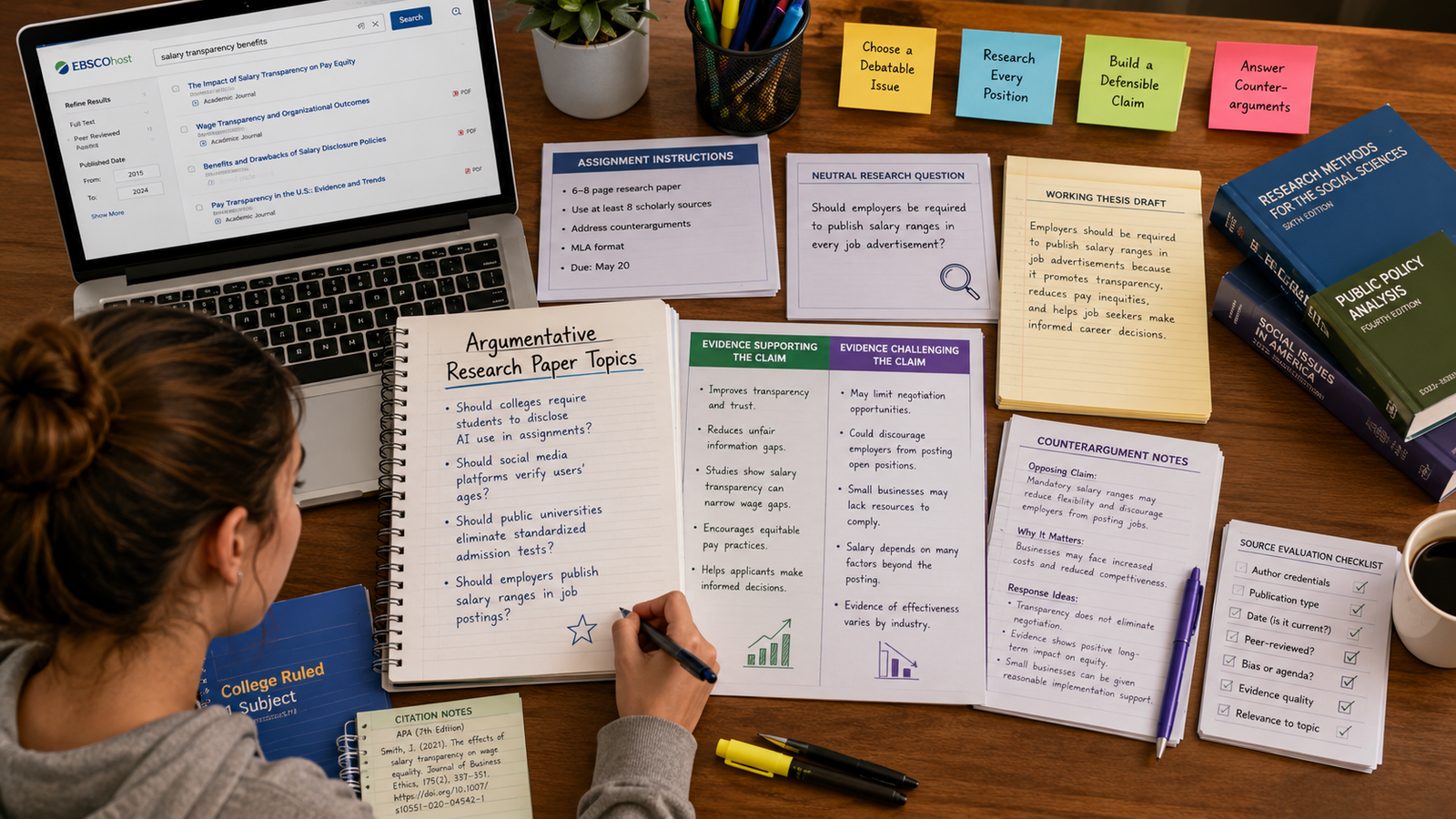
Choosing an argumentative research paper topic can feel harder than writing the paper itself. You may find a subject that interests you but later discover that it is too broad, has no meaningful opposing position, or cannot be supported with credible academic sources.
A successful argumentative paper needs more than a controversial question. It requires a focused issue, a defensible claim, reliable evidence, logical analysis, and a fair response to counterarguments.
The strongest argumentative research paper topics allow students to:
- Examine more than one reasonable position
- Evaluate evidence rather than repeat opinions
- Develop a specific and supportable thesis
- Address a clearly defined audience or problem
- Reach a conclusion after researching the issue
- Complete the argument within the assigned length
This guide provides topic ideas across education, artificial intelligence, technology, social media, psychology, healthcare, business, economics, environmental science, criminal justice, politics, law, and college life. It also explains how to narrow a broad subject, develop a research question, test source availability, and build an argument that can withstand serious objections.
Quick Answer: What Are Good Argumentative Research Paper Topics?
Good argumentative research paper topics involve issues on which informed people can reasonably disagree.
Examples include:
- Should colleges require students to disclose generative AI use?
- Should public universities eliminate standardized admission tests?
- Should employers publish salary ranges in every job advertisement?
- Should schools prohibit smartphones during instructional periods?
- Should social media platforms verify users’ ages?
- Should college athletes be classified as employees?
- Should companies adopt four-day workweeks?
- Should cash bail be eliminated?
- Should healthcare be treated as a legal right?
- Should governments restrict facial-recognition technology?
- Should public transportation be free for students?
- Should mental health days count as excused school absences?
- Should student loan interest be eliminated?
- Should colleges replace final exams with major projects?
- Should employers be allowed to monitor remote workers?
- Should governments prohibit single-use plastics?
- Should news organizations label AI-generated content?
- Should unpaid internships be prohibited?
- Should public colleges provide free textbooks?
- Should voting registration become automatic?
A strong topic should lead to a claim that requires evidence and explanation. It should not have an answer based entirely on preference or common agreement.
What Is an Argumentative Research Paper?
An argumentative research paper presents a defensible claim about a debatable issue and supports that claim with credible evidence. Before building your claim, review the main types of research papers to confirm that your instructor expects an argumentative format rather than an analytical, explanatory, experimental, or literature-review paper.
The paper normally includes:
- Background information
- A focused research question
- A clear thesis
- Supporting claims
- Evidence from reliable sources
- Analysis connecting evidence to claims
- Counterarguments
- Responses to opposing evidence
- A conclusion based on the research
An argumentative paper does not simply present two sides and stop. The writer evaluates the available evidence and explains why one conclusion, policy, interpretation, or solution is stronger.
Purdue OWL describes academic argument as a process in which the writer presents a thesis and supports it through reasoning and evidence. Counterarguments strengthen the paper when they are handled strategically rather than ignored.
Argumentative vs. Persuasive Research Papers
Argumentative and persuasive papers overlap, but their emphasis can differ.
| Argumentative research paper | Persuasive research paper |
| Focuses on evaluating competing claims | Focuses on convincing a target audience |
| Emphasizes logic, evidence, and reasoning | May use evidence alongside audience appeals |
| Requires fair treatment of opposing evidence | Often recommends a position or action |
| Builds a defensible conclusion | Seeks agreement or behavioral change |
In practice, many instructors use the terms interchangeably. Always follow the assignment prompt and grading rubric. Students whose assignment focuses more on convincing a specific audience can also explore these persuasive research paper topics and choose an issue connected to a clear action, policy, or recommendation.
What Makes an Argumentative Research Topic Strong?
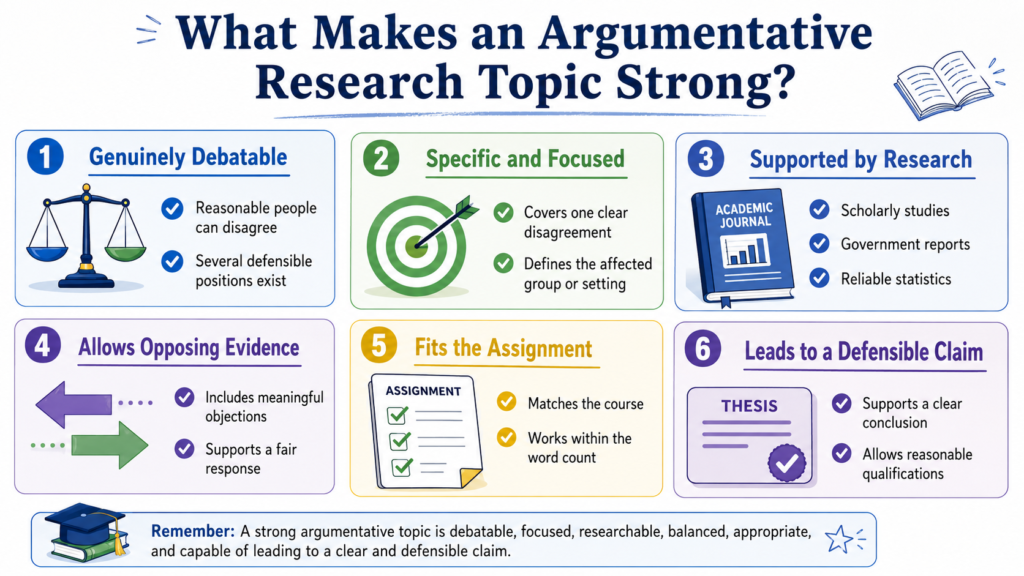
A strong topic must create a genuine opportunity for research and reasoning. Students who have not yet decided whether their assignment should be argumentative, analytical, or informative can first review these good research paper topics and shortlist ideas with enough credible evidence.
It Is Debatable
Reasonable people should be able to disagree after reviewing the evidence.
Weak topic:
Students need access to education.
Most readers already agree.
Stronger topic:
Should public community colleges provide tuition-free enrollment to all first-time students?
The second version raises questions about access, cost, completion, funding, and fairness.
It Is Focused
Broad subject:
Artificial intelligence
Focused topic:
Should colleges require students to disclose generative AI use in graded writing assignments?
The focused version identifies:
- The institution
- The technology
- The academic context
- The policy under debate
It Can Be Researched
A topic should have enough credible material to support both your position and the strongest opposing position.
Useful evidence may include:
- Peer-reviewed studies
- Academic books
- Government reports
- Court decisions
- Policy evaluations
- Professional associations
- Reliable statistics
- Primary documents
Academic databases can help students scan the existing debate, identify how researchers define the issue, and find related scholarship. Using alternative keywords and following citations from useful articles can also broaden the source pool.
It Allows More Than One Serious Position
Some issues have more than two possible answers.
For example:
Question: Should colleges regulate student AI use?
Possible positions:
- Prohibit AI use in graded work.
- Permit AI with full disclosure.
- Permit AI only for brainstorming and editing.
- Allow instructors to establish course-specific policies.
- Treat AI like calculators or reference tools.
Recognizing multiple positions can produce a more thoughtful argument than forcing every issue into a simple yes-or-no format.
It Fits the Assignment Length
A five-page paper cannot adequately analyze every consequence of climate change.
A narrower topic is more manageable:
Should Phoenix require reflective roofing on new commercial buildings to reduce urban heat?
The topic should be large enough to matter but limited enough to examine carefully.
It Leads to a Defensible Claim
Your final position should be specific enough to support and qualify.
Weak claim:
Technology is harmful.
Stronger claim:
Public high schools should prohibit nonacademic smartphone use during instructional periods because constant notifications interrupt attention, create enforcement problems, and reduce direct classroom participation.
How Do You Choose an Argumentative Research Paper Topic?
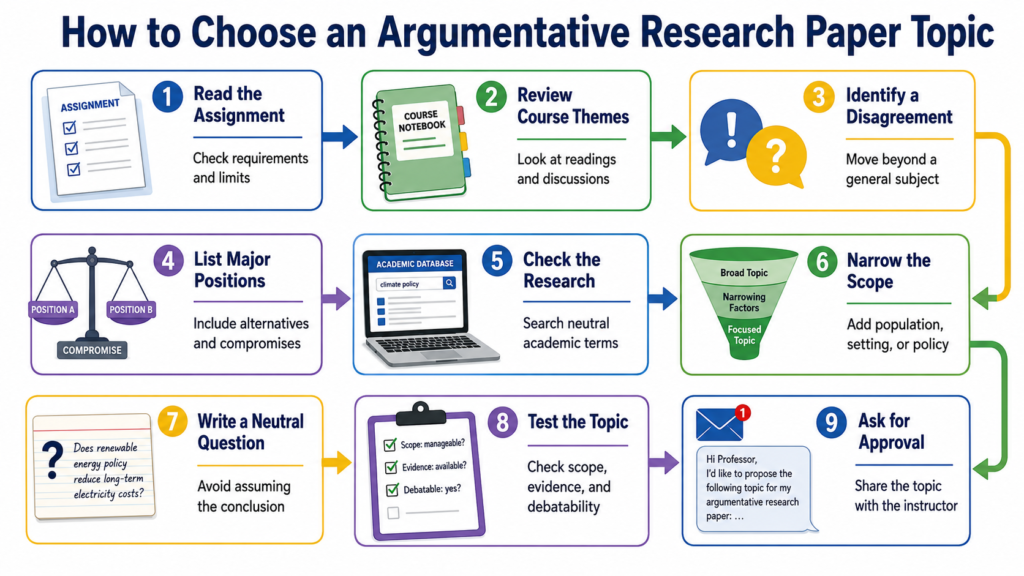
Use a step-by-step process instead of selecting the first controversial idea you see.
Step 1: Read the Assignment Prompt
Identify:
- Required subject
- Paper length
- Minimum sources
- Citation style
- Intended audience
- Whether a policy recommendation is required
- Whether first-person language is allowed
- Whether topics require approval
- Any prohibited subject areas
The assignment may require a position, an evaluation, a solution, or an interpretation. These are related but not identical tasks.
Step 2: Review Course Themes
Look through:
- Syllabus units
- Lecture notes
- Assigned readings
- Discussion prompts
- Previous assignments
- Current debates in the discipline
A course-related topic is more likely to meet your instructor’s expectations.
Step 3: Identify a Problem or Disagreement
Move beyond a general subject.
General subject:
Online education
Problem:
Some online courses provide limited opportunities for direct interaction.
Argumentative question:
Should fully online introductory courses be required to include weekly live support sessions?
Step 4: List the Main Positions
Do not choose your thesis immediately.
Write down:
- Arguments supporting the change
- Arguments opposing the change
- Alternative policies
- Groups affected
- Possible costs
- Possible benefits
- Ethical concerns
- Implementation challenges
This reduces the risk of building the paper around your first reaction.
Step 5: Check Available Research
Search neutral terms rather than wording designed to confirm your opinion.
Biased search:
Why school uniforms are effective
Neutral searches:
- school uniform academic outcomes
- school uniforms student behavior
- school uniform policy costs
- student views school uniforms
- school uniform systematic review
Step 6: Narrow the Scope
Add:
- Population
- Institution
- Industry
- Setting
- Location
- Policy
- Time period
- Outcome
Broad:
Employee monitoring
Focused:
Should large employers be allowed to use screen-monitoring software for remote hourly workers?
Step 7: Write a Working Research Question
The wording should not assume the answer.
Biased:
Why should harmful remote-proctoring software be banned?
Neutral:
Should colleges continue using remote-proctoring software for online exams?
Step 8: Test the Topic
Ask:
- Is it debatable?
- Can I find credible sources?
- Can I research the opposing view?
- Is the issue manageable?
- Can I explain why it matters?
- Can I develop a qualified claim?
- Does it fit the assignment?
Step 9: Ask for Instructor Approval
When required, share:
- Working topic
- Research question
- Possible position
- Course connection
- Several preliminary sources
Education Argumentative Research Paper Topics
- Should public community colleges provide tuition-free enrollment?
- Should standardized tests remain part of college admissions?
- Should financial literacy be required for high school graduation?
- Should public schools prohibit smartphones during class?
- Should colleges require attendance in introductory courses?
- Should students be allowed to revise major assignments for higher grades?
- Should schools adopt four-day instructional weeks?
- Should homework be limited in elementary education?
- Should public schools require student uniforms?
- Should colleges replace commercial textbooks with open educational resources?
- Should high schools begin later in the morning?
- Should class participation affect final grades?
- Should colleges require internships before graduation?
- Should public universities eliminate legacy admissions?
- Should teachers deduct points for late work?
- Should students be allowed to record college lectures?
- Should college applicants be required to submit standardized test scores?
- Should schools replace letter grades with mastery-based assessment?
- Should high schools require community service?
- Should universities guarantee academic advising appointments?
- Should students receive individual grades for group projects?
- Should final exams be replaced with capstone projects?
- Should public schools provide free breakfast and lunch to all students?
- Should colleges require first-year study-skills courses?
- Should classroom participation be optional for students with documented anxiety?
Focused Education Example
Too broad:
Technology in schools
Focused question:
Should public high schools require students to store personal smartphones during instructional periods?
Possible evidence areas:
- Student attention
- Emergency communication
- Classroom discipline
- Academic performance
- Enforcement costs
- Accessibility needs
Artificial Intelligence Argumentative Research Paper Topics
- Should students disclose all generative AI use in academic work?
- Should colleges permit AI tools for brainstorming?
- Should AI-generated writing be prohibited in first-year composition courses?
- Should teachers use AI to grade essays?
- Should employers be permitted to use AI in applicant screening?
- Should AI-generated political advertisements carry permanent labels?
- Should creators be compensated when their work trains AI systems?
- Should healthcare providers use AI for preliminary diagnosis?
- Should courts use algorithmic risk assessments?
- Should companies disclose when customer support is automated?
- Should AI-generated art receive copyright protection?
- Should police departments use predictive algorithms?
- Should AI systems be allowed to make lending decisions?
- Should universities provide approved AI platforms for students?
- Should schools teach AI literacy as a required subject?
- Should businesses be legally responsible for harmful chatbot advice?
- Should AI tools be restricted in mental health support?
- Should companies audit automated systems for bias?
- Should AI-generated music qualify for creative awards?
- Should employees receive notice when AI evaluates their performance?
- Should high-risk AI systems require government licensing?
- Should AI companies disclose their training-data sources?
- Should AI-generated news articles require human review?
- Should students be allowed to use AI for language editing?
- Should universities use AI-detection software in academic misconduct cases?
Better AI Topic Framing
Weak:
Is AI good or bad?
Stronger:
Should colleges allow generative AI for brainstorming while prohibiting undisclosed AI-generated final submissions?
The stronger question identifies a specific use, context, and possible policy.
Technology Argumentative Research Paper Topics
- Should governments prohibit facial recognition in public places?
- Should consumers have a legal right to repair electronic devices?
- Should social platforms verify the ages of users?
- Should police require warrants to access location data?
- Should employers monitor remote employees?
- Should internet access be treated as a public utility?
- Should governments regulate addictive application features?
- Should companies report major data breaches immediately?
- Should children under 13 be prohibited from owning smartphones?
- Should governments regulate deepfake technology?
- Should remote-proctoring software be allowed in higher education?
- Should app stores be liable for fraudulent applications?
- Should remote employers reimburse workers for internet expenses?
- Should public libraries provide mobile hotspot lending?
- Should digital subscriptions require one-click cancellation?
- Should companies be prohibited from selling precise location data?
- Should autonomous vehicles prioritize passengers or pedestrians?
- Should social applications include automatic time limits?
- Should public Wi-Fi providers collect user data?
- Should manufacturers provide longer software support?
- Should companies be required to offer human review of automated decisions?
- Should schools provide a device to every student?
- Should biometric authentication replace passwords?
- Should smart-home manufacturers be liable for security failures?
- Should online platforms be required to provide ad-free subscription options?
Social Media Argumentative Research Paper Topics
- Should social platforms verify every user’s age?
- Should social media companies remove false health information?
- Should influencers be legally responsible for deceptive claims?
- Should political advertisements be prohibited on social platforms?
- Should teenagers have daily social media limits?
- Should schools require social media literacy courses?
- Should beauty filters carry visible warnings?
- Should anonymous social media accounts be restricted?
- Should platforms explain why content is recommended?
- Should chronological feeds be the default?
- Should parents have access to teenagers’ private accounts?
- Should public officials be permitted to block constituents?
- Should repeat misinformation offenders lose their accounts?
- Should influencer disclosures be more prominent?
- Should platforms prohibit targeted advertising to minors?
- Should colleges consider online conduct in disciplinary cases?
- Should users receive payment when platforms profit from their content?
- Should companies be liable for addictive interface design?
- Should edited advertising images be labeled?
- Should public like counts be removed?
- Should platforms be required to archive political advertisements?
- Should users privately verify their identities?
- Should colleges restrict social media on campus networks?
- Should platforms make deleting old data easier?
- Should companies provide independent researchers access to recommendation data?
Psychology Argumentative Research Paper Topics
- Should employers use personality tests when hiring?
- Should schools teach emotional-regulation skills?
- Should eyewitness testimony require stronger courtroom warnings?
- Should social platforms remove variable-reward design features?
- Should public schools provide mindfulness programs?
- Should advertising to children face stricter limits?
- Should employers require emotional-intelligence training for managers?
- Should courts consider adolescent brain development during sentencing?
- Should memory-recovery techniques face greater restrictions?
- Should colleges allow emotional-support animals in residence halls?
- Should schools provide test-anxiety programs?
- Should psychology studies require more representative participant groups?
- Should workplaces use financial rewards to motivate performance?
- Should sleep education be required in health courses?
- Should public campaigns use fear-based messaging?
- Should schools reduce competitive grading?
- Should consumer laws address psychologically manipulative interfaces?
- Should students be taught about cognitive biases?
- Should jurors be excluded after extensive media exposure to a case?
- Should psychology students be required to participate in research?
Mental Health Argumentative Research Paper Topics
- Should colleges provide excused mental health days?
- Should mental health screenings be included in annual physical exams?
- Should schools employ more full-time counselors?
- Should employers provide burnout-prevention programs?
- Should insurers cover teletherapy at the same rate as in-person therapy?
- Should social platforms provide mental health warnings?
- Should college faculty receive training in recognizing student distress?
- Should schools reduce high-stakes testing?
- Should mental health education be required in high school?
- Should employers restrict after-hours communication?
- Should colleges provide free short-term counseling?
- Should workplace mental health leave receive legal protection?
- Should schools provide quiet wellness spaces?
- Should public health programs address loneliness?
- Should crisis-response teams replace police in some emergencies?
- Should employers be prohibited from asking about mental health history?
- Should mental health applications face stronger regulation?
- Should students receive flexible deadlines during documented crises?
- Should insurers cover preventive mental health services?
- Should colleges require wellness check-ins for first-year students?
Use careful language when discussing mental health. Avoid assuming that a correlation proves causation or applying clinical labels to groups without appropriate evidence.
Health and Medicine Argumentative Research Paper Topics
- Should healthcare be considered a basic right?
- Should vaccinations be required for healthcare workers?
- Should hospitals screen patients for food insecurity?
- Should telemedicine remain available across state lines?
- Should employers be required to provide paid sick leave?
- Should sugary drinks carry warning labels?
- Should organ donation use an opt-out system?
- Should hospitals publish procedure prices?
- Should medical debt appear on credit reports?
- Should governments regulate health claims made by influencers?
- Should health insurers cover fertility treatment?
- Should hospitals limit consecutive nursing shifts?
- Should genetic-testing companies sell customer data?
- Should governments tax high-sugar products?
- Should drug companies advertise directly to consumers?
- Should college campuses provide free menstrual products?
- Should medical schools require rural clinical placements?
- Should patients receive immediate access to clinical notes?
- Should hospitals be required to meet minimum nurse-to-patient ratios?
- Should schools provide preventive health screenings?
- Should nutrition counseling be covered by health insurance?
- Should pharmacies provide certain medications without prescriptions?
- Should employers provide paid mental health days?
- Should governments regulate weight-loss advertising?
- Should hospitals provide free language-interpretation services?
Nursing Argumentative Research Paper Topics
- Should hospitals establish mandatory nurse-to-patient ratios?
- Should nurses be allowed to work consecutive 12-hour shifts?
- Should nursing students complete more simulation training?
- Should hospitals provide mandatory de-escalation training?
- Should nurses receive hazard pay during public health emergencies?
- Should bedside handoffs be required?
- Should nursing schools expand accelerated degree programs?
- Should hospitals provide formal mentorship for newly licensed nurses?
- Should workplace violence against nurses receive stronger legal penalties?
- Should hospitals limit mandatory overtime?
- Should nursing education include more telehealth training?
- Should nurses have greater authority in hospital policy decisions?
- Should all nursing programs require rural clinical experience?
- Should hospitals provide mental health support after traumatic events?
- Should nurse practitioners receive full practice authority?
- Should hospitals publish nurse-retention data?
- Should continuing education be funded by employers?
- Should nurses be required to receive seasonal vaccinations?
- Should hospitals use AI tools for nursing documentation?
- Should compassion-fatigue screening become routine?
Business Argumentative Research Paper Topics
- Should companies adopt four-day workweeks?
- Should employers publish salary ranges?
- Should remote workers have a right to disconnect?
- Should paid parental leave be mandatory?
- Should unpaid internships be prohibited?
- Should companies disclose product environmental costs?
- Should employee-monitoring software be restricted?
- Should companies provide profit-sharing programs?
- Should businesses prioritize retention over rapid expansion?
- Should employers require office attendance?
- Should companies report pay gaps?
- Should businesses remove degree requirements from suitable jobs?
- Should employers provide student-loan assistance?
- Should corporations be liable for supply-chain labor abuses?
- Should companies disclose incentivized reviews?
- Should executive compensation face limits?
- Should hourly workers receive predictable schedules?
- Should automated customer service always include human access?
- Should subscription companies warn customers before renewals?
- Should businesses prioritize local suppliers?
- Should deceptive sustainability claims receive financial penalties?
- Should employers pay interns at least minimum wage?
- Should companies provide workers access to collected performance data?
- Should businesses permit fully remote work when performance is maintained?
- Should companies publish employee-turnover rates?
Marketing Argumentative Research Paper Topics
- Should targeted advertising to children be prohibited?
- Should influencers face penalties for undisclosed sponsorships?
- Should edited beauty advertisements carry labels?
- Should companies use location data for advertising?
- Should food packaging face stronger health-claim rules?
- Should political microtargeting be prohibited?
- Should advertisements use fear appeals?
- Should incentivized reviews require standardized labels?
- Should environmental marketing claims require independent verification?
- Should brands collect customer data without direct permission?
- Should high-sugar products be advertised near schools?
- Should online retailers be prohibited from using fake countdown timers?
- Should celebrities be responsible for false endorsement claims?
- Should AI-generated models be disclosed?
- Should weight-loss products be marketed to teenagers?
- Should digital advertisements explain why users were targeted?
- Should loyalty programs face stronger privacy rules?
- Should brands use consumer emotions to encourage impulse buying?
- Should companies advertise unhealthy food to children?
- Should product placement in educational content be prohibited?
Economics Argumentative Research Paper Topics
- Should minimum wages increase automatically with inflation?
- Should student loan interest be eliminated?
- Should public transportation be free?
- Should governments adopt universal basic income?
- Should unpaid internships be prohibited?
- Should rent-control programs be expanded?
- Should governments subsidize childcare?
- Should high incomes face higher tax rates?
- Should public college tuition be capped?
- Should medical debt be forgiven?
- Should gig workers be classified as employees?
- Should employers be required to provide retirement plans?
- Should cities tax vacant properties?
- Should financial literacy be required in school?
- Should buy-now-pay-later services face stronger regulation?
- Should public colleges receive more state funding?
- Should cities tax short-term rentals?
- Should essential workers receive hazard pay?
- Should inherited wealth face higher taxation?
- Should rental payments contribute to credit scores?
- Should employers use credit history when hiring?
- Should governments support employee-owned businesses?
- Should banks be required to offer low-cost accounts?
- Should local governments provide more housing vouchers?
- Should college application fees be eliminated?
Criminal Justice Argumentative Research Paper Topics
- Should cash bail be eliminated?
- Should private prisons be prohibited?
- Should police officers be required to wear body cameras?
- Should nonviolent drug offenses result in incarceration?
- Should juveniles receive life sentences without parole?
- Should solitary confinement be banned?
- Should police use facial-recognition technology?
- Should prisons provide free college education?
- Should voting rights be restored automatically after release?
- Should restorative justice replace punishment in some cases?
- Should police departments use civilian review boards?
- Should mandatory minimum sentences be eliminated?
- Should mental health teams respond instead of police?
- Should incarcerated workers receive minimum wage?
- Should police interrogations always be recorded?
- Should prosecutors publish plea-deal data?
- Should juvenile records be sealed automatically?
- Should pretrial detention be limited to serious risks?
- Should predictive policing be prohibited?
- Should the death penalty be abolished?
- Should prisons provide free family communication?
- Should officers receive mandatory de-escalation training?
- Should drug treatment replace jail for possession?
- Should states compensate wrongfully convicted people?
- Should employers be prohibited from asking about old convictions?
Environmental Science Argumentative Research Paper Topics
- Should governments ban single-use plastic bags?
- Should colleges eliminate bottled-water sales?
- Should cities require green roofs?
- Should households pay according to waste production?
- Should development be restricted in flood-prone areas?
- Should producers be responsible for packaging waste?
- Should fast-fashion companies face environmental taxes?
- Should cities prohibit gas-powered leaf blowers?
- Should public transportation receive more funding than highways?
- Should governments subsidize residential solar systems?
- Should environmental education be required?
- Should manufacturers be responsible for electronic waste?
- Should private cars be restricted in city centers?
- Should commercial buildings report energy use?
- Should certain pesticides be prohibited?
- Should colleges require composting?
- Should products disclose carbon footprints?
- Should disposable food packaging face restrictions?
- Should excessive water use cost more?
- Should airlines disclose flight emissions?
- Should new homes meet stricter efficiency standards?
- Should parking spaces be converted into green areas?
- Should protected natural areas be expanded?
- Should consumers receive incentives to repair products?
- Should colleges reduce meat offerings for environmental reasons?
Climate Change Argumentative Research Paper Topics
- Should carbon emissions be taxed?
- Should fossil-fuel subsidies be eliminated?
- Should construction be prohibited in high-risk flood zones?
- Should home sellers disclose climate risks?
- Should cities provide free cooling centers?
- Should companies publish climate-transition plans?
- Should public pension funds divest from fossil fuels?
- Should airlines face higher environmental taxes?
- Should schools close during extreme heat?
- Should governments fund relocation after repeated disasters?
- Should climate education be required?
- Should cities mandate reflective roofing?
- Should insurers be permitted to leave high-risk markets?
- Should governments subsidize climate-resilient agriculture?
- Should large companies face mandatory emission limits?
- Should households receive energy-reduction incentives?
- Should public transit expansion be prioritized?
- Should water-intensive landscaping be restricted?
- Should colleges publish annual carbon emissions?
- Should climate adaptation receive more funding than disaster recovery?
Law Argumentative Research Paper Topics
- Should consumers have a right to repair electronics?
- Should noncompete agreements be prohibited?
- Should police require warrants for location data?
- Should privacy be treated as a fundamental right?
- Should employers monitor remote workers?
- Should social platforms be liable for harmful content?
- Should autonomous-vehicle manufacturers be liable for crashes?
- Should facial-recognition evidence be allowed in court?
- Should deepfake content require legal disclosure?
- Should schools regulate off-campus online speech?
- Should tenants have access to legal counsel in eviction cases?
- Should deceptive subscription practices be prohibited?
- Should biometric data receive stronger legal protection?
- Should whistleblowers receive greater protection?
- Should college athletes be classified as employees?
- Should jury service receive higher compensation?
- Should consumers be allowed to delete company-held data?
- Should law enforcement purchase data from commercial brokers?
- Should courts use algorithmic sentencing tools?
- Should copyright law protect AI-generated content?
- Should employers ask about salary history?
- Should landlords use automated tenant-screening systems?
- Should minors be allowed to delete social media records?
- Should automated decisions require human appeal?
- Should deceptive online design patterns be prohibited?
Politics Argumentative Research Paper Topics
Political laws, officeholders, and election procedures can change. Students choosing these topics should verify current information through official government sources and recent academic research.
- Should voting registration become automatic?
- Should election day be a federal holiday?
- Should voting be mandatory?
- Should ranked-choice voting be expanded?
- Should congressional term limits be introduced?
- Should campaigns receive public funding?
- Should social media political advertising be prohibited?
- Should political donations face lower limits?
- Should redistricting be controlled by independent commissions?
- Should local elections coincide with national elections?
- Should citizens be allowed to vote online?
- Should former officials face lobbying restrictions?
- Should campaign spending receive stricter limits?
- Should voting begin at age 16?
- Should primary elections be open to all voters?
- Should elected officials trade individual stocks?
- Should candidates be required to participate in debates?
- Should political advertisements disclose funding more prominently?
- Should opinion polling be restricted immediately before elections?
- Should public officials be subject to stronger transparency requirements?
Argumentative Research Paper Topics About Communication and Media
- Should opinion articles carry clearer labels?
- Should journalists publish graphic conflict images?
- Should public figures receive stronger deepfake protection?
- Should news outlets remove paywalls during emergencies?
- Should media companies disclose political ownership interests?
- Should platforms promote verified emergency information?
- Should anonymous sources be used less frequently?
- Should corrections receive the same prominence as errors?
- Should disturbing content require warnings?
- Should brands sponsor educational content?
- Should media outlets publish leaked private communications?
- Should true-crime producers compensate victims’ families?
- Should public broadcasting receive government funding?
- Should debates include third-party candidates?
- Should journalists disclose AI assistance?
- Should misinformation be regulated during emergencies?
- Should reality programs provide mental health support?
- Should news outlets identify suspects before charges?
- Should manipulated news footage be removed automatically?
- Should advertising be prohibited in children’s educational media?
Argumentative Research Paper Topics About College Life
- Should colleges guarantee first-year housing?
- Should attendance affect final grades?
- Should failed course retakes replace the original grade?
- Should meal plans offer greater flexibility?
- Should students receive free transportation passes?
- Should colleges recognize mental health days?
- Should campus parking be free?
- Should residence halls permit emotional-support animals?
- Should colleges prohibit unpaid internships?
- Should institutions provide free course materials?
- Should first-year students be required to live on campus?
- Should campus counseling be free?
- Should college athletes receive salaries?
- Should colleges offer childcare to student parents?
- Should volunteering earn academic credit?
- Should fraternity and sorority activities face tighter regulation?
- Should professors record every lecture?
- Should laundry facilities be free?
- Should colleges provide more evening courses?
- Should public colleges eliminate application fees?
- Should institutions guarantee internship placements?
- Should students serve on governing boards?
- Should dining halls offer allergen-free meals at all times?
- Should some final exams be replaced by projects?
- Should colleges provide free financial-planning services?
Easy Argumentative Research Paper Topics
An easy topic still requires research. It is easier because the issue is understandable, the scope can be controlled, and credible evidence is accessible.
- Should school begin later?
- Should students receive less homework?
- Should phones be prohibited during class?
- Should financial literacy be required?
- Should college textbooks be free?
- Should students wear uniforms?
- Should attendance affect grades?
- Should schools provide free lunches?
- Should students revise assignments?
- Should colleges recognize mental health days?
- Should public transportation be free for students?
- Should schools require community service?
- Should online classes include live meetings?
- Should students record lectures?
- Should group projects use individual grading?
- Should schools provide free tutoring?
- Should exams permit formula sheets?
- Should students receive longer lunch breaks?
- Should colleges eliminate application fees?
- Should schools offer flexible deadlines?
Argumentative Research Paper Topics for High School Students
- Should high schools begin later?
- Should homework be limited?
- Should students use phones during lunch?
- Should financial literacy be required?
- Should school uniforms be mandatory?
- Should community service be required for graduation?
- Should sports participation affect grades?
- Should schools provide free breakfast?
- Should students evaluate teachers?
- Should attendance count toward final grades?
- Should high schools offer more career training?
- Should students have part-time jobs?
- Should schools teach media literacy?
- Should school security measures be expanded?
- Should peer tutoring receive academic credit?
- Should final exams be replaced with projects?
- Should students receive mental health days?
- Should class rankings be eliminated?
- Should schools permit AI for brainstorming?
- Should extracurricular participation be required?
Controversial Argumentative Research Paper Topics
Controversial topics can produce strong research papers, but they require careful wording, current sources, and respectful treatment of opposing views.
- Should physician-assisted death be legal?
- Should the death penalty be abolished?
- Should governments regulate abortion access?
- Should firearm ownership face stronger restrictions?
- Should college tuition be free?
- Should student debt be forgiven?
- Should voting be mandatory?
- Should private prisons be prohibited?
- Should cash bail be eliminated?
- Should universal basic income be adopted?
- Should platforms remove misinformation?
- Should AI development face government controls?
- Should animal testing be prohibited?
- Should human embryo gene editing be allowed?
- Should public schools teach religious texts academically?
- Should immigration policy create more citizenship pathways?
- Should new fossil-fuel development be prohibited?
- Should healthcare be publicly funded?
- Should admissions consider socioeconomic disadvantage?
- Should hate speech receive legal protection?
Avoid framing people who disagree as unintelligent, immoral, or uninformed. Your goal is to evaluate claims and evidence rather than attack groups.
How Do You Narrow an Argumentative Research Topic?
Use this formula:
Broad issue + specific disagreement + affected group + setting + outcome
Example:
Broad issue: Smartphone use
Disagreement: Restriction during class
Affected group: High school students
Setting: Public schools
Outcome: Attention and participation
Focused research question:
Should public high schools require students to store smartphones during instructional periods to improve attention and participation?
Another Example
Broad subject:
Remote work
Focused question:
Should large employers be prohibited from monitoring remote workers’ screens outside scheduled working hours?
A narrow topic identifies:
- What is being debated
- Who is affected
- Where the policy applies
- What outcome matters
How Do You Turn a Topic Into an Argumentative Research Question?
A research question should invite a defensible answer.
Policy Question
Should public colleges provide free textbooks?
Cause Question
Does employee monitoring reduce trust enough to outweigh possible productivity benefits?
Evaluation Question
Are standardized admission tests a fair measure of college readiness?
Comparison Question
Are required financial literacy courses more effective than optional workshops?
Interpretation Question
Does a selected novel portray justice as more important than revenge?
Avoid questions that ask only for definitions.
Weak:
What is remote work?
Stronger:
Should employers be allowed to require full-time office attendance when employees maintain performance remotely?
How Do You Write an Argumentative Thesis?
Your thesis should answer the research question and identify the main reasoning behind your position. Students completing a larger academic project can also review the differences between a research paper, abstract and conference presentation so the thesis and supporting material match the required final format.
Weak Thesis
School phones are bad.
Problems:
- Vague
- Informal
- Not qualified
- No supporting reasons
Stronger Thesis
Public high schools should restrict personal smartphone use during instructional periods because frequent notifications interrupt attention, complicate classroom management, and reduce direct student participation.
Qualified Thesis
Public high schools should restrict nonacademic smartphone use during instructional periods while allowing documented exceptions for medical, accessibility, and teacher-approved educational purposes.
Qualified claims are often stronger because they recognize limits and practical exceptions.
How Do You Research Both Sides?
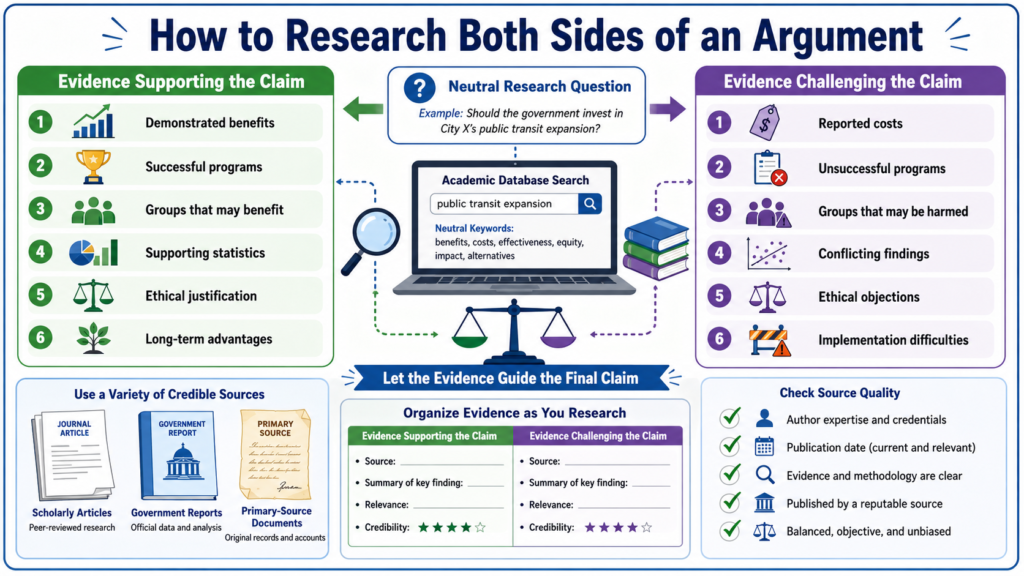
Create a two-column evidence table.
| Evidence supporting your claim | Evidence challenging your claim |
| Demonstrated benefits | Reported costs |
| Successful programs | Unsuccessful programs |
| Groups that benefit | Groups that may be harmed |
| Ethical justifications | Ethical objections |
| Long-term effects | Implementation difficulties |
| Supporting statistics | Conflicting findings |
Search using neutral language and synonyms. USC Libraries recommends varying search terms and following citations from useful publications to find related and more recent research.
When one database produces limited or repetitive results, these Google Scholar alternatives for students can help you locate scholarly articles, government reports, academic books, and subject-specific research databases.
Do not stop after finding enough evidence for the position you already prefer. Your argument becomes more credible when it responds to the strongest available objections.
How Do You Evaluate Sources?
Check each source for:
Authority
- Who is the author?
- What qualifications do they have?
- Who published the work?
Evidence
- Does the source provide data?
- Is the research method explained?
- Do the conclusions match the findings?
Currency
- Is the information recent enough?
- Have laws, technologies, or policies changed?
Relevance
- Does the source address the correct population?
- Does it examine your specific question?
- Is the setting comparable?
Purpose
- Is the source informing, advocating, or selling?
- Who funded the study?
- Does the organization benefit from one conclusion?
Perspective
- Does your evidence represent different viewpoints?
- Are most sources from organizations supporting one side?
Primary sources can also be valuable because they provide direct records, data, testimony, laws, speeches, or documents connected to the issue being studied.
How Do You Address Counterarguments?
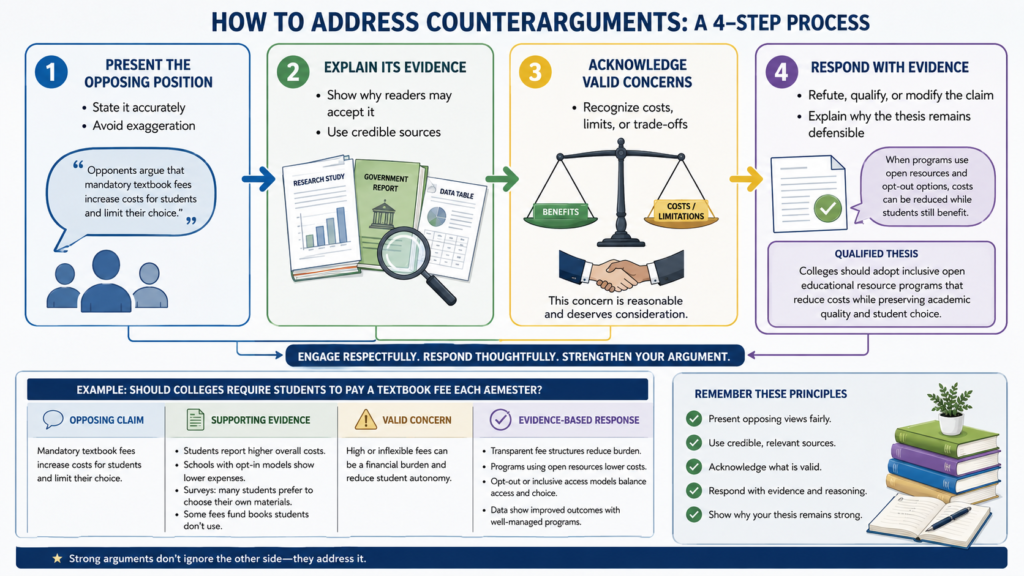
A counterargument should be represented accurately and answered with evidence.
Step 1: Present the Opposing Position
Opponents of tuition-free community college argue that universal programs may provide public funding to students who can already afford tuition.
Step 2: Explain Its Supporting Evidence
Discuss:
- Program costs
- Funding limits
- Completion data
- Alternative uses of public money
Step 3: Acknowledge Valid Concerns
The concern is reasonable because a poorly targeted program could increase spending without improving graduation rates.
Step 4: Respond
You may:
- Refute the objection
- Qualify your thesis
- Modify the proposed policy
- Show that another concern is more important
- Explain why the evidence applies differently
Example:
An income-based program combined with academic-progress requirements could direct funding toward students with the greatest need while reducing unnecessary costs.
Counterarguments can appear in a dedicated section or be integrated into individual body paragraphs. Strategic placement helps demonstrate fairness and strengthen the logic of the paper.
How Do You Avoid Bias?
Argumentative writing does not require pretending that evidence against your thesis does not exist.
Avoid:
- Searching only for support
- Misrepresenting opposing claims
- Using emotional language instead of evidence
- Treating correlation as proof of causation
- Ignoring financial or practical limitations
- Using one personal example as general proof
- Selecting only favorable statistics
- Attacking people instead of claims
- Writing a research question that assumes the conclusion
Biased question:
Why should colleges ban invasive remote-proctoring software?
Neutral question:
Should colleges continue using remote-proctoring software for online examinations?
The final thesis can still oppose the technology, but the research question should allow the evidence to guide the conclusion.
Common Topic-Selection Mistakes
Choosing a Subject Instead of a Topic
Subject:
Climate change
Topic:
Should coastal cities prohibit new residential construction in areas with repeated flood losses?
Selecting an Issue With No Real Disagreement
A paper needs a claim that informed readers could challenge.
Choosing an Overly Emotional Topic
Strong personal feelings may make it harder to evaluate contradictory evidence fairly.
Ignoring the Paper Length
A short paper needs a narrow issue.
Choosing Before Checking Sources
A topic can sound promising but fail when credible research is limited.
Using Outdated Evidence
Current policies, laws, technology, and public data may change quickly.
Assuming Only Two Positions Exist
Many debates involve compromises, exemptions, or alternative policies.
Picking a Topic Only Because It Sounds Controversial
Controversy does not automatically create academic value.
How Do You Test a Topic Before Committing?
Use this checklist.
Assignment Fit
- Does it match the course?
- Does the assignment require argument?
- Is the topic permitted?
- Can it fit the required length?
Debatability
- Can reasonable people disagree?
- Are there multiple serious positions?
- Is the answer not obvious?
Evidence
- Are scholarly sources available?
- Can you find current data?
- Can you access full-text sources?
- Can you research opposing evidence?
Scope
- Does the topic focus on one main issue?
- Is the affected group defined?
- Is the setting clear?
- Can you explain the necessary background briefly?
Argument Potential
- Can you write a defensible thesis?
- Can you identify several supporting reasons?
- Can you address a strong counterargument?
- Can you reach a meaningful conclusion?
Choosing a focused topic early can prevent rushed research, weak sources, and missed deadlines. Students falling behind across several assignments can also follow this guide on how to boost my grades and organize their academic workload.
Argumentative Research Topic Planning Worksheet
Assignment Requirements
Course:
Paper length:
Minimum sources:
Citation style:
Due date:
Broad Subject
Specific Disagreement
Affected Population
Setting
Working Research Question
Tentative Position
1st Reason Supporting
2nd Reason Supporting
3rd Reason Supporting
Strongest Counterargument
Possible Response
Search Keywords
Preliminary Source Check
- I found scholarly sources.
- I found current evidence.
- I found evidence supporting the claim.
- I found evidence challenging the claim.
- I found sources related to the correct population.
- I checked the credibility of the authors and publishers.
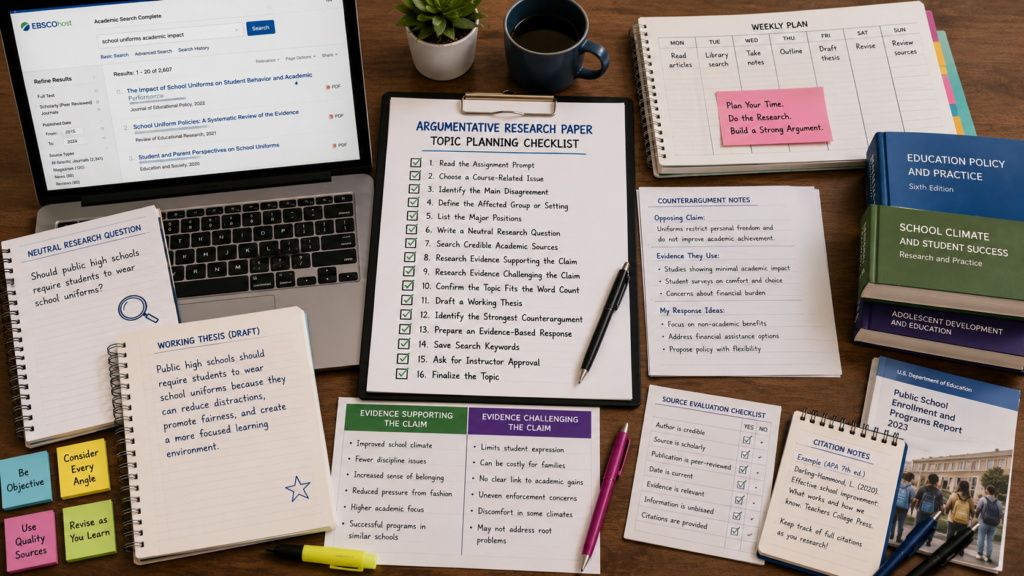
Checklist Argumentative Research Paper Topic
Before finalizing your topic, confirm:
- It fits the assignment.
- It is genuinely debatable.
- It focuses on one main disagreement.
- It identifies the affected group or setting.
- It can be covered within the word count.
- Credible sources are available.
- More than one position can be researched.
- The question does not assume the conclusion.
- I can write a clear working thesis.
- I can identify supporting reasons.
- I can explain the strongest counterargument.
- I can respond using evidence.
- I understand the key terminology.
- The topic holds my interest.
- I requested instructor approval when necessary.
Frequently Asked Questions
What are the best argumentative research paper topics?
The best topics are focused, debatable, researchable, and relevant to the course. Strong subjects include AI disclosure, school phone policies, college costs, employee monitoring, social media regulation, healthcare access, criminal justice reform, and environmental policy.
What is an easy argumentative research topic?
An easier topic has familiar terminology, accessible research, and clear opposing views. Examples include later school start times, free textbooks, classroom phone restrictions, mental health days, school uniforms, and financial literacy requirements.
What is the difference between a topic and a thesis?
The topic identifies the issue. The thesis states the position you will defend.
Topic:
Smartphone policies in high schools
Thesis:
High schools should restrict nonacademic smartphone use during instructional periods while allowing medical and teacher-approved exceptions.
Can an argumentative topic be written as a question?
Yes. A neutral question helps direct the research without assuming the answer.
Should I choose my position before researching?
You may begin with a tentative opinion, but remain willing to adjust it. Research may reveal limitations, costs, or better alternatives.
How controversial should my topic be?
It should allow meaningful disagreement, but it does not have to involve an emotionally charged social issue. Questions about education, technology, campus policy, and employment can create strong arguments.
How many sides should I research?
At minimum, research your likely position and the strongest opposing position. Complicated topics may have several policy options.
How do I make a broad topic more specific?
Add a policy, population, setting, location, or outcome. Instead of “AI in college,” ask whether colleges should require students to disclose AI use in graded writing.
Does an argumentative paper need counterarguments?
Yes. Addressing reasonable objections shows that you understand the issue and helps you explain why your conclusion remains defensible.
Can I change my topic after starting?
Usually, yes. Students often narrow or modify a topic after seeing what evidence is available. Ask your instructor before making a major change when approval was required.
What topics should I avoid?
Avoid topics that are too broad, unsupported by credible research, unrelated to the course, purely personal, unfairly worded, or based on claims that most readers already accept.
How many sources do I need?
Follow the assignment requirements. Before committing to a topic, find more potential sources than the minimum because some may later prove irrelevant, repetitive, or unreliable.
Final Thoughts
Finding strong argumentative research paper topics becomes easier when you begin with a specific disagreement rather than a broad subject.
Choose an issue connected to your course, identify the people or institutions affected, and determine which policy, interpretation, or solution is being debated. Then conduct a preliminary source search before deciding what you believe.
A workable topic should help you answer five questions:
- What is the exact disagreement?
- Who is affected?
- What evidence supports the major positions?
- What conclusion can I defend?
- What would a well-informed opponent say?
Do not select a topic only because it sounds controversial. Select one that can be researched fairly, narrowed to a manageable scope, and supported with credible evidence.
Your first opinion does not need to become your final thesis. Research should test your assumptions, reveal limitations, and help you develop a claim that remains convincing after the strongest counterarguments have been considered. Managing an argumentative research paper alongside quizzes, discussions, and weekly coursework can become difficult. Students can explore online class help students for support with course planning, workload management, and demanding online classes.