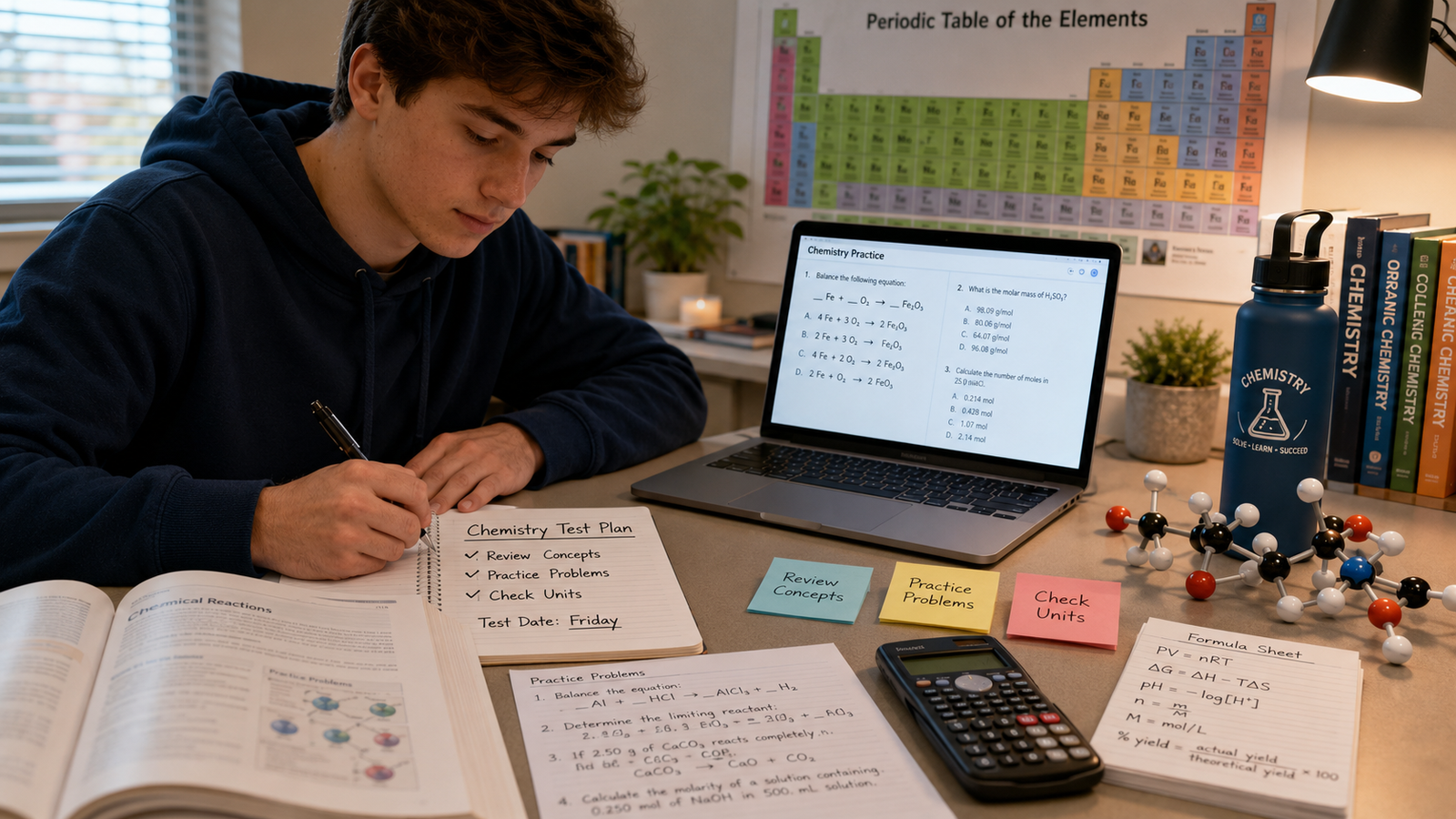
Chemistry tests can feel difficult because they combine several skills at once. You may need to remember definitions, understand scientific ideas, use formulas, balance equations, interpret graphs, and solve numerical problems during the same exam.
Many students prepare by rereading the textbook or memorizing notes the night before. That approach may help with a few definitions, but it usually does not prepare you to apply concepts to unfamiliar questions.
A better chemistry study plan combines concept review with active problem-solving. You need to understand what happens in a reaction, know why a formula applies, practice calculations without looking at examples, and review the mistakes that keep costing you points.
This guide explains how to study for a chemistry test step by step, organize your review time, practice calculations, memorize essential information, and walk into the exam feeling prepared rather than overwhelmed.
Quick Answer: How Should You Study for a Chemistry Test?
To study effectively for a chemistry test, begin several days before the exam and divide the material into smaller topics. Review the main concepts, create a formula sheet, practice chemical equations and calculations, test yourself without notes, and correct every mistake you make.
A practical study process includes:
- Check the test topics and format.
- Organize class notes, worksheets, and textbook chapters.
- Identify concepts you understand and topics that need work.
- Review one chemistry topic at a time.
- Practice equations and calculations by hand.
- Explain important concepts in your own words.
- Complete mixed questions under timed conditions.
- Review mistakes before the exam.
Chemistry improves through active practice. Reading solutions is not the same as solving problems yourself.
Why Chemistry Tests Feel Difficult
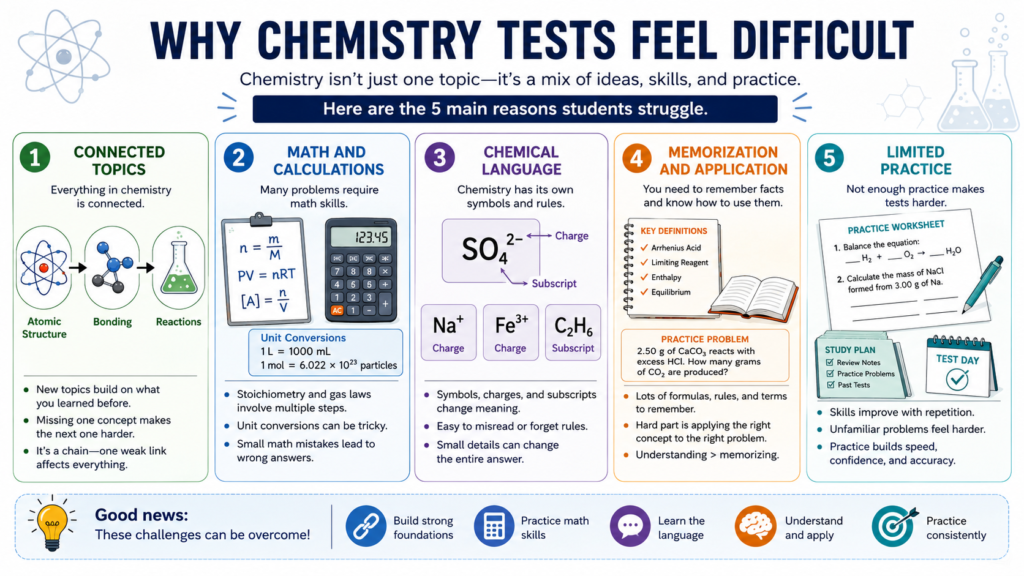
Chemistry is not based on memorization alone. It requires students to connect ideas from several parts of the course.
A question about gases, for example, may require you to:
- Recognize the correct gas law
- Convert temperature to Kelvin
- Rearrange an equation
- Substitute values correctly
- Track units
- Check whether the final answer is reasonable
A reaction question may require you to:
- Identify reactants and products
- Write correct chemical formulas
- Balance the equation
- Use mole ratios
- Convert between mass and moles
Missing one foundational skill can affect the entire solution.
Chemistry Topics Build on One Another
New chemistry lessons often depend on earlier concepts.
Stoichiometry depends on:
- Chemical formulas
- Balanced equations
- Molar mass
- Unit conversions
- Mole ratios
Acid-base calculations may depend on:
- Molarity
- Ions
- Chemical equations
- Logarithms
- Equilibrium concepts
When a current topic feels confusing, the real problem may be an earlier skill that needs review.
Students Often Study Too Passively
Rereading highlighted notes can create the feeling that material is familiar. However, familiarity does not guarantee that you can answer a test question without help.
Passive review includes:
- Rereading chapters
- Watching solutions without attempting them
- Highlighting definitions
- Looking over completed worksheets
Active chemistry study includes:
- Solving problems from a blank page
- Balancing equations
- Drawing particle diagrams
- Explaining reactions aloud
- Completing flashcards from memory
- Correcting mistakes
The exam requires active recall, so your preparation should do the same.
Chemistry Uses Its Own Language
Students must understand symbols, formulas, units, prefixes, charges, and scientific terms.
For example:
- Na means sodium
- Na⁺ represents a sodium ion
- NaCl represents sodium chloride
- (aq) means dissolved in water
- mol measures amount of substance
- M commonly represents molarity
A small misunderstanding in chemical notation can change the meaning of an entire problem.
Start by Checking What the Test Covers
Do not begin by reviewing every page of the textbook. First, identify what will actually appear on the test.
Check:
- The study guide
- Course syllabus
- Teacher announcements
- Recent homework
- Lab worksheets
- Quizzes
- Chapter objectives
- Review questions
Create a topic list such as:
- Atomic structure
- Periodic trends
- Ionic and covalent bonding
- Chemical nomenclature
- Balancing equations
- Mole calculations
- Stoichiometry
- Solutions and molarity
- Acids and bases
- Gas laws
Mark each topic:
- Strong: You can answer questions without notes.
- Needs review: You understand the idea but make mistakes.
- Weak: You cannot explain or solve it independently.
Spend the most time on weak and medium-level topics rather than repeatedly reviewing material you already know.
Understand the Test Format
The way you prepare should match the way you will be tested.
Ask whether the exam includes:
- Multiple-choice questions
- Short written explanations
- Numerical problems
- Chemical equations
- Lab-based questions
- Graph interpretation
- Molecular diagrams
- Vocabulary
- An allowed formula sheet
- A periodic table
If the exam requires calculations, your study sessions should include calculations. If it requires written explanations, practice describing concepts in complete sentences.
A student who only memorizes terms may struggle when asked to explain why atomic radius changes across the periodic table.
Gather Your Chemistry Study Materials
Before studying, place the necessary resources in one location.
You may need:
- Class notes
- Chemistry textbook
- Study guide
- Homework assignments
- Previous quizzes
- Lab reports
- Practice problems
- Periodic table
- Calculator
- Formula sheet
- Blank paper
- Graph paper
- Flashcards
Keeping everything together reduces interruptions and helps you compare information across different sources.
Avoid spending too much time making your materials look perfect. Organization should support studying, not replace it.
Create a Chemistry Test Study Plan
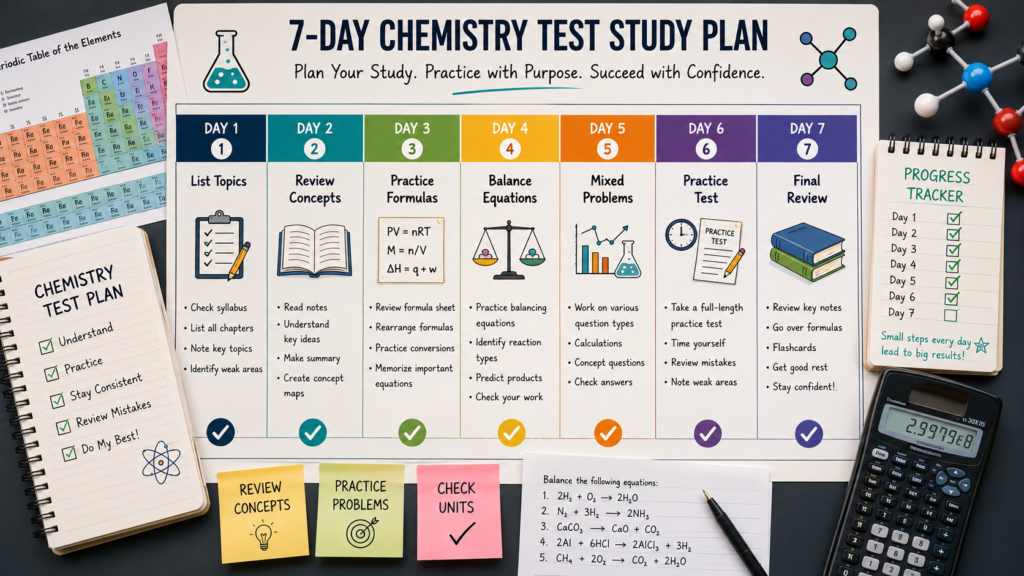
Cramming chemistry in one night is risky because the subject requires repeated practice.
Students who struggle to fit chemistry review around homework and other subjects can use these time management activities for high school students to build a more realistic weekly study schedule.
A seven-day schedule may look like this:
| Day | Main Study Task |
| Day 1 | List test topics and complete a short self-check |
| Day 2 | Review key concepts and vocabulary |
| Day 3 | Practice formulas, units, and conversions |
| Day 4 | Work on equations and reaction problems |
| Day 5 | Complete mixed practice questions |
| Day 6 | Take a timed practice test and review mistakes |
| Day 7 | Complete a short final review and prepare for the exam |
Students with less time can combine tasks, but each session should still contain active practice.
Use Short, Focused Study Sessions
Instead of one four-hour session, try:
- 35–45 minutes of focused chemistry work
- A 5–10 minute break
- Another focused session
Give each session a specific goal.
Weak goal:
Study chemistry.
Stronger goal:
Balance ten equations and correct every error.
A defined task makes it easier to measure progress.
Build a Strong Chemistry Foundation
Before practicing advanced problems, check the basic skills that support them.
Review Units and Conversions
Chemistry calculations depend heavily on units.
Common units include:
- Grams
- Moles
- Liters
- Milliliters
- Atmospheres
- Kilopascals
- Kelvin
- Joules
- Moles per liter
Practice:
- Milliliters to liters
- Celsius to Kelvin
- Grams to moles
- Moles to particles
- Scientific notation
- Metric prefixes
Always write units beside numbers. Units can help you decide which conversion is needed and reveal mistakes in your work.
Review Significant Figures
Many chemistry courses require answers to be reported using the correct number of significant figures.
Practice identifying:
- Leading zeros
- Captive zeros
- Trailing zeros
- Exact numbers
- Decimal-place rules for addition and subtraction
- Significant-figure rules for multiplication and division
Do not leave significant figures until the final night. Use the correct rules during every practice session.
Understand Chemical Formulas
Make sure you can distinguish:
- Element symbols
- Subscripts
- Coefficients
- Charges
- Parentheses
- States of matter
For example, the coefficient in 2H₂O means two water molecules or two moles of water. The subscript means each water unit contains two hydrogen atoms.
Coefficients may be changed when balancing equations. Subscripts should not be changed because doing so changes the substance.
Study Chemistry Concepts Before Memorizing Formulas
Formulas are easier to use when you understand the relationship they represent.
For every equation, ask:
- What does each symbol mean?
- Which units should be used?
- What conditions must be true?
- What changes when one variable increases?
- When should this formula not be used?
For example, molarity describes how many moles of solute are present in one liter of solution. Understanding that relationship makes dilution and concentration questions easier to interpret.
Create a formula sheet with four columns:
| Formula | Meaning | Required Units | Used For |
| Molarity formula | Moles per liter | mol and L | Solution concentration |
| Density formula | Mass per volume | g and mL | Density calculations |
| Ideal gas law | Gas-variable relationship | Depends on R | Gas problems |
The formula sheet should explain the equations rather than simply list symbols.
Use Concept Maps to Connect Chemistry Ideas
Chemistry topics are easier to remember when you see how they connect.
For a stoichiometry concept map, you might connect:
Balanced equation → Mole ratio → Moles → Molar mass → Grams
For solutions:
Solute + Solvent → Solution → Concentration → Molarity → Dilution
A concept map helps you see the sequence of decisions required in multi-step problems.
Explain Chemistry in Your Own Words
After reviewing a topic, close your notes and explain it aloud.
Try answering:
- Why do atoms form bonds?
- What is the difference between ionic and covalent bonding?
- Why must chemical equations be balanced?
- What does molarity measure?
- What happens at the equivalence point in a titration?
- Why does temperature need to be converted to Kelvin in gas-law problems?
If your explanation is vague, return to your notes and fill the gap.
The goal is not to repeat textbook wording. It is to explain the concept clearly enough that another student could follow it.
Study the Periodic Table as a Tool
Do not treat the periodic table as a page of isolated facts. It provides information you can use to solve problems.
Depending on your course, review how to identify:
- Atomic number
- Average atomic mass
- Groups
- Periods
- Metals and nonmetals
- Valence electrons
- Common ion charges
- Atomic-radius trends
- Electronegativity trends
- Ionization-energy trends
Practice using trends rather than memorizing random comparisons.
For instance, ask:
- Which element has the larger atomic radius?
- Which atom is more electronegative?
- Which element is more likely to form a positive ion?
Then explain the reason for your choice.
Practice Chemical Nomenclature
Naming compounds requires repeated practice.
Review how to name:
- Ionic compounds
- Covalent compounds
- Compounds with transition metals
- Acids
- Polyatomic ions
Practice in both directions:
- Write the name from the formula.
- Write the formula from the name.
Examples:
- Sodium chloride → NaCl
- Carbon dioxide → CO₂
- Iron(III) oxide → Fe₂O₃
Do not only review correct answers. Check why each subscript, charge, prefix, or Roman numeral is needed.
Balance Chemical Equations by Hand
Balancing equations is a skill that improves through practice.
Use this process:
- Write the correct formulas.
- Count atoms on both sides.
- Add coefficients.
- Recount every element.
- Reduce coefficients to the smallest whole-number ratio.
Never balance an equation by changing subscripts.
Example:
Unbalanced:
H₂ + O₂ → H₂O
Balanced:
2H₂ + O₂ → 2H₂O
Practice easy equations first, then move to combustion, replacement, and more complex reaction types.
Review Reaction Types
Students may be asked to identify or predict reactions.
Common categories include:
- Synthesis
- Decomposition
- Single replacement
- Double replacement
- Combustion
- Acid-base neutralization
- Precipitation
- Oxidation-reduction
For each type, learn:
- The general pattern
- Common clues
- How products are predicted
- How the equation is balanced
Do not memorize patterns without practicing actual examples.
Practice Mole and Molar-Mass Problems
The mole connects microscopic particles with measurable laboratory quantities.
Students should be comfortable converting among:
- Grams
- Moles
- Particles
- Atoms
- Molecules
- Formula units
A general path is:
Grams → Moles → Particles
or
Particles → Moles → Grams
Write conversion factors so units cancel visibly. This makes the setup easier to check.
Prepare for Stoichiometry Questions
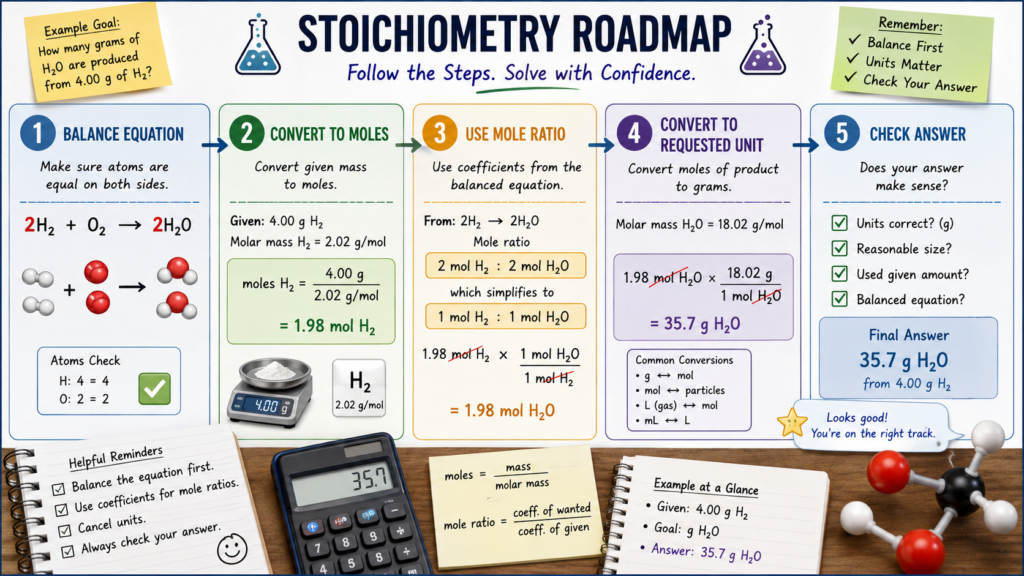
Stoichiometry often feels difficult because it combines several chemistry skills.
Use a consistent process:
- Balance the equation.
- Convert the given amount to moles.
- Use the mole ratio.
- Convert to the requested unit.
- Check units and significant figures.
A common error is using coefficients as gram ratios. Coefficients represent mole ratios, not mass ratios.
Write every conversion step rather than attempting the calculation mentally.
Create a Chemistry Mistake Log
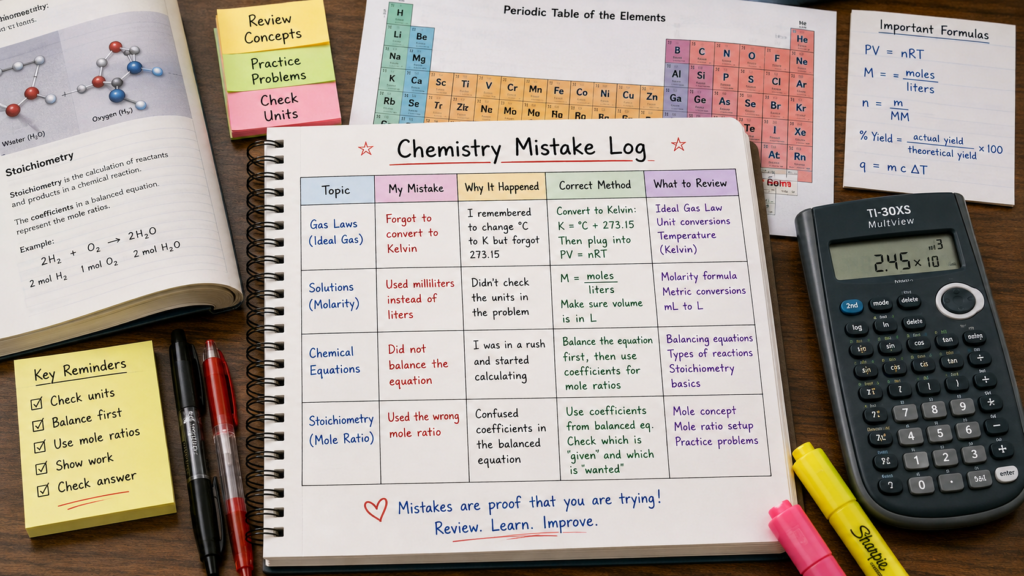
A mistake log helps you identify recurring problems.
Use a table like this:
| Topic | Mistake | Why It Happened | Correct Approach |
| Gas laws | Used Celsius | Forgot absolute temperature | Convert to Kelvin first |
| Stoichiometry | Skipped balancing | Began conversion too early | Balance before using mole ratios |
| Molarity | Used mL | Formula requires liters | Divide mL by 1,000 |
| Nomenclature | Missed Roman numeral | Ignored metal charge | Determine oxidation state |
Review this log before the test. It is often more useful than rereading material you already understand.
Use Flashcards for Information That Must Be Recalled
Flashcards work well for:
- Polyatomic ions
- Solubility rules
- Element symbols
- Common charges
- Acid names
- Reaction patterns
- Vocabulary
- Formula meanings
Keep each card focused on one question.
Weak flashcard:
Everything about acids and bases
Stronger flashcards:
1: What ion do acids produce in water?
2: What is the conjugate base of H₂CO₃?
3: What pH range is acidic?
Test yourself from both directions when possible.
Do Not Rely Only on Flashcards
Flashcards are useful for recall, but they cannot replace calculation practice.
Knowing the ideal gas law does not guarantee you can:
- Choose the correct value of R
- Convert temperature
- Rearrange the equation
- Track units
- Interpret the result
Use flashcards for memory and worksheets for application.
Practice Chemistry Problems Without Looking at Examples
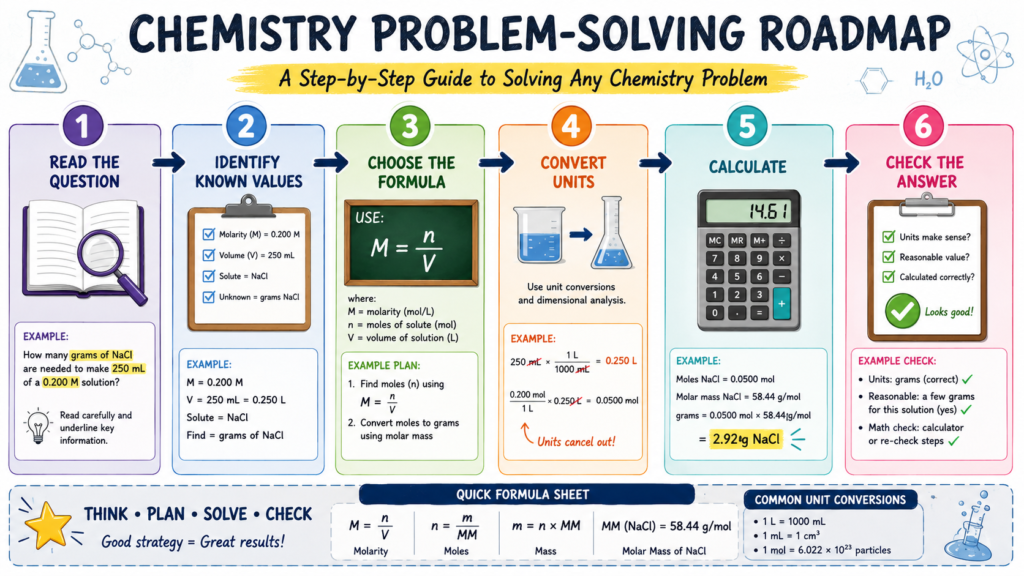
One of the most important steps in chemistry preparation is solving questions without following a worked example line by line.
Worked examples are useful when learning a new method, but they can create false confidence. A solution may look easy when every step is already written for you. The real test is whether you can begin with a blank page and complete the problem independently.
Use this three-round practice method:
Round 1: Guided Practice
Review one example and pay attention to:
- The information given
- The formula or rule selected
- Unit conversions
- Calculation steps
- Final answer format
Round 2: Independent Practice
Cover the example and solve a similar problem without help.
Do not check the answer until you finish.
Round 3: Mixed Practice
Complete questions from several topics without being told which formula or method to use.
Mixed practice is especially useful because real tests rarely group every question by method.
Show Every Step in Chemistry Calculations
Skipping steps may save a few seconds during homework, but it makes mistakes difficult to find.
For numerical problems, write:
- The information provided
- The value you need to find
- The formula
- Any unit conversions
- Substitution
- Calculation
- Final answer with units
Example format:
Given:
Mass = 10.0 g
Molar mass = 20.0 g/mol
Find:
Number of moles
Setup:
Moles = mass ÷ molar mass
Calculation:
10.0 g ÷ 20.0 g/mol = 0.500 mol
Writing units throughout the solution helps confirm that the setup is correct.
Practice Rearranging Chemistry Formulas
Students sometimes know a formula but struggle when the unknown variable is not isolated.
Practice rearranging equations before adding numbers.
For example, if:
PV = nRT
you may need to solve for:
- Pressure
- Volume
- Number of moles
- Temperature
Working symbolically first reduces calculator mistakes.
Create a small formula practice sheet where you:
- Write the original equation
- Circle the unknown variable
- Rearrange the equation
- Check that the new form makes sense
Do this for the main formulas listed on your test guide.
Use Dimensional Analysis
Dimensional analysis is a reliable method for chemistry conversions.
The main idea is to multiply by conversion factors so unwanted units cancel.
For example:
250 mL × 1 L / 1000 mL = 0.250 L
The milliliter units cancel, leaving liters.
Dimensional analysis is useful for:
- Metric conversions
- Grams and moles
- Moles and particles
- Solution calculations
- Gas-law unit changes
- Energy conversions
Write conversion factors clearly. If the unwanted unit does not cancel, the conversion is probably arranged incorrectly.
Practice Solution and Molarity Problems
For solution problems, students should understand:
- Solute
- Solvent
- Solution
- Concentration
- Molarity
- Dilution
Molarity describes the amount of solute in a given volume of solution.
When solving molarity questions:
- Convert the volume to liters.
- Identify the number of moles.
- Use the correct relationship.
- Include the final unit.
A common mistake is using milliliters directly when the formula requires liters.
For dilution questions, remember that the amount of solute stays the same while more solvent is added.
Study Acids and Bases Through Patterns
Acid-base chemistry can involve definitions, equations, pH, titration, and equilibrium.
Start by reviewing the basic distinctions.
Acids
Common properties include:
- Donate protons in Brønsted-Lowry theory
- Increase hydrogen-ion concentration in water
- Usually have a pH below 7
Bases
Common properties include:
- Accept protons in Brønsted-Lowry theory
- Increase hydroxide-ion concentration in water
- Usually have a pH above 7
Then practice:
- Identifying acids and bases
- Writing conjugate acid-base pairs
- Predicting neutralization products
- Calculating pH or concentration
- Reading titration curves
Do not treat every acid as strong or every base as weak. Strength and concentration describe different ideas.
Review Gas-Law Problems Carefully
Gas-law questions often test both chemistry and algebra.
Before solving:
- Identify which variables change
- Identify which variable stays constant
- Convert temperature to Kelvin
- Confirm pressure units
- Select the correct gas law
Common gas variables include:
- Pressure
- Volume
- Temperature
- Number of moles
Students frequently lose points by using Celsius instead of Kelvin or mixing pressure units.
Write a quick condition note beside the problem:
Temperature changes, pressure constant
or
Pressure and volume change, moles constant
This can help you choose the correct relationship.
Prepare for Thermochemistry Questions
Thermochemistry focuses on energy changes during physical and chemical processes.
Review:
- Endothermic processes
- Exothermic processes
- Heat
- Temperature
- Specific heat
- Enthalpy
- Energy diagrams
Be able to explain:
- Where energy enters or leaves the system
- Whether products have more or less energy than reactants
- What the sign of an energy change means
- How mass and specific heat affect temperature change
For calculation questions, list every variable and unit before using the formula.
Practice Reading Chemistry Graphs
Chemistry exams may include graphs related to:
- Heating curves
- Reaction energy
- Gas behavior
- Solubility
- Titration
- Reaction rates
- Concentration
When reading a graph, identify:
- X-axis
- Y-axis
- Units
- Trend
- Important points
- Any flat or changing regions
Do not jump directly to the question. First explain what the graph represents.
For a heating curve, for example, a flat section may indicate a phase change rather than no energy transfer.
Review Laboratory Questions
Teachers often include questions based on completed experiments.
Review your lab materials for:
- Purpose
- Variables
- Equipment
- Procedure
- Observations
- Calculations
- Sources of error
- Safety rules
- Conclusions
Ask yourself:
- Why was each step performed?
- Which variable was controlled?
- What evidence supported the conclusion?
- How could the experiment be improved?
- What would happen if one condition changed?
Do not memorize only the final result. Understand the reasoning behind the procedure.
Use Practice Tests Properly
A practice test is most useful when completed under realistic conditions.
The same active-recall, timed-practice, and mistake-review methods used to study for a math test also work well for calculation-heavy chemistry exams.
Set up your session like the actual exam:
- Use the same calculator rules
- Use only the allowed formula sheet
- Set a timer
- Work without notes
- Complete questions in one sitting when possible
Afterward, sort mistakes into categories:
- Concept misunderstanding
- Wrong formula
- Unit error
- Arithmetic mistake
- Misread question
- Time-management problem
- Careless notation
Do not only record your score. The error categories show what to study next.
Practice Multiple-Choice Chemistry Questions Strategically
Multiple-choice questions may test small differences between concepts.
Use this approach:
- Read the entire question.
- Identify what is being asked.
- Estimate the likely answer before reviewing choices.
- Eliminate clearly incorrect options.
- Check units, signs, and chemical formulas.
- Select the best-supported answer.
Watch for distractors based on common mistakes, such as:
- Using Celsius instead of Kelvin
- Forgetting to balance an equation
- Confusing coefficients with subscripts
- Reversing periodic trends
- Selecting a similar but incorrect unit
Prepare for Written Chemistry Responses
Some chemistry exams require students to explain their reasoning.
A complete written answer should:
- State the scientific idea
- Apply it to the question
- Use correct chemistry vocabulary
- Include evidence or calculation when needed
- Avoid unsupported statements
Weak answer:
The reaction happens faster because it is hotter.
Stronger answer:
Increasing temperature gives particles more kinetic energy, which increases the frequency of effective collisions and can increase the reaction rate.
Practice explaining concepts in two or three clear sentences.
Use the Blank-Page Method
The blank-page method shows what you can recall without prompts.
Choose a topic and write everything you remember on blank paper.
For example, for stoichiometry, write:
- Required steps
- Important formulas
- Common units
- Typical mistakes
- One sample setup
Then compare your page with your notes.
Anything missing becomes part of your next review session.
This method works well for:
- Periodic trends
- Bonding
- Mole conversions
- Gas laws
- Acids and bases
- Reaction types
Teach a Chemistry Topic to Someone Else
Teaching exposes weak understanding quickly.
Choose one topic and explain it to:
- A classmate
- A study partner
- A family member
- An imaginary student
Explain:
- What the concept means
- Why it matters
- How to recognize the problem type
- Which steps are used
- What mistakes to avoid
If you rely heavily on your notes or cannot answer a follow-up question, review the topic again.
Create a Two-Column Review Sheet
Divide a page into two columns.
| Concept or Question | Explanation or Answer |
| What is molarity? | Moles of solute per liter of solution |
| Why balance equations? | To follow conservation of mass |
| Why use Kelvin? | Gas-law relationships require an absolute scale |
| What is an exothermic reaction? | A process that releases heat to the surroundings |
Cover the answer column and test yourself.
This works well for definitions, rules, trends, and short explanations.
Form a Focused Chemistry Study Group
A study group can help when members actively solve and explain problems.
A productive group can:
- Divide topics for review
- Compare solution methods
- Quiz one another
- Explain difficult concepts
- Check calculations
- Discuss lab questions
Avoid groups where:
- One student completes all the work
- Everyone copies answers
- The session becomes mostly social
- Members study unrelated topics
Set a clear goal before meeting, such as:
Review gas laws and complete twelve mixed questions.
Ask Your Teacher Specific Questions
Instead of saying:
I do not understand chemistry.
Bring a focused question:
- Why do I need to convert this temperature to Kelvin?
- How do I know which gas law applies?
- Why is this compound named with a Roman numeral?
- Where did my mole conversion go wrong?
- Why is this reaction classified as oxidation-reduction?
Specific questions make it easier for your teacher or tutor to identify the exact problem.
Ask for help before the test day. Waiting until the final hour leaves little time to practice the corrected method.
Avoid Common Chemistry Study Mistakes
Memorizing Answers Instead of Methods
You may remember the answer to one problem but struggle when the numbers change.
Focus on the process.
Practicing Only Easy Questions
Easy questions build confidence, but difficult and mixed questions reveal whether you truly understand the topic.
Ignoring Units
A number without the correct unit may be incomplete or wrong.
Track units through every calculation.
Skipping Equation Balancing
Stoichiometry calculations based on an unbalanced equation will produce incorrect mole ratios.
Depending Too Much on a Formula Sheet
A formula sheet does not tell you:
- Which equation to use
- What units are required
- Which variables are constant
- How to interpret the answer
Studying Every Topic Equally
Spend more time on weak, heavily tested, and calculation-based topics.
Cramming the Night Before
Chemistry requires repeated retrieval and problem-solving. One late-night session rarely provides enough practice.
What to Do the Night Before a Chemistry Test
The night before the exam should be used for final review, not first-time learning.
Complete these tasks:
- Review your formula sheet
- Read your mistake log
- Complete a few representative problems
- Review important ions, rules, or definitions
- Pack your calculator and supplies
- Confirm the exam time and location
- Stop studying at a reasonable hour
Avoid attempting an entire chapter late at night.
A rested student is more likely to read carefully, recall information, and avoid calculation errors.
What to Do on the Morning of the Test
Keep the review short.
You can:
- Review formulas
- Read key definitions
- Look over common mistakes
- Complete one easy warm-up problem
- Check your calculator
Do not attempt a difficult new topic right before the test. That can increase anxiety without improving readiness.
How to Manage Time During the Chemistry Test
At the beginning of the exam:
- Read the instructions.
- Scan the sections.
- Note the number of calculation problems.
- Check whether a formula sheet or periodic table is included.
- Plan how much time to spend on each section.
During the test:
- Complete familiar questions first.
- Mark difficult questions and return later.
- Show calculation steps.
- Write units.
- Check chemical formulas.
- Leave time to review.
Do not spend half the exam on one problem.
How to Check Chemistry Answers
Use different checks depending on the question.
For Calculations
Ask:
- Are the units correct?
- Is the sign reasonable?
- Is the decimal in the right place?
- Did I use significant figures?
- Does the value make sense?
For Equations
Check:
- Are formulas correct?
- Are atoms balanced?
- Are charges balanced when required?
- Are coefficients in the lowest whole-number ratio?
For Multiple Choice
Check whether you:
- Answered the actual question
- Selected the correct unit
- Considered all choices
- Avoided a familiar distractor
For Written Responses
Check:
- Did I answer every part?
- Did I use accurate vocabulary?
- Did I explain why?
- Did I provide evidence or calculations?
A Three-Day Emergency Chemistry Study Plan
When only three days remain, prioritize heavily tested topics and active practice.
One Day: Diagnose and Review
- List all exam topics.
- Complete a short self-test.
- Review weak concepts.
- Create a formula sheet.
- Practice basic questions.
Second Day: Calculations and Reactions
- Balance equations.
- Practice mole conversions.
- Complete stoichiometry questions.
- Review gas laws or solution calculations.
- Update the mistake log.
Third Day: Mixed Practice and Final Review
- Complete a timed practice set.
- Correct every mistake.
- Review definitions and formulas.
- Complete a few final problems.
- Stop at a reasonable time and rest.
This plan is not ideal, but it is more effective than reading the whole textbook from beginning to end.
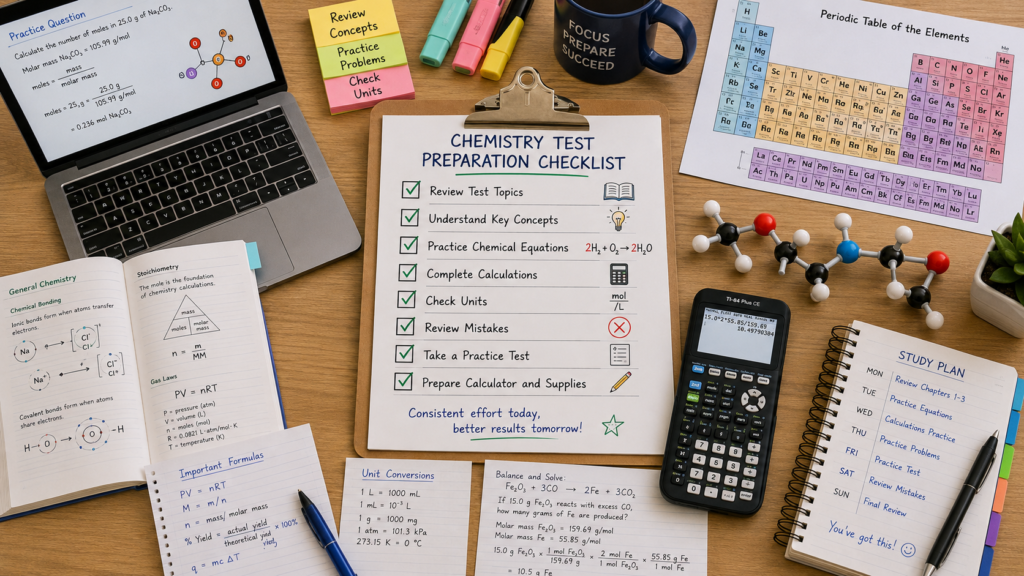
Test Preparation Checklist Chemistry
Organize the Material
- I know which chapters and topics are included.
- I understand the test format.
- I collected notes, worksheets, quizzes, and lab materials.
- I identified my weakest topics.
Review the Concepts
- I can explain the main ideas in my own words.
- I understand important periodic trends.
- I can read chemical symbols and formulas.
- I know the purpose of the main equations.
- I reviewed relevant laboratory concepts.
Practice the Skills
- I can balance chemical equations.
- I can convert units using dimensional analysis.
- I can complete mole and molar-mass conversions.
- I can solve the required calculation types.
- I can interpret graphs and diagrams.
- I can write short scientific explanations.
Check Readiness
- I completed mixed questions without notes.
- I reviewed every incorrect answer.
- I created a mistake log.
- I practiced under timed conditions.
- I prepared my calculator and supplies.
- I protected enough time for sleep.
Frequently Asked Questions
How many days should I study for a chemistry test?
Starting five to seven days before the exam gives most students time to review concepts, practice calculations, and correct mistakes. More time may be needed for a cumulative final or a test covering several difficult chapters.
How many hours should I study chemistry each day?
The amount depends on the exam and your current understanding. Many students benefit from one or two focused sessions of 30–45 minutes per day rather than one very long session.
Is memorization enough for a chemistry test?
No. Memorization helps with vocabulary, ions, formulas, and rules, but students also need to apply concepts, solve problems, balance equations, and interpret scientific information.
What should I study first for chemistry?
Start with the test guide and identify weak foundational skills. Review the concepts needed for later topics, such as formulas, units, chemical equations, and mole conversions.
How can I remember chemistry formulas?
Understand what each formula represents, write the meaning of every variable, practice rearranging it, and use it in several problems. Repeated application is more effective than copying the formula many times.
How do I study chemistry if I am bad at math?
Review the specific math skills used in your course, including fractions, algebra, scientific notation, unit conversions and equation rearrangement. Practice chemistry calculations one step at a time and write units throughout.
Students who need to strengthen those foundations can use practical strategies on how to get better at math before working through more advanced chemistry calculations.
Should I study with flashcards?
Flashcards are helpful for vocabulary, ions, element symbols, rules, and formula meanings. They should be combined with calculation practice and concept questions.
What is the best way to practice stoichiometry?
Use the same process every time: balance the equation, convert the given amount to moles, apply the mole ratio, convert to the requested unit, and check units and significant figures.
How do I stop making careless mistakes in chemistry?
Write every step, track units, circle the requested quantity, check signs and conversions, and keep a mistake log. Review recurring errors before taking the test.
What should I do when I do not understand a chemistry problem?
Identify the exact step that causes confusion, review a similar example and ask a focused question. Then solve a new problem independently to confirm that you understand the correction.
Final Thoughts
Studying for a chemistry test becomes easier when you stop treating the subject as one large collection of formulas and facts.
Effective preparation involves:
- Understanding concepts
- Practicing calculations
- Balancing equations
- Tracking units
- Reviewing mistakes
- Testing yourself without notes
- Starting before the night of the exam
Focus on the topics that cause the most trouble, but continue mixing them with questions from the rest of the test. The goal is to recognize what each question requires and complete the solution without relying on a worked example.
Students balancing chemistry with several other courses may need extra academic structure. Students managing difficult chemistry topics, assignments, and multiple course deadlines can use online class help for added support with planning, organization, and course understanding. Support with study planning, course organization and difficult concepts can help you stay on track while remaining responsible for your own work.