
Look at these three words: though, through, and tough.
They look almost identical. They do not sound identical.
Now consider the word read. In “I read every night,” it has one pronunciation. In “I read that book yesterday,” the spelling stays exactly the same, but the pronunciation changes.
Examples like these explain why English learners sometimes stop in the middle of a lesson and ask a very reasonable question: Is English a difficult language to learn?
The honest answer is yes and no.
English can be difficult because its spelling and pronunciation do not always match, common verbs are irregular, phrasal verbs can change meaning unexpectedly, and small words such as a, the, in, and at cause persistent mistakes.
At the same time, English has no grammatical gender for most nouns, adjectives usually do not change according to gender or number, and basic verb conjugation is simpler than in many languages.
How hard English feels also depends on your first language, previous language-learning experience, exposure to English, reasons for learning, and the amount of meaningful practice you get.
This guide explains exactly what makes English hard, what makes it easier, how long learning may take, and how students can make steady progress without trying to become perfect overnight.
English is moderately difficult for many language learners, but there is no universal difficulty level that applies to everyone. Its irregular spelling, pronunciation, phrasal verbs, articles and prepositions can be challenging, while stable adjectives and mostly gender-neutral nouns make some grammar features easier.
Quick Answer: Is English Hard to Learn?
English is moderately difficult for many language learners, but there is no universal difficulty level that applies to everyone.
The hardest parts of English often include:
- Inconsistent spelling and pronunciation
- Phrasal verbs
- Articles such as a, an, and the
- Irregular verbs
- Prepositions
- Word stress
- Fast connected speech
- Idioms and informal expressions
However, learners may find some features easier:
- Most nouns do not have grammatical gender.
- Adjectives usually keep the same form.
- Basic sentence order is relatively consistent.
- Many basic verbs change very little between subjects.
- English learning resources are widely available.
- Learners can hear many varieties of English through media and online communication.
The real question is therefore not whether English is universally easy or hard. A better question is: Which parts of English will be difficult for you, and how can you practice them effectively?
Key Takeaways
- English is not equally difficult for every learner.
- Your first language can influence which English sounds and grammar patterns feel unfamiliar.
- English spelling does not always tell you how a word is pronounced.
- Pronunciation, articles, prepositions, phrasal verbs, and irregular verbs cause frequent problems.
- English also has relatively simple features, including mostly gender-neutral nouns and stable adjective forms.
- Language progress should be measured by what you can understand and communicate, not by whether you sound like a native speaker.
- The CEFR describes language proficiency from A1 to C2.
- Consistent listening, speaking, reading, and writing practice is more useful than occasional intensive study.
- Mistakes are a normal part of language development.
- A clear weekly routine can make English feel much more manageable.
Why Is English Difficult for Some Learners?
There is no single answer because language difficulty is relative.
A Spanish-speaking learner may quickly recognize English words such as important, different, hospital, and possible. However, that learner may struggle with English vowel sounds or the use of auxiliary verbs in questions.
A Mandarin speaker may already have experience learning another writing system but find English articles and consonant clusters unfamiliar.
An Arabic speaker may find some English sentence patterns manageable while having difficulty with sounds or spelling distinctions that work differently in Arabic.
The challenges are influenced by the relationship between English and the languages you already know.
Your First Language Affects What Feels Difficult
When learning English, students naturally use knowledge from their first language.
Sometimes this helps.
For example, languages may share:
- Similar vocabulary
- Related word origins
- Sentence patterns
- Alphabet systems
- Grammatical concepts
Sometimes previous language knowledge creates interference.
A student may directly translate a sentence from their first language and produce English word order that sounds unusual. Another student may pronounce an English letter according to the sound it represents in another language.
This is not laziness or lack of intelligence. Your brain is using an existing communication system to understand a new one.
The goal is to gradually notice where English follows a different pattern.
Your Learning Goal Changes the Difficulty
“Learning English” can mean many different things.
One student wants to:
- Order food
- Introduce themselves
- Ask for directions
Another needs to:
- Attend a U.S. university lecture
- Read an academic textbook
- Write a research paper
- Participate in class discussions
A professional may need to:
- Give presentations
- Write formal emails
- Negotiate with clients
- Understand industry terminology
These goals require different levels of vocabulary, accuracy, listening ability, and communication skill.
Basic conversational English is a different goal from advanced academic English.
The Hardest Parts of Learning English
Several English features repeatedly cause problems for language learners.
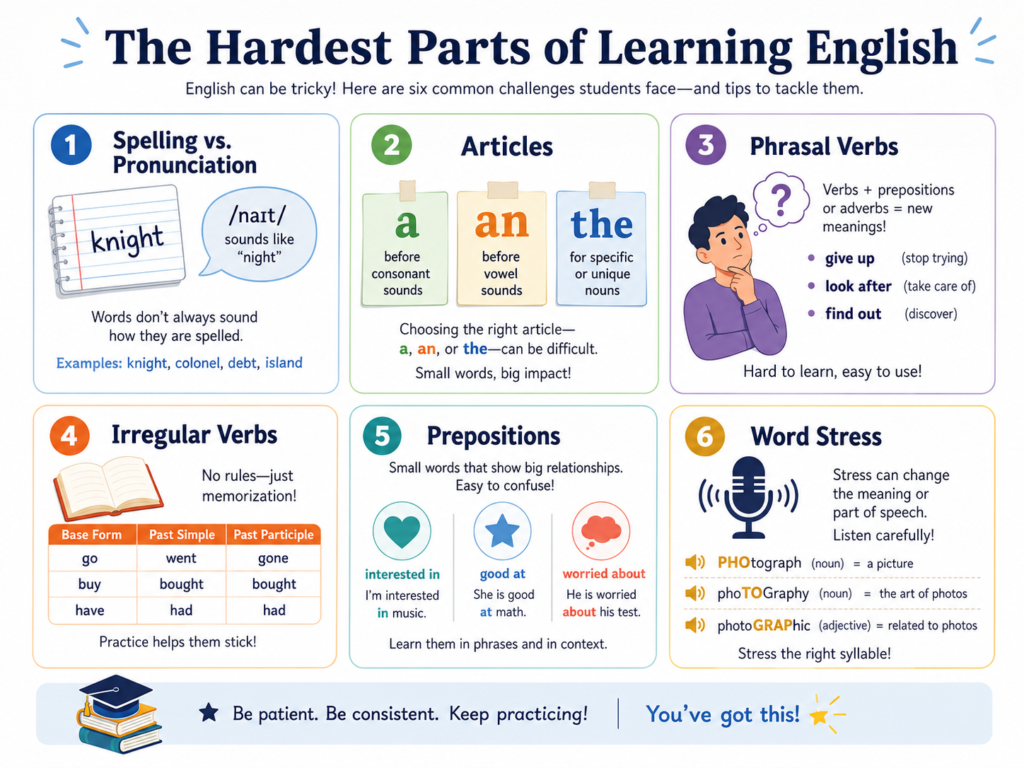
1. English Spelling and Pronunciation Do Not Always Match
One of the most obvious challenges is the relationship between written English and spoken English.
Consider:
- though
- through
- tough
- thought
The spelling pattern ough does not represent one predictable pronunciation.
Silent letters create additional confusion:
- knife
- write
- honest
- island
- debt
A beginner may reasonably assume that every written letter should be pronounced.
English does not work that way.
Why Is English Spelling So Inconsistent?
English vocabulary and spelling developed through contact with different languages and historical changes in pronunciation.
As a result, modern spelling often preserves information about a word’s history rather than giving learners a perfect pronunciation guide.
The problem is not that English has no spelling patterns. It does have patterns. However, the relationship between spelling and sound contains enough irregularity that learners cannot always confidently pronounce an unfamiliar word from spelling alone.
How to Improve English Pronunciation
When learning a new word, record four things:
| Word | Meaning | Pronunciation | Example |
| enough | sufficient | /ɪˈnʌf/ | We have enough time. |
| receipt | proof of purchase | /rɪˈsiːt/ | Keep the receipt. |
| comfortable | physically relaxed | Check audio | This chair is comfortable. |
Use audio from a reliable learner’s dictionary.
Then:
- Listen to the word.
- Notice the stressed syllable.
- Repeat the word slowly.
- Say the full example sentence.
- Record yourself.
- Compare your pronunciation with the model.
Do not learn spelling and pronunciation as completely separate subjects.
2. English Has Many Vowel Sounds
English uses 26 alphabet letters, but written letters do not represent a simple one-letter-to-one-sound system.
For learners, vowels can be particularly challenging.
Compare:
- ship and sheep
- full and fool
- hat and hut
- bed and bad
A small pronunciation difference may change the word a listener hears.
Practice Minimal Pairs
Minimal pairs are two words that differ by one sound.
Examples include:
| Sound contrast | Word 1 | Word 2 |
| /ɪ/ and /iː/ | ship | sheep |
| /ʊ/ and /uː/ | full | fool |
| /æ/ and /ʌ/ | bat | but |
| /l/ and /r/ | light | right |
Use three stages:
- Listen: Can you hear the difference?
- Identify: Which word did the speaker say?
- Produce: Can you say the difference clearly?
Your goal is understandable speech, not losing every feature of your natural accent.
3. English Word Stress Can Change How Speech Sounds
English words often emphasize one syllable more strongly than others.
For example:
- PHOtograph
- phoTOGraphy
- photoGRAPHic
The main stress moves even though the words belong to the same family.
Incorrect stress does not automatically make a sentence impossible to understand, but it can make familiar words harder for listeners to recognize.
Learn Vocabulary With Stress
Do not memorize:
opportunity
Memorize:
opporTU-nity
Say it in a sentence:
This internship is a good opportunity.
Learning the sound pattern with the word can reduce future pronunciation problems.
4. Fast Spoken English Sounds Different From Textbook English
A beginner may understand this sentence on a page:
What are you going to do?
Then a fluent speaker says it quickly, and the learner hears something much less clear.
In natural speech, words connect. Sounds may become weaker or change as people speak at a normal speed.
This is one reason students sometimes say:
“I know the words, but I cannot understand people when they talk.”
The problem may not be vocabulary. It may be connected-speech recognition.
Train With Short Audio Clips
Choose a clip of 10 to 30 seconds.
Then:
- Listen without subtitles.
- Write the words you understand.
- Listen again.
- Check the transcript or subtitles.
- Mark the parts you missed.
- Listen to those sections repeatedly.
- Repeat the speaker’s sentence aloud.
This is more focused than watching a two-hour movie and hoping your listening automatically improves.
5. English Articles Are Difficult
The words a, an, and the are short, but they cause long-term problems for many learners.
Compare:
I bought a book.
The listener does not yet know which book.
Later:
The book is about U.S. history.
Now the speaker and listener know which book is being discussed.
English can also use no article:
Books can be expensive.
The speaker is discussing books generally.
A Simple Article Guide
| Article | Basic use | Example |
| a/an | One nonspecific singular countable noun | I need a calculator. |
| the | A specific or identifiable noun | The calculator is on my desk. |
| no article | General plural or uncountable idea | Calculators are useful. |
This guide does not cover every exception, but it gives beginners a practical starting point.
Best Way to Practice Articles
Write a short description of your room.
For example:
There is a desk near my window. The desk has two drawers. I keep books and paper on it.
Then identify why each article is used.
Grammar becomes easier when you connect a rule with meaning.
6. English Phrasal Verbs Can Be Confusing
A phrasal verb combines a verb with another short word.
For example:
- give up
- find out
- turn down
- look after
- run into
The meaning is not always obvious from the individual words.
Consider turn down.
It may mean:
Reduce the volume.
Or:
Reject an offer.
The surrounding context determines the meaning.
Do Not Memorize Phrasal Verbs Alphabetically
Learn them by situation.
Studying
- hand in an assignment
- look up a word
- catch up on work
- fall behind
- go over notes
Work
- take on responsibility
- follow up
- set up a meeting
- carry out a task
- turn down an offer
This creates useful connections between vocabulary and real communication.
7. Irregular Verbs Must Be Learned
Many English verbs form the past tense by adding -ed:
- walk → walked
- study → studied
- call → called
However, common irregular verbs follow different patterns:
- go → went
- see → saw
- teach → taught
- buy → bought
- write → wrote
A student who says “I goed to class” is applying a logical English rule.
The problem is that go is an exception.
Learn Irregular Verbs in Groups
Instead of memorizing one enormous list, notice patterns.
Same in all three forms
- cut – cut – cut
- put – put – put
- hit – hit – hit
Vowel changes
- sing – sang – sung
- drink – drank – drunk
- begin – began – begun
-ought or -aught patterns
- buy – bought
- bring – brought
- teach – taught
Patterns will not eliminate every exception, but they make vocabulary less random.
8. Prepositions Are Small but Difficult
Why do English speakers say:
- at 5:00
- on Monday
- in July
Why are you:
- interested in
- good at
- responsible for
- worried about
Students often want one universal rule.
Unfortunately, many preposition combinations need to be learned as phrases.
Learn Chunks Instead of Individual Words
Do not memorize:
responsible
Learn:
responsible for
Do not memorize:
depend
Learn:
depend on
Do not memorize:
apply
Learn:
apply for a job
apply to a college
This method improves both vocabulary and grammatical accuracy.
9. English Has Idioms and Informal Expressions
Imagine hearing:
That test was a piece of cake.
A beginner may picture food.
The speaker simply means the test was easy.
English contains many expressions whose meaning cannot be understood literally.
Examples include:
- break the ice
- hit the books
- under the weather
- call it a day
- on the same page
Learners do not need to memorize thousands of idioms immediately.
Prioritize expressions that repeatedly appear in:
- Classes
- Workplaces
- TV programs
- Social conversations
- Your field of study
What Makes English Easier to Learn?
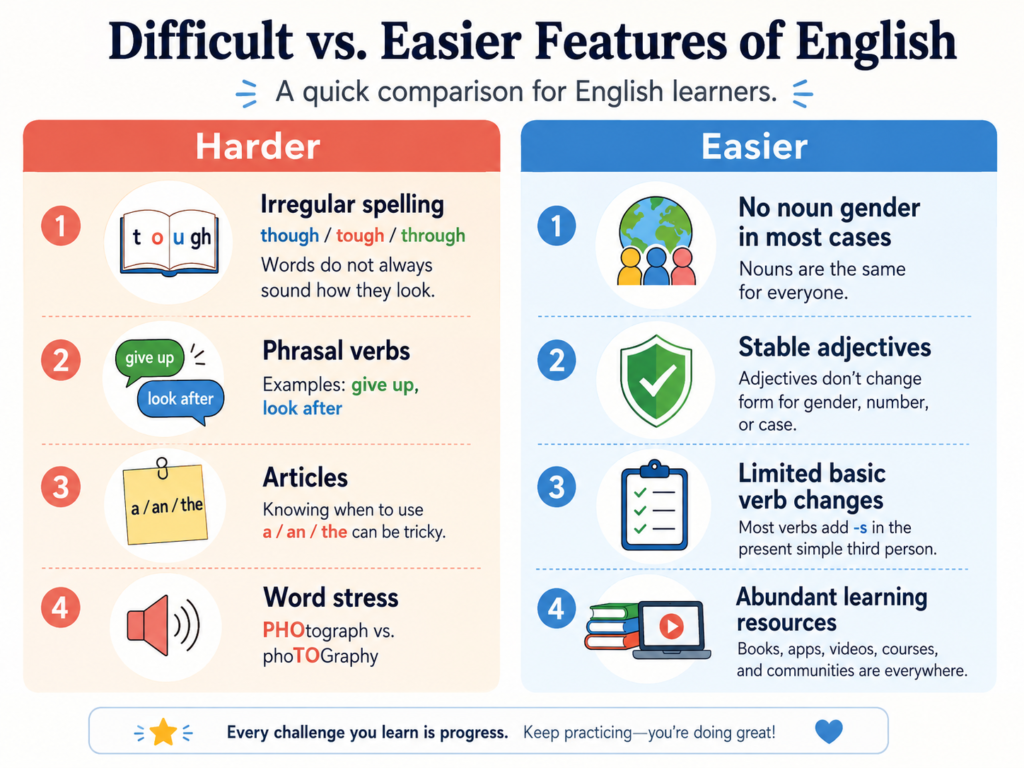
English has genuine challenges, but several features can make the early stages of learning less complicated.
1. Most English Nouns Do Not Have Grammatical Gender
In many languages, learners must remember whether nouns belong to a grammatical gender.
Standard English generally does not require learners to memorize a gender for words such as:
- table
- phone
- university
- book
- car
This removes one category of memorization.
2. English Adjectives Usually Do Not Change
Consider:
- a small house
- two small houses
- a small book
- three small books
The adjective small stays the same.
Students do not usually need to change an English adjective to match the noun’s grammatical gender or number.
3. Basic English Verb Conjugation Can Be Relatively Manageable
Look at the present tense of work:
- I work
- you work
- we work
- they work
- he works
- she works
The third-person singular changes, but most forms stay the same.
Compare this with languages in which a verb may take different endings for multiple people and numbers.
English verbs become more complicated when students study tense and aspect, but basic subject agreement is comparatively limited.
4. Basic English Sentence Order Is Often Predictable
A common sentence pattern is:
Subject + Verb + Object
For example:
Maria reads books.
The student completed the assignment.
We watched the lecture.
English certainly allows more complex sentences, but beginners can communicate many ideas using predictable basic structures.
5. English Learning Resources Are Easy to Find
Students can access:
- Podcasts
- Videos
- News
- Graded readers
- Dictionaries
- Pronunciation recordings
- Language exchanges
- Online exercises
- University resources
The British Council, for example, organizes free vocabulary and language-learning activities by learner level and includes work on meaning, pronunciation, and spelling.
The challenge is usually not finding any resource. It is choosing a small number of useful resources and practicing consistently.
Is English the Hardest Language in the World?
No language can be universally labeled the hardest for every learner.
Language difficulty depends partly on the distance between a learner’s existing language knowledge and the new language.
For a native English speaker, the U.S. Foreign Service Institute places Arabic, Mandarin and Cantonese Chinese, Japanese, and Korean among its “super-hard” languages for Foreign Service training.
However, those rankings describe the experience of English-speaking learners. They do not establish a universal list of the hardest languages for everyone.
For example, a Korean speaker learning Japanese may encounter familiar linguistic features that an English speaker does not.
Likewise, a Dutch speaker and a Japanese speaker do not begin English from the same linguistic starting point.
The more useful approach is to identify the distance between your first language and English in areas such as:
- Writing system
- Word order
- Sound system
- Verb structure
- Articles
- Grammatical gender
- Vocabulary relationships
Is English Harder Than Spanish?
There is no universal winner because English and Spanish have different difficulties.
| Feature | English | Spanish |
| Spelling-pronunciation relationship | Less predictable | Generally more consistent |
| Grammatical gender | Limited for nouns | Masculine and feminine nouns |
| Adjective agreement | Usually unchanged | Often changes for gender and number |
| Verb conjugation | Relatively limited in basic forms | More verb forms |
| Phrasal verbs | Very common | Different verb-expression challenges |
| Global learning resources | Extremely widespread | Extremely widespread |
A Spanish speaker may find English vocabulary partly familiar because the languages share many words with Latin or French origins.
However, English pronunciation, phrasal verbs, and articles may remain difficult.
The better language is not the one with fewer rules. It is the one that matches your learning goal.
How Long Does It Take to Learn English?
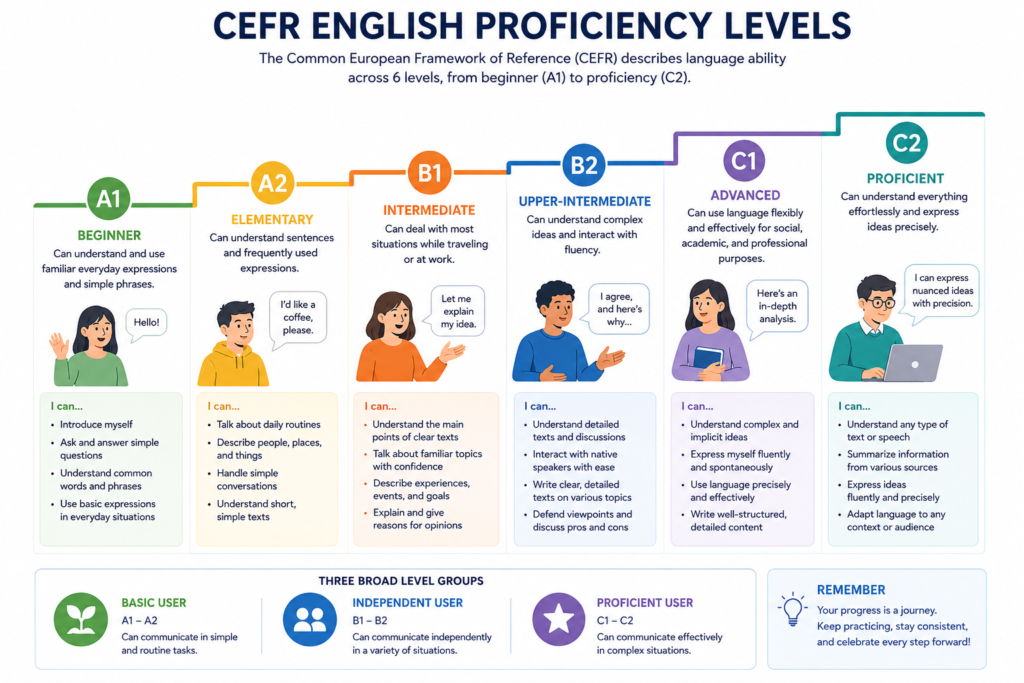
There is no honest single answer such as “three months” or “one year.”
First, you need to define what “learn English” means.
The Common European Framework of Reference for Languages, or CEFR, describes proficiency through six broad levels:
| CEFR level | General stage |
| A1 | Beginner |
| A2 | Elementary/basic user |
| B1 | Intermediate/independent user |
| B2 | Upper-intermediate/independent user |
| C1 | Advanced/proficient user |
| C2 | Highly proficient user |
A1, a learner may understand and use familiar everyday expressions in simple situations.
B1, learners can generally handle familiar topics and straightforward communication more independently.
C1, a learner can use English flexibly for demanding social, academic, and professional purposes.
Cambridge English gives a broad estimate of approximately 200 guided learning hours to progress from one CEFR level to the next. This should not be treated as a countdown clock.
Progress varies according to:
- Starting level
- First language
- Previous language-learning experience
- Study intensity
- Quality of instruction
- Opportunities to speak
- Listening exposure
- Feedback
- Motivation
- Age and personal circumstances
Can You Learn English in Three Months?
You can make significant progress in three months.
A beginner may learn to:
- Introduce themselves
- Discuss basic routines
- Order food
- Ask simple questions
- Understand common phrases
- Write short messages
However, advanced academic or professional fluency is a much larger goal.
Be suspicious of anyone promising complete English fluency in a fixed number of weeks.
How to Know Your Current English Level
Do not judge your English level only by vocabulary size.
Language ability involves several skills:
- Reading
- Listening
- Speaking
- Writing
- Interaction
You may be a strong reader and a hesitant speaker.
You may understand casual conversations but struggle with academic writing.
Use “can-do” questions.
Beginner Questions
Can I:
- Introduce myself?
- Understand slow, simple instructions?
- Ask basic questions?
- Write a short personal message?
Intermediate Questions
Can I:
- Explain an experience?
- Follow the main point of a familiar conversation?
- Read straightforward articles?
- Participate in a discussion about familiar topics?
Advanced Questions
Can I:
- Follow university lectures?
- Understand implied meaning?
- Adjust my language for formal and informal situations?
- Write clear, organized arguments?
- Discuss complex topics spontaneously?
A reliable placement or level test can also help you choose materials that are neither far too easy nor impossibly difficult.
The Best Way to Learn English Faster
There is no magic shortcut, but an inefficient study routine can make progress unnecessarily slow.
Step 1: Choose a Specific English Goal
Do not write:
I want to improve my English.
Write:
I want to understand lectures in my college classes.
Or:
I want to speak confidently during job interviews.
Or:
I want to reach B2-level English for university study.
A specific goal tells you which skills deserve the most attention.
Step 2: Practice All Four Main Skills
Use a balanced weekly routine.
| Skill | Practice example |
| Listening | Short podcast with transcript |
| Speaking | Language exchange or recorded response |
| Reading | Graded article or learner text |
| Writing | Daily paragraph or email practice |
Do not spend six months completing grammar exercises and then wonder why speaking still feels difficult.
Speaking improves partly through speaking.
Listening improves partly through listening.
Step 3: Learn Useful Vocabulary in Context
Avoid memorizing random lists of advanced words.
Learn vocabulary connected with:
- Your studies
- Work
- Daily routine
- Travel
- Family
- Personal interests
For each word, save:
- Meaning
- Pronunciation
- Common word partners
- One example sentence
For example:
deadline
Common combinations:
- meet a deadline
- miss a deadline
- tight deadline
- extend a deadline
Example:
I have to meet the assignment deadline on Friday.
Students balancing language study with a heavy academic schedule may also benefit from better time management activities for high school students and college learners so that English practice becomes part of the week rather than another last-minute task.
Step 4: Use Spaced Review
Do not study 100 words on Sunday and forget them by Friday.
Review new vocabulary after increasing intervals.
For example:
- Day 1
- Day 2
- Day 4
- Day 7
- Day 14
During each review, try to retrieve the word before checking the answer.
Step 5: Speak Before You Feel Ready
Many learners wait for this imaginary moment:
“I will start speaking when my grammar is good.”
That moment may never arrive.
Begin with simple communication.
Say:
I went to the store yesterday.
You do not need to produce a five-minute speech about consumer economics.
Build fluency from language you can actually use.
Step 6: Get Specific Feedback
“Your English needs improvement” is poor feedback.
Useful feedback sounds like:
You repeatedly forget the third-person s.
Or:
Your listener understands your words, but your sentence stress makes the main idea difficult to identify.
Or:
You are using the before general plural nouns.
Track repeated mistakes.
When students want to improve overall academic performance alongside their language skills, a broader guide on how to boost your grades can help them organize study habits across multiple subjects.
A Practical Seven-Day English Study Plan
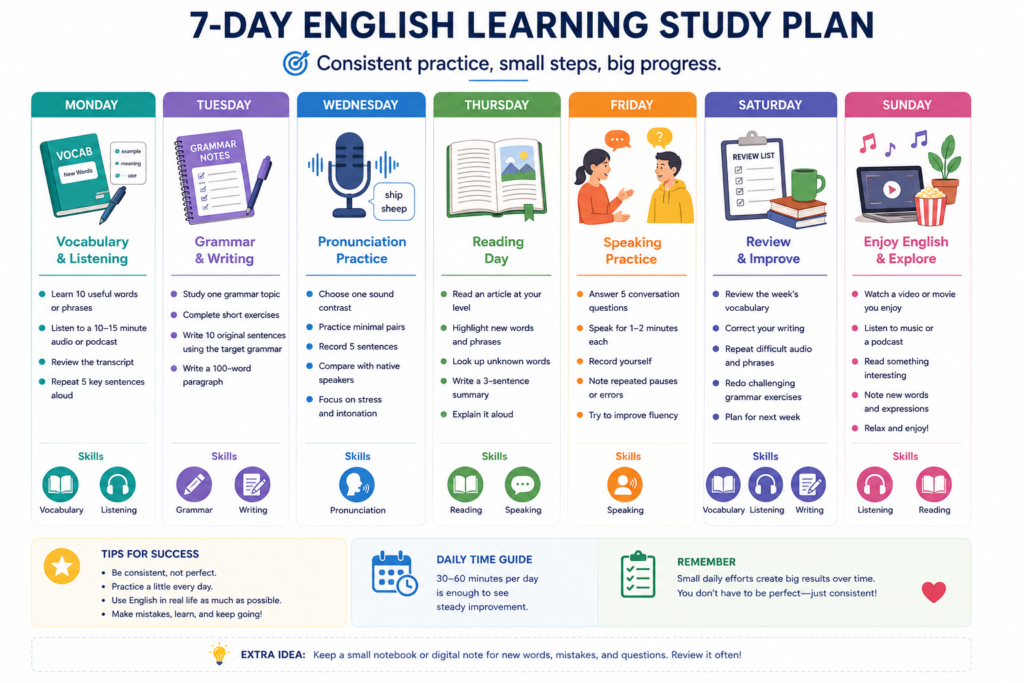
You do not need four free hours every day.
Consistency is more important than creating an unrealistic schedule that you abandon after one week.
Monday: Vocabulary and Listening
- Learn 10 useful words or phrases.
- Listen to a 10-minute English recording.
- Review the transcript.
- Repeat five sentences aloud.
Tuesday: Grammar and Writing
- Study one grammar problem.
- Complete short exercises.
- Write 10 original sentences.
- Write one 100-word paragraph.
Wednesday: Pronunciation
- Choose one sound contrast.
- Practice minimal pairs.
- Record five sentences.
- Compare your recording with reliable audio.
Thursday: Reading
- Read an article at your level.
- Highlight useful phrases.
- Write a three-sentence summary.
- Explain the article aloud.
Friday: Speaking
- Answer five conversation questions.
- Speak for one to two minutes per question.
- Record yourself.
- Note repeated pauses or errors.
Saturday: Review
- Review the week’s vocabulary.
- Correct your writing.
- Repeat difficult audio.
- Redo your hardest grammar questions.
Sunday: English for Enjoyment
Choose something you actually like:
- A movie
- Sports commentary
- A video game
- A podcast
- Music
- A YouTube channel
English should not exist only inside a textbook.
Students who feel overwhelmed by assignments and language practice should also understand how homework can cause stress and build a more realistic weekly workload.
Common English Learning Mistakes
Trying to Translate Every Word
Word-for-word translation slows reading and can create unnatural sentences.
Instead, first ask:
What is the main idea?
Then look up words that are necessary for understanding.
Studying Vocabulary Without Using It
Recognizing a word in a flashcard does not guarantee you can use it.
After learning a word:
- Say it.
- Write it.
- Use it in a sentence.
- Use it again two days later.
Avoiding Speaking Because of an Accent
An accent is not automatically a communication problem.
The goal should be intelligibility: can another person understand you without unreasonable effort?
Focus first on sounds, word stress, rhythm, and sentence features that affect understanding.
Using English Subtitles Forever
Subtitles can help beginners connect sound and text.
However, if your eyes read every sentence before your ears process it, listening development may slow.
Try:
- English audio without subtitles.
- English subtitles.
- Review difficult lines.
- Listen again without subtitles.
Jumping Between Too Many Resources
One app on Monday.
A new YouTube teacher on Tuesday.
Three vocabulary systems on Wednesday.
A new course on Thursday.
Constantly changing resources can feel productive because you are always starting something.
Choose:
- One main structured course
- One dictionary
- One vocabulary system
- One listening source
Use them consistently before adding more.
Focusing on Advanced Vocabulary Too Early
Students sometimes memorize words such as ubiquitous and meticulous while still struggling with:
- get
- make
- take
- put
- do
Common words can have many meanings and combinations.
Master high-frequency vocabulary first.
Trying to Eliminate Every Mistake
If you stop after every error, conversation becomes exhausting.
During speaking practice, choose a focus.
For example:
Today I am checking past-tense verbs.
Allow less important errors to wait for another session.
Is English Difficult for International College Students?
Academic English can be challenging even for students who communicate comfortably in daily conversations.
College courses may require learners to:
- Follow fast lectures
- Take notes
- Read textbooks
- Understand discipline-specific vocabulary
- Join discussions
- Write arguments
- Cite sources
- Give presentations
A student may be socially fluent but still struggle with academic language.
Build Academic English Separately
Practice:
- Lecture note-taking
- Paragraph organization
- Transition language
- Research vocabulary
- Citation terminology
- Academic verbs
Examples of academic verbs include:
- analyze
- evaluate
- compare
- interpret
- demonstrate
- justify
Students who are overwhelmed by several online classes may look for an online course help service for legitimate tutoring, scheduling, technical guidance, or study support. However, exams and graded assignments should reflect the student’s own work and follow school academic-integrity rules.
Best Free Resources for Learning English
Choose resources according to your current level and goal.
British Council LearnEnglish
Useful for:
- Grammar
- Vocabulary
- Listening
- Reading
- Speaking
- Writing
- Level-based activities
Cambridge Dictionary
Useful for:
- Definitions
- British and American pronunciation audio
- Grammar information
- Example sentences
VOA Learning English
Useful for:
- Slower news-based English
- Listening
- Vocabulary in context
University Writing Centers
Useful for students working on:
- Academic paragraphs
- Essays
- Research papers
- Citation
- Grammar in formal writing
Language Exchange
Useful for:
- Real conversation
- Listening to different speakers
- Building speaking confidence
Protect your privacy when meeting unknown language partners online and use established platforms or school-supported programs where possible.
Myths About Learning English
Myth 1: You Must Sound American or British to Speak Good English
English is used internationally by speakers with many accents.
Clear communication is more important than copying one exact accent.
Myth 2: Children Always Learn Languages Easily and Adults Cannot
Adults and children may have different learning strengths and circumstances.
Adults can use explicit strategies, existing knowledge, and clear goals.
Age does not make meaningful language learning impossible.
Myth 3: You Need Perfect Grammar Before Speaking
Speaking is part of learning.
Waiting for perfection removes opportunities to practice real communication.
Myth 4: Watching Movies Automatically Makes You Fluent
Movies provide useful exposure.
However, passive watching alone may not provide enough speaking, retrieval, feedback, or focused vocabulary study.
Myth 5: More Vocabulary Always Means Better English
Vocabulary matters, but communication also requires:
- Grammar
- Listening
- Pronunciation
- Interaction
- Context
Knowing 20 difficult words is not helpful if you cannot understand a simple question.
Myth 6: Making Mistakes Creates Bad English Habits Forever
Uncorrected repeated errors can become persistent.
However, avoiding all language use because you fear mistakes creates a different problem: no meaningful practice.
Speak, notice patterns, receive feedback and correct repeated errors.
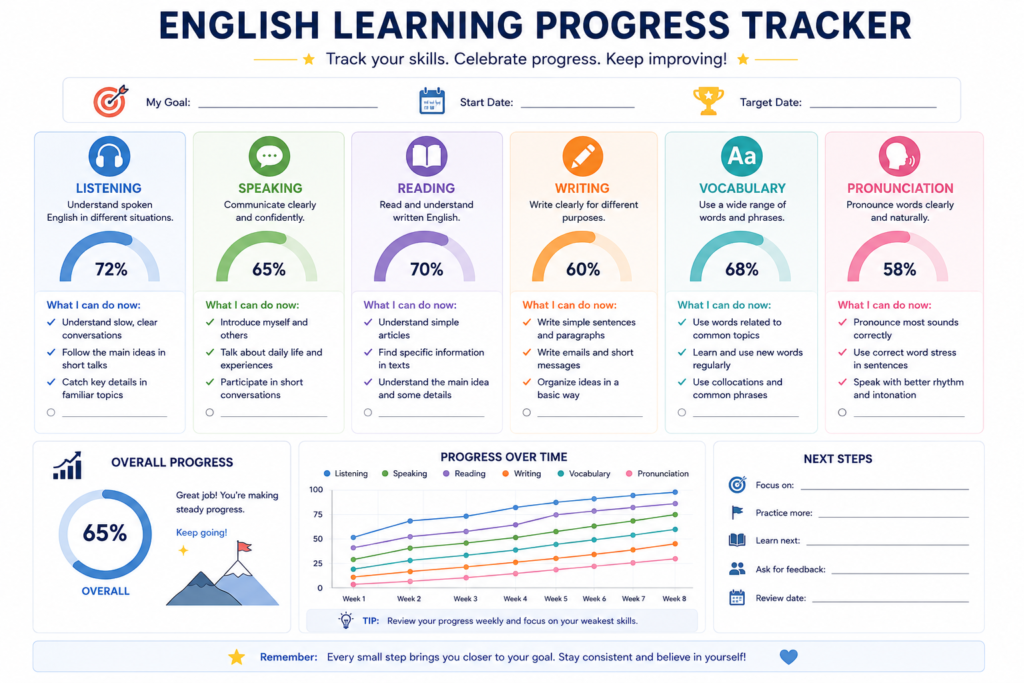
English Learning Progress Checklist
Assess Your Starting Point
- Identify your approximate English level.
- List your strongest skill.
- Identify your weakest skill.
- Write one specific English goal.
- Decide how many days per week you can study.
Build Your Routine
- Choose one main English course or learning system.
- Select a learner’s dictionary.
- Create a vocabulary review system.
- Schedule weekly listening practice.
- Schedule speaking practice.
- Write in English at least once per week.
Improve Vocabulary
- Learn words by topic.
- Record pronunciation.
- Save example sentences.
- Learn common word combinations.
- Review vocabulary over several days.
- Use new words in your own sentences.
Improve Speaking and Listening
- Listen to short audio clips.
- Use transcripts after an initial listening attempt.
- Repeat complete sentences.
- Record your voice.
- Practice one pronunciation problem at a time.
- Have regular conversations in English.
Review Your Progress
- Retake an appropriate level assessment periodically.
- Save older writing samples.
- Compare old and new recordings.
- Track repeated grammar mistakes.
- Adjust your study routine.
- Set the next communication goal.
Final Thoughts
So, is English a difficult language to learn?
Some parts genuinely are.
English spelling can be unpredictable. Pronunciation requires careful listening. Phrasal verbs may feel illogical. Articles and prepositions can continue causing mistakes even after years of study.
But English is not an impossible language reserved for people with a special talent.
You do not have to learn every word. You do not need to lose your accent. So you do not have to understand every movie after one month.
So you need a clear goal and regular opportunities to understand and use the language.
Start with one practical step today.
Listen to a 30-second English audio clip. Write what you hear. Check the transcript. Identify one phrase you missed. Listen again and repeat that phrase aloud.
That small exercise is not dramatic, but repeated practice is how difficult English gradually becomes familiar English.
Frequently Asked Questions
Here are answers to some of the most specific questions learners have about the difficulty of English.
English can be difficult because spelling and pronunciation are not always predictable, and learners must master phrasal verbs, articles, prepositions, irregular verbs, and connected speech. However, mostly gender-neutral nouns, stable adjectives, and relatively limited basic verb conjugation make some parts easier.
No. There is no universal hardest language for every person. Difficulty depends partly on a learner’s first language, previous language experience, writing system, and learning goals.
English spelling does not always reliably show pronunciation. English also uses sound distinctions, word stress, and connected-speech patterns that may not exist in a learner’s first language.
The answer depends on your starting level, goal, first language, study intensity, and opportunities to use English. Cambridge gives a broad estimate of around 200 guided learning hours for progression from one CEFR level to the next, but individual results vary significantly.
You can improve substantially in three months with regular practice. A beginner may develop basic communication skills, but reaching advanced academic or professional proficiency normally requires a longer learning process.
The answer varies by learner. Pronunciation, spelling, articles, prepositions, phrasal verbs, irregular verbs, and understanding fast speech are common challenges.
Set a specific goal and practice listening, speaking, reading, and writing consistently. Use level-appropriate materials, review vocabulary over time, get targeted feedback, and actively use new language rather than only reading grammar explanations.