
Watching your grades drop can feel discouraging, especially when you believe you are already putting in plenty of effort. You may attend class, complete most of your work, and spend hours reviewing notes, yet your scores still do not improve.
The problem is not always a lack of effort. Sometimes students focus on low-impact tasks, study passively, miss important deadlines, or prepare for tests without reviewing why they lost points previously.
When asking, “How can I boost my grades?”, begin with three actions:
- Find exactly where you are losing points.
- Recover any points that are still available.
- replace passive studying with focused practice.
This guide explains how to raise your grades using a realistic system for assignments, exams, class participation, study planning, and academic recovery. It is designed for high school, college and online students who need both immediate improvements and better long-term habits.
Can You Really Improve Your Grades?
Yes, but the amount of improvement possible depends on your current grade, the remaining coursework, assignment weights, school policies, and how much of the term is left.
A student with several missing assignments may improve quickly by submitting acceptable late work. A student who has completed everything but performs poorly on major exams may need a different strategy. That student must improve understanding, test preparation, and exam performance rather than simply working longer.
Start by determining which situation describes you:
- You have missing or incomplete work.
- You submit assignments but lose points for avoidable mistakes.
- You understand lessons but perform poorly under test conditions.
- You struggle to understand the course material.
- You study inconsistently and begin too late.
- You are overloaded by several courses at once.
- You do not know how your final grade is calculated.
Your solution should match the actual cause of the problem.
How to Boost Your Grades Quickly
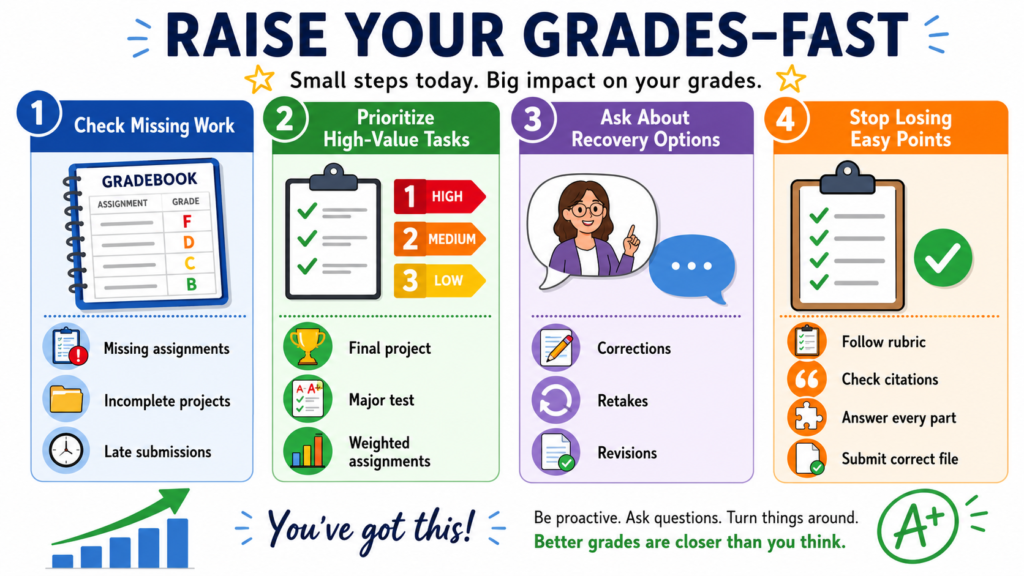
When the end of a grading period is approaching, focus first on actions that can still change your score. Do not spend your limited time rewriting perfect notes if an overdue project worth 15% of your grade remains unfinished.
Check for Missing Assignments
Open your learning management system, grade portal, syllabus, and course calendar. Create one list containing:
- Missing assignments
- Incomplete work
- Work marked as not submitted
- Assignments that can be revised
- Upcoming high-value tasks
- Tests or quizzes that can be retaken
Then identify which items your instructor still accepts.
A missing assignment may currently count as a zero. Even partial credit could make a meaningful difference, depending on the assignment’s weight and your school’s late-work policy.
Contact your teacher or professor respectfully:
Hello Professor [Name], I noticed that my [assignment name] is currently missing. I understand that it was my responsibility to submit it on time. Would you still accept it for partial credit? I can complete and submit it by [specific date]. Thank you for considering my request.
Do not demand extra opportunities or give a long explanation. Take responsibility and propose a clear completion date.
Complete High-Value Work First
Not all coursework affects your grade equally.
An exam worth 25% deserves more preparation than a discussion post worth 1%. Before deciding what to work on, review the weighting in your syllabus.
Create a priority table:
| Task | Deadline | Grade weight | Current status | Priority |
| Final project | Friday | 20% | Not started | Very high |
| Chapter quiz | Wednesday | 5% | Needs review | Medium |
| Discussion response | Tonight | 1% | Nearly complete | Low |
| Missing lab report | Late | 10% | Instructor accepts it | High |
Complete urgent, recoverable, and highly weighted work before polishing low-value tasks.
Ask About Corrections or Retakes
Some instructors allow:
- Test corrections
- Quiz retakes
- Revised essays
- Resubmitted projects
- Replacement assignments
- Extra practice for limited credit
Ask what the written course policy permits. Do not assume that every instructor offers extra credit or retakes.
A useful question is:
I reviewed my mistakes on the last assessment and identified the areas I misunderstood. Does the course policy allow corrections, a retake, or another way to demonstrate improvement?
This approach shows that you are interested in learning rather than simply requesting free points.
Stop Losing Easy Points
Students sometimes focus on difficult material while continuing to lose points for:
- Late submissions
- Missing citations
- Unanswered question parts
- Incorrect file formats
- Failure to follow the rubric
- Incomplete calculations
- Poor proofreading
- Skipped discussion replies
- Missing units or labels
Before submitting anything, check the instructions and rubric line by line.
Calculate What Grade Is Still Possible
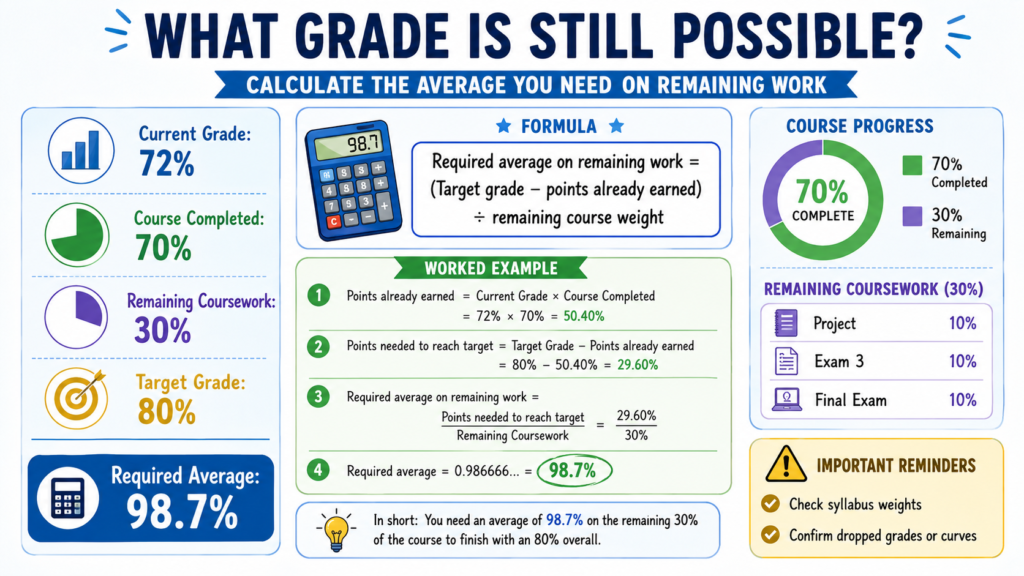
A clear grade calculation prevents unrealistic expectations and helps you prioritize correctly.
Suppose your current grade is 72%, and 70% of the course has already been completed. The remaining 30% includes a project and final exam.
Your current work contributes:
0.72 × 70 = 50.4 points
To finish with an 80%, you need:
80 − 50.4 = 29.6 points
Because only 30 points remain available, you would need approximately:
29.6 ÷ 30 = 98.7%
An 80% may still be mathematically possible, but it would require an extremely strong finish.
Use this formula:
Required average on remaining work =
(Target final grade − points already earned) ÷ remaining course weight
Your gradebook may contain dropped assignments, weighted categories, curves, or special rules. Confirm your calculation using the syllabus or ask your instructor for clarification.
Conduct a Personal Grade Audit
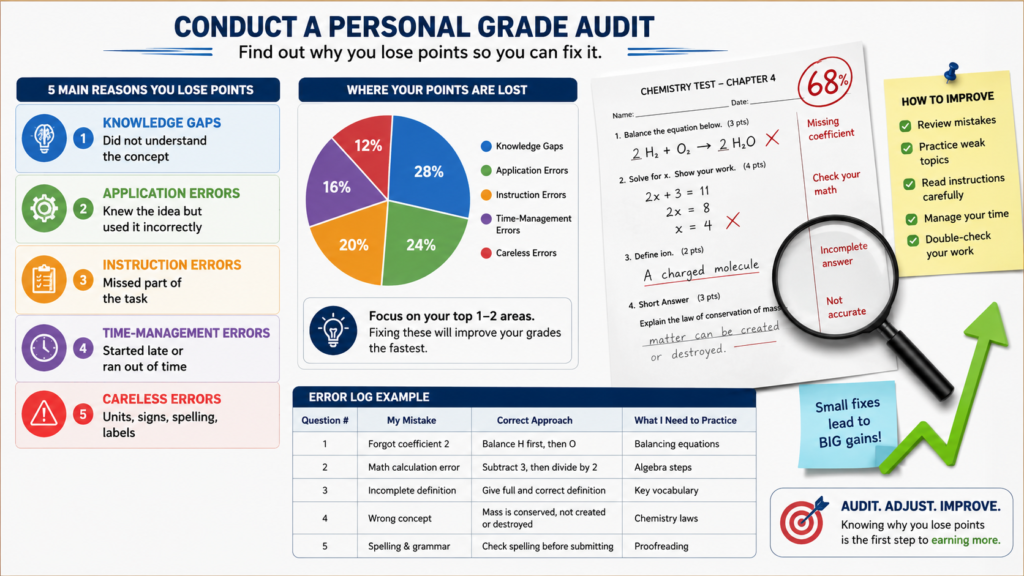
Before creating a new study schedule, study your existing grades.
Download or write down every scored assignment and sort the lost points into categories.
Knowledge Gaps
You did not understand the concept.
Examples:
- Could not solve the equation
- Misunderstood a historical event
- Confused two scientific processes
- Used the wrong theory
- Could not explain the reading
Application Errors
You knew the information but could not use it correctly.
Examples:
- Chose the wrong formula
- Misread a graph
- Failed to apply evidence
- Used the correct concept in the wrong situation
Instruction Errors
You did not follow the task correctly.
Examples:
- Answered only one part
- Used the wrong format
- Exceeded or missed the word count
- Forgot citations
- Submitted the wrong document
Time-Management Errors
Your work suffered because you started too late or ran out of time.
Examples:
- Rushed an essay
- Left exam questions blank
- Missed a deadline
- Submitted an incomplete project
Careless Errors
You understood the task but made preventable mistakes.
Examples:
- Sign errors
- Incorrect units
- Spelling mistakes
- Unlabeled graphs
- Copied a number incorrectly
Count how many points you lose in each category. The largest category should become your first improvement target.
Replace Passive Review With Active Recall
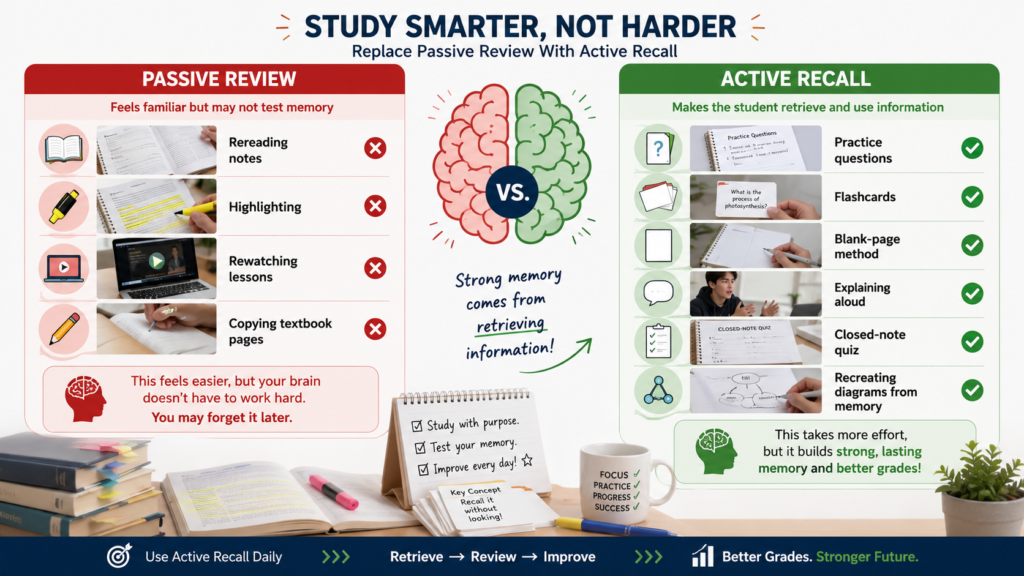
Many students study by rereading chapters, highlighting notes, or watching lessons repeatedly. These activities can create familiarity, but familiarity is not the same as being able to retrieve and apply information independently.
Active recall requires you to produce an answer without looking at the material.
Examples include:
- Answering practice questions
- Using flashcards
- Writing everything you remember
- Explaining a topic aloud
- Recreating a diagram from memory
- Solving problems without examples
- Taking a closed-note practice quiz
Research-based guidance from the U.S. Department of Education recommends using quizzes and active retrieval throughout learning because retrieving information strengthens long-term memory.
Use the Blank-Page Method
After studying a topic:
- Close your notes.
- Write everything you remember.
- Organize the information into major ideas.
- Reopen your notes.
- Add missing details in another color.
- Test yourself again later.
The differences between your memory and your notes reveal what needs more work.
Convert Notes Into Questions
Instead of copying:
Mitochondria generate ATP through cellular respiration.
Write:
What is the role of mitochondria in cellular respiration?
Questions force you to practice retrieval instead of recognition.
Space Your Study Sessions
Cramming places most of your study time into one long session. Spaced practice divides review across several days.
The spacing effect describes the advantage of distributing practice over time instead of completing the same amount of practice in one concentrated session.
A simple review schedule might look like this:
| Review | Suggested timing |
| First review | Same day as class |
| Second review | One or two days later |
| Third review | About four days later |
| Fourth review | About one week later |
| Final review | Before the assessment |
The intervals do not need to be exact. The goal is to revisit material after some forgetting has occurred.
Combine spacing with active recall:
- Do not merely reread the chapter four times.
- Test yourself four times across different days.
- Review explanations only after trying to recall the answer.
Use Practice Testing Correctly
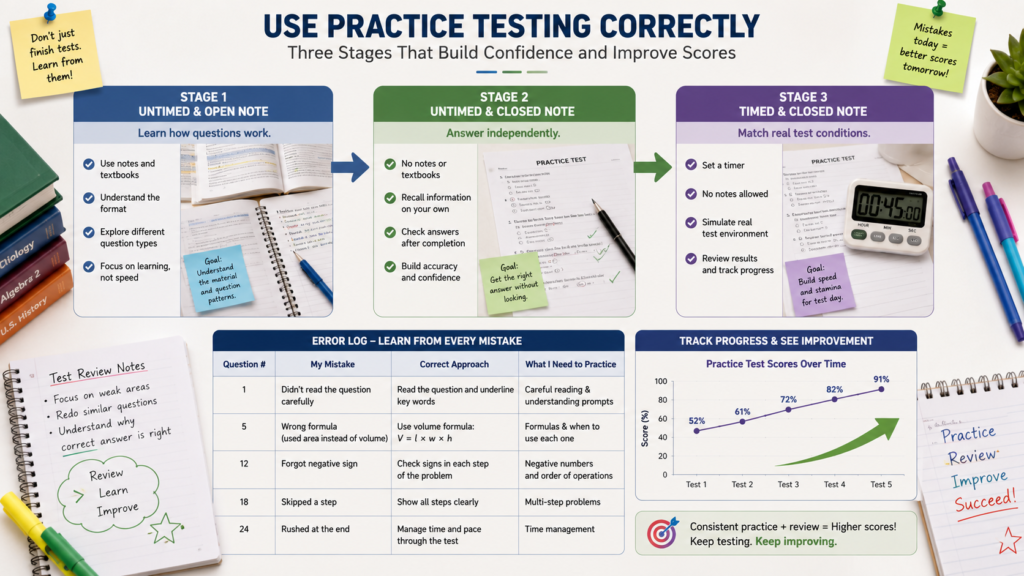
Practice tests reveal whether you can retrieve information, apply it, and manage time under realistic conditions.
When repeated calculation mistakes are affecting your scores, these steps on how to get better at math can help you strengthen weak skills through regular problem-solving practice.
The American Psychological Association highlights repeated retrieval practice as a strong way to improve future access to learned information.
Use practice tests in three stages.
Stage 1: Untimed and Open Note
Learn how the questions work. Focus on accuracy and reasoning.
Stage 2: Untimed and Closed Note
Attempt answers independently. Check your notes only after finishing.
Stage 3: Timed and Closed Note
Match the real assessment conditions as closely as possible.
Afterward, create an error log:
| Question | My error | Correct approach | What I will practice |
| 4 | Misread the graph | Compare the axes before choosing | Graph interpretation |
| 11 | Forgot the formula | Retrieve formula before solving | Formula practice |
| 18 | Chose a vague answer | Use evidence from the passage | Evidence-based responses |
The value of practice testing comes largely from reviewing why answers were wrong.
Improve Your Class Notes
Strong notes should help you think, review, and test yourself. They do not need to contain every sentence spoken by the instructor.
Organize each page into:
- Main topic
- Key ideas
- Definitions
- Worked examples
- Questions
- Areas of confusion
- Brief summary
After class, spend five to ten minutes cleaning up the notes. Fill in missing steps while the lesson is still fresh.
Add questions in the margin. These become ready-made active-recall prompts.
For example:
| Notes | Self-test question |
| Supply generally increases when price rises | How does price affect quantity supplied? |
| The nucleus stores genetic material | What is the primary function of the nucleus? |
| Judicial review allows courts to assess laws | What does judicial review permit courts to do? |
Read Textbooks More Effectively
Reading a chapter from beginning to end without interruption is often inefficient.
Use a question-based reading process.
Preview
Examine:
- Headings
- Learning objectives
- Diagrams
- Vocabulary
- Chapter summaries
- Review questions
Question
Turn headings into questions.
Heading:
Causes of the Civil War
Question:
What political, economic, and social factors contributed to the Civil War?
Read
Read to answer the question rather than to finish pages.
Retrieve
Close the book and explain the answer.
Review
Check what you missed and correct misunderstandings.
This method makes reading an active task.
Create a Weekly Study Schedule You Can Maintain
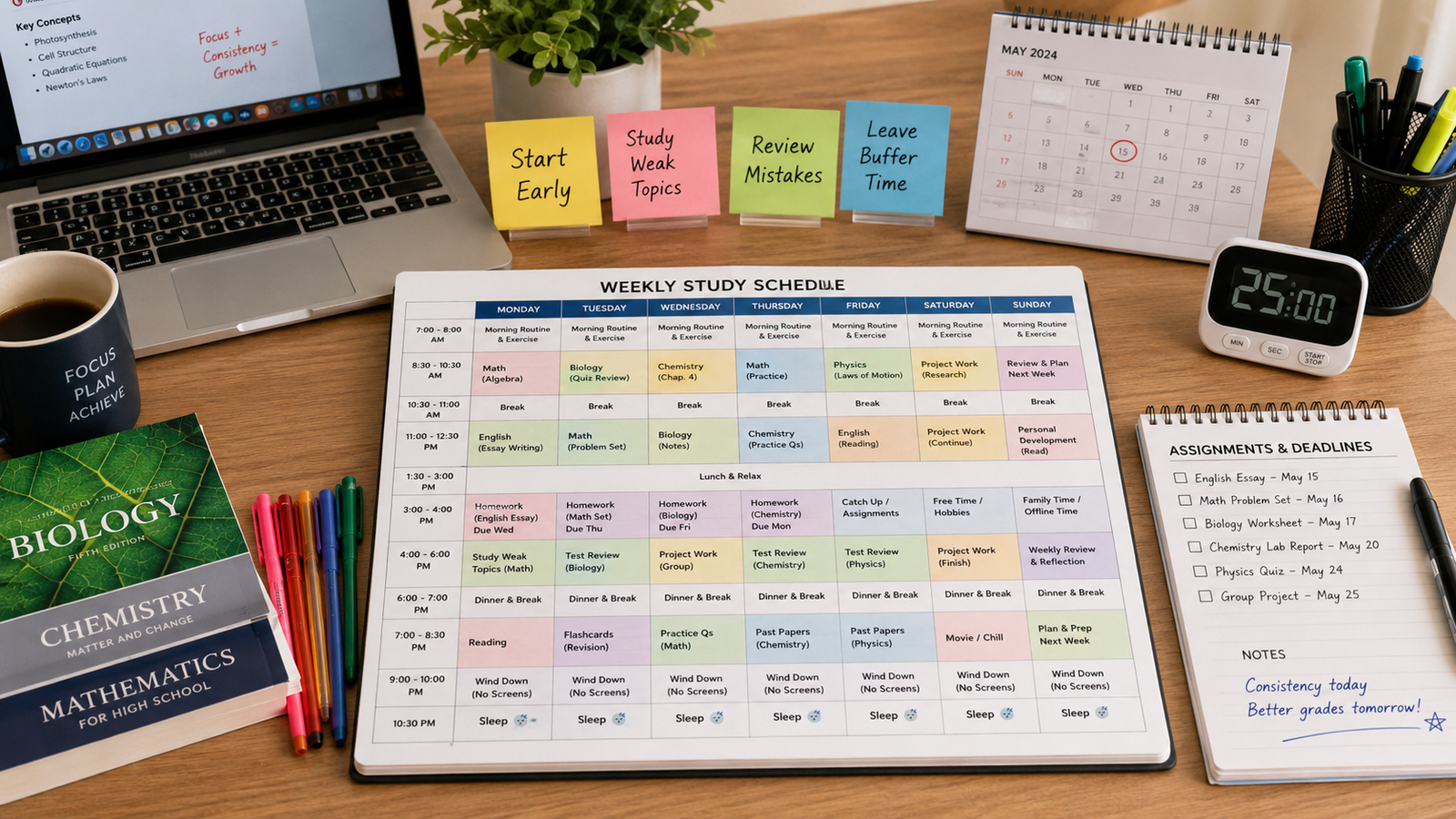
An unrealistic schedule usually collapses after a few days. Students who struggle to balance homework, tests, activities, and personal responsibilities can use these time management activities for high school students to build a schedule they can actually follow.
Do not plan every available hour. Leave room for meals, transportation, work, activities, rest, and unexpected tasks.
Example Weekly Schedule
| Day | Main academic task | Time |
| Monday | Review lecture notes and complete math practice | 60 minutes |
| Tuesday | Draft history essay and quiz biology terms | 75 minutes |
| Wednesday | Finish math homework and review errors | 60 minutes |
| Thursday | Revise history essay and complete biology questions | 75 minutes |
| Friday | Weekly review and organize upcoming deadlines | 45 minutes |
| Saturday | Major project work and practice test | 2 hours |
| Sunday | Plan the week and complete light review | 45 minutes |
Assign specific tasks instead of writing “study.”
Weak plan:
Study science for one hour.
Better plan:
Complete 20 genetics questions, review wrong answers, and recreate the meiosis diagram from memory.
Use Focused Study Blocks
Long study sessions are not always productive. Concentration often drops while the student remains seated.
Try:
- 25 minutes of focused work and a 5-minute break
- 40 minutes of work and a 10-minute break
- 50 minutes of work and a 10-minute break
Choose a format that matches the difficulty of the task and your ability to concentrate.
During a work block:
- Put your phone away.
- Close unrelated tabs.
- Keep only required materials nearby.
- Write down distracting thoughts instead of acting on them.
- Work toward one measurable outcome.
A study block should end with completed questions, reviewed material, drafted paragraphs, or another visible result.
Ask Better Questions in Class
Telling an instructor, “I don’t understand anything,” makes it difficult for them to identify the problem.
Ask specific questions:
- “Why is this formula used instead of the previous one?”
- “Where did my reasoning become incorrect?”
- “Does my thesis answer the prompt?”
- “What is missing from this explanation?”
- “Which concept should I review before attempting this problem?”
- “Can you show me how these two ideas are different?”
Bring your attempted work. Instructors can provide better feedback when they see your reasoning.
Use Instructor Feedback as a Study Guide
Comments on assignments often identify exactly what will improve future work.
Create a feedback tracker:
| Feedback received | What it means | Action for next task |
| “Needs stronger evidence” | Claims are not sufficiently supported | Add a source or example after each main claim |
| “Show your work” | Answer lacks mathematical reasoning | Write each calculation step |
| “Too descriptive” | Work summarizes but does not analyze | Explain why the evidence matters |
| “Unclear organization” | Ideas are difficult to follow | Outline before writing |
Before submitting your next assignment, review the tracker.
Students often lose the same points repeatedly because they read feedback once but never convert it into a new behavior.
Improve Test Performance
Studying and test-taking are related but different skills. For subject-specific preparation, students taking AP Biology can review how long the AP Biology Exam is and plan their practice around the official section timing.
Before the Test
- Review over several days.
- Complete practice questions.
- Identify weak topics.
- Practice under time limits.
- Prepare required materials.
- Sleep instead of studying all night.
Research reviews have found close relationships among sleep, learning capacity, memory, and academic performance.
During the Test
- Read directions carefully.
- Check the number of sections.
- Note the available time.
- Start with questions you can answer.
- Mark difficult questions and return later.
- Reserve time for review.
- Answer every required part.
- Check units, labels, and calculations.
After the Test
Do not look only at the final score.
Ask:
- Which topics caused errors?
- Did I run out of time?
- Did I misread instructions?
- Did I know the material but fail to explain it?
- Were mistakes conceptual or careless?
- What should I change before the next test?
Every returned exam can become a personalized study guide.
Improve Writing Assignment Grades
For essays and written projects, begin with the rubric.
Turn each rubric category into a checklist:
- Clear response to the prompt
- Strong thesis or central claim
- Logical paragraph organization
- Relevant evidence
- Explanation of evidence
- Correct citations
- Required formatting
- Proofreading
- Submission requirements
Use a Three-Stage Writing Process
Stage 1: Plan
Create the thesis, main points, and evidence.
Stage 2: Draft
Focus on developing complete ideas without trying to perfect every sentence immediately.
Stage 3: Revise
Check structure, reasoning, evidence, clarity, grammar, and formatting separately.
Trying to research, draft, edit, and proofread at the same time often slows the process and leads to missed issues.
Improve Math and Science Grades
Math and science courses require frequent problem-solving practice. Students preparing for an upcoming exam can also follow this guide on how to study for a math test to practice formulas, review mistakes, and work under timed conditions.
Do not rely on watching someone else solve questions.
Use this sequence:
- Review one worked example.
- Cover the solution.
- Solve a similar problem independently.
- Check the answer.
- Identify the first incorrect step.
- Correct the reasoning.
- Solve another question without assistance.
Create an error log for:
- Formula selection
- Algebra
- Units
- Signs
- Graph interpretation
- Scientific reasoning
- Calculation steps
Reviewing the error log before an exam may be more useful than repeating questions you already know how to solve.
Improve Grades in Online Classes
Online courses require students to manage deadlines without frequent in-person reminders.
At the beginning of each week:
- Open every course dashboard.
- Record all deadlines.
- Check announcements.
- Download instructions and rubrics.
- Identify quizzes that require preparation.
- Schedule discussion posts and replies separately.
- Begin major assignments before the due date.
Do not assume that “due Sunday” means you should begin Sunday.
Online students also need to check whether an assignment has multiple parts. A discussion activity may require an original response plus two peer replies on different dates.
Build a Grade-Recovery Plan
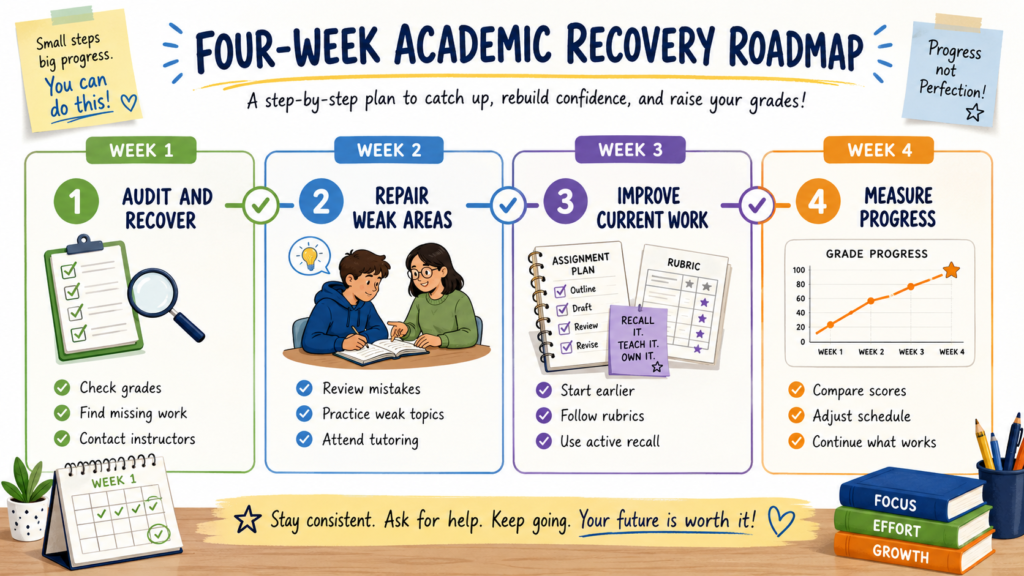
Use this four-week template when your grades need immediate attention.
1: Audit and Recover
- List every grade.
- Identify missing work.
- Review course policies.
- Contact instructors.
- Submit recoverable assignments.
- Calculate realistic grade targets.
2: Repair Weak Areas
- Categorize previous mistakes.
- Choose the two weakest topics.
- Complete targeted practice.
- Attend office hours or tutoring.
- Begin using an error log.
3: Improve Current Work
- Start assignments earlier.
- Follow rubrics carefully.
- Use active recall.
- Complete timed practice.
- Review instructor feedback before submitting.
4: Measure Progress
- Compare recent and previous scores.
- Identify which changes worked.
- Adjust the weekly schedule.
- Continue successful methods.
- Ask for further guidance where needed.
Do not attempt to change ten habits at once. Choose two or three behaviors that will have the largest impact.
What to Do When You Feel Academically Overwhelmed
When everything feels urgent, students may avoid starting because they do not know which task to choose.
Use the following reset:
- Write every task in one place.
- Mark each deadline.
- Identify tasks that can still earn points.
- Circle the three highest-impact items.
- Break the first item into a 20-minute starting step.
- Begin before trying to perfect the entire plan.
Your first task may be:
- Open the assignment instructions.
- Create the document.
- Write an outline.
- Solve the first five questions.
- Email the instructor.
- Collect the required sources.
A small completed action reduces uncertainty and creates momentum.
If stress, attention difficulties, illness, or another personal issue is significantly affecting your schoolwork, contact a school counselor, academic adviser, accessibility office, or qualified health professional. Study strategies are useful, but they do not replace appropriate support.
Habits That Can Lower Your Grades
Avoid relying on:
- Last-minute cramming
- Copying notes without testing yourself
- Studying only easy material
- Multitasking with social media
- Skipping class after falling behind
- Ignoring instructor feedback
- Waiting for motivation
- Completing low-value tasks before major assignments
- Sacrificing sleep repeatedly
- Comparing your progress constantly with others
Improvement depends more on consistent actions than occasional long study sessions.
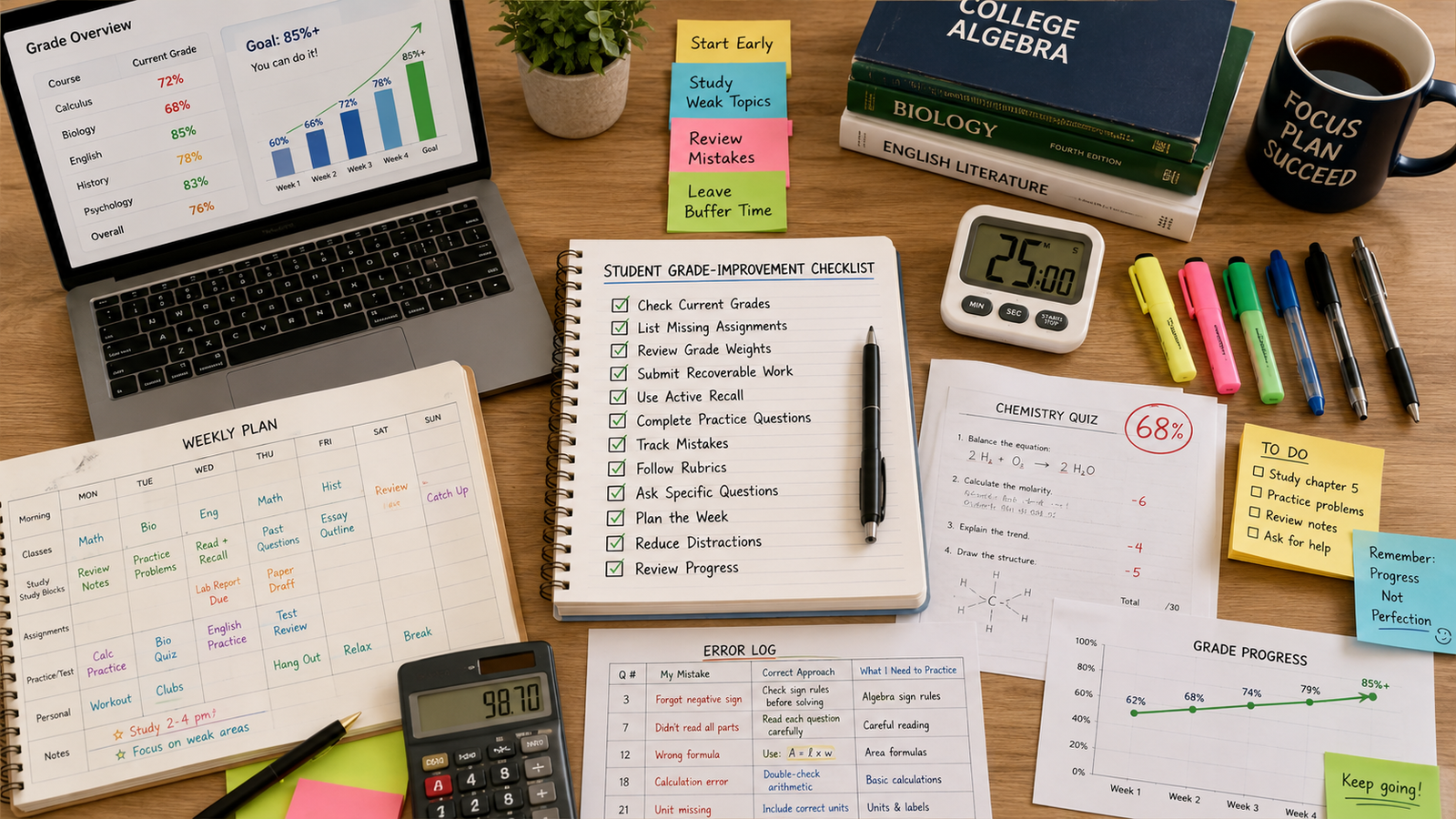
Student Grade-Improvement Checklist
Review Your Current Position
- Check every course grade.
- List missing assignments.
- Review grading weights.
- Calculate realistic targets.
- Identify your main source of lost points.
Recover Available Points
- Submit accepted late work.
- Ask about revisions or corrections.
- Complete high-value tasks first.
- Follow every rubric requirement.
- Stop missing small recurring assignments.
Study More Effectively
- Use active recall.
- Space review across several days.
- Complete practice questions.
- Keep an error log.
- Study weak areas first.
- Practice under realistic conditions.
Improve Your Routine
- Plan the week in advance.
- Use focused study blocks.
- Remove distractions.
- Review feedback.
- Ask specific questions.
- Maintain a consistent sleep schedule.
Frequently Asked Questions
How can I boost my grades quickly?
Start by checking for missing work, accepted late assignments, test corrections, revisions, and upcoming high-weight assessments. Complete tasks that can still earn the largest number of points before spending time on low-value work.
Can I raise my grade in one week?
A noticeable improvement may be possible when missing assignments can still be submitted or a major assessment is approaching. However, the result depends on assignment weights, current grades, and course policies. Calculate what is mathematically possible before setting a target.
What is the most effective way to study?
Active recall, spaced practice, and practice testing are generally more useful than passive rereading alone. Try answering questions without notes, reviewing the gaps, and testing yourself again on another day.
How many hours should I study each day?
There is no single correct number for every student. The required time depends on course difficulty, workload, existing understanding, and upcoming deadlines. Focus on clearly defined tasks and measurable progress rather than simply counting hours.
Why do I study hard but still get low grades?
You may be using passive methods, practicing only familiar topics, misreading questions, ignoring feedback, or losing points through incomplete instructions and poor time management. Review previous work to find the pattern before changing your routine.
Should I study my strongest or weakest subject first?
Give priority to weak subjects with urgent deadlines or high-value assessments. However, continue short maintenance reviews for stronger courses so they do not become new problems.
Is it too late to improve my grades?
It depends on how much of the course remains and which assignments can still affect the final score. Review the syllabus, calculate possible outcomes, and speak with your instructor as early as possible.
Does sleep affect grades?
Sleep supports attention, learning, and memory. Research has associated insufficient or poor-quality sleep with weaker learning and academic performance, so repeatedly replacing sleep with late-night studying may be counterproductive.
How can I stop procrastinating?
Break the task into a small first action, remove distractions, and work for a short timed block. Do not wait until you feel fully motivated. Starting often reduces the resistance that makes the task feel overwhelming.
Should I ask my teacher for extra credit?
First complete all regular work and check the written course policy. Ask respectfully whether revisions, corrections, or approved extra-credit opportunities exist. Do not expect an instructor to create a special assignment solely to replace work you chose not to complete.
Final Thoughts
Boosting your grades begins with understanding why points are being lost. A student with missing assignments needs a different plan from someone who struggles with test anxiety, weak understanding, careless errors, or poor scheduling.
Begin with a grade audit. Recover available points, prioritize high-value work, and turn instructor feedback into specific actions. Then replace passive review with retrieval practice, spaced learning, targeted questions, and realistic test practice.
You do not need to rebuild your entire academic routine overnight. Choose one immediate action and one long-term habit:
- Submit one recoverable assignment.
- Create one error log.
- Schedule three focused review sessions.
- Ask one specific question.
- Begin the next major task earlier.
Small changes become valuable when they are repeated. The goal is not simply to spend more time studying. It is to use your available time on the actions most likely to improve understanding, performance, and future grades. Falling behind in several classes can make it difficult to decide what to complete first. Visit Pay Someone to Do My Online Course to learn about available support for managing online coursework, deadlines, and demanding class schedules.