
Maya opened her laptop at 7:30 p.m. She had already spent the entire day attending classes, taking notes, completing a quiz and preparing for a group presentation. Her evening task list still included math problems, two textbook chapters, a discussion post, and research for an upcoming paper.
At first, she told herself she would finish everything before bed. By 10:00 p.m., however, she was rereading the same paragraph, checking the clock every few minutes, and worrying about how tired she would feel the next morning.
The problem was not one difficult assignment. It was the combination of limited time, multiple deadlines, fear of poor grades, and the feeling that the work never truly ended.
So, how does homework cause stress?
Homework can cause stress when its demands feel greater than a student’s available time, energy, skills, or support. Heavy workloads, unclear instructions, competing deadlines, perfectionism, and lost sleep can make ordinary assignments feel unmanageable. Students may then experience worry, frustration, physical tension, poor concentration, and burnout.
Homework is not automatically harmful. A focused assignment can reinforce classroom learning and help students practice important skills. Stress becomes more likely when homework is excessive, poorly coordinated, unnecessarily difficult, or completed under constant pressure.
This guide explains why homework can become stressful, how it affects students, what warning signs to notice, and how students, parents, and instructors can reduce unnecessary academic pressure.
Quick Answer: How Does Homework Cause Stress?
Homework causes stress when students believe they do not have enough time, ability, energy, or support to complete what is expected.
Common causes include:
- Too much work at once
- Several deadlines on the same day
- Unclear assignment instructions
- Fear of low grades
- Perfectionism
- Difficulty understanding the material
- Distractions at home
- Family, work, or extracurricular responsibilities
- Procrastination
- Loss of sleep
- Limited breaks and recovery time
- Feeling unable to ask for help
The American Psychological Association identifies homework deadlines and upcoming exams as examples of events that can produce short-term stress in students. Stress does not always mean a student is lazy or unprepared; it can be a response to demands that feel difficult to control.
What Is Homework Stress?
Homework stress is the mental, emotional, or physical pressure a student experiences while thinking about, starting, completing, or submitting schoolwork outside class.
It may appear before the student begins working:
“There is too much to finish tonight.”
It may happen during the assignment:
“I do not understand this, and I am running out of time.”
It may continue after submission:
“What if I misunderstood the instructions and receive a bad grade?”
A small amount of pressure can encourage a student to begin a task or meet a deadline. The problem develops when the stress is frequent, intense, or difficult to escape.
Healthy academic pressure usually has:
- A clear purpose
- Realistic expectations
- Enough time
- Accessible support
- Opportunities for rest
- Feedback that helps the student improve
Unhealthy homework pressure often feels:
- Constant
- Confusing
- Unpredictable
- Punitive
- Impossible to complete well
- Difficult to balance with basic needs
Why Does Homework Cause Stress?
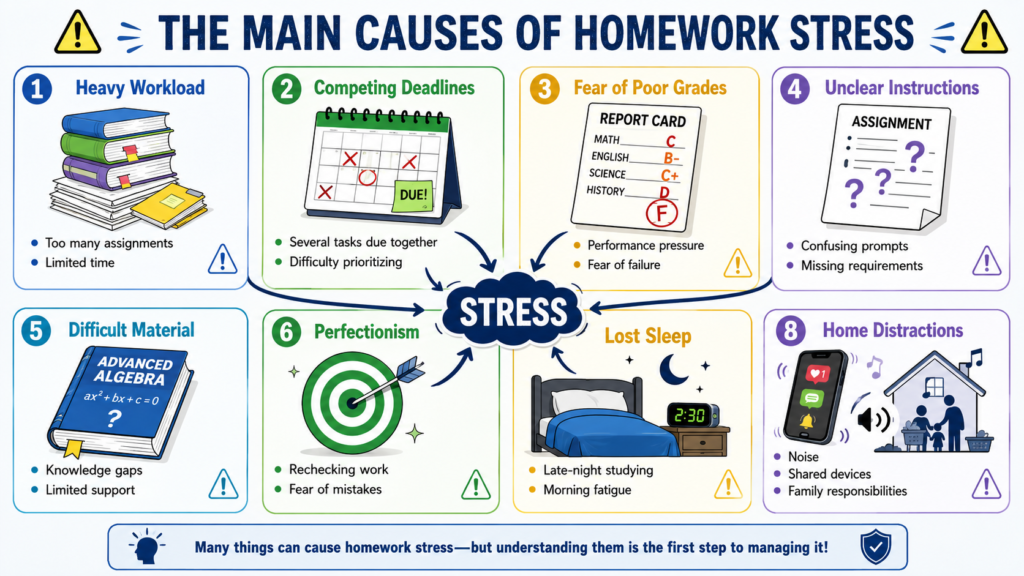
Homework stress rarely comes from one source. It usually develops when several pressures combine.
A student may have a reasonable assignment but an unreasonable schedule. Another may have enough time but lack the background knowledge needed to complete the task. A third may understand the material but feel that anything below a perfect grade is a failure.
The following factors explain why homework becomes stressful for many students.
1. The Workload Feels Larger Than the Available Time
The most direct source of homework stress is an imbalance between how much work students receive and how much time they have to complete it.
A student’s after-school hours may already include:
- Commuting
- Sports
- Employment
- Household responsibilities
- Family care
- Meals
- Religious or community activities
- Personal hygiene
- Sleep
When each instructor assigns work without considering the student’s total workload, several individually reasonable assignments can become overwhelming when combined. Practicing these time management activities for high school students can help learners estimate task duration, prioritize deadlines, reduce distractions, and create a more realistic homework schedule.
For example, one teacher may assign 45 minutes of reading, another may assign a worksheet, and a third may schedule a test. None of these tasks appears extreme alone. Together, they may require several hours.
The stress comes from the feeling that there is no acceptable choice. The student must either:
- Rush the work
- Submit something incomplete
- skip another responsibility
- Sacrifice sleep
- Accept a lower grade
Research discussed by the American Psychological Association has linked excessive homework, particularly in high-achieving environments, with greater stress and reduced balance in students’ lives.
2. Multiple Deadlines Compete for Attention
Students often manage assignments from several courses at the same time.
A typical week may include:
- A math problem set
- A science lab report
- A history reading
- A group presentation
- A discussion-board response
- An essay draft
- A quiz
- A major exam
When deadlines cluster together, students must constantly decide which task deserves attention first. This creates mental overload.
Even while working on one assignment, a student may be thinking:
“I should be studying for tomorrow’s exam.”
That divided attention makes concentration harder. The student may work more slowly, which creates even more pressure.
Deadline stress is particularly difficult when:
- Several major assignments are due together
- Instructions arrive late
- Deadlines change unexpectedly
- Group members depend on one another
- Students cannot estimate how long a task will take
- Late penalties are severe
3. Students Fear Poor Grades
Homework often contributes directly to course grades. As a result, students may treat every assignment as a judgment of their intelligence or future potential. Students concerned about their academic performance can use these practical strategies on how to boost your grades without treating every homework assignment as a test of personal worth.
A low grade may feel connected to:
- College admission
- Scholarships
- Family expectations
- Athletic eligibility
- Academic standing
- Graduation requirements
- Career plans
This can turn a normal assignment into a high-stakes event.
Instead of thinking:
“This task will help me practice.”
The student may think:
“If I make mistakes, I will damage my future.”
Fear of failure can make students:
- Avoid starting
- Recheck simple answers repeatedly
- Compare themselves with classmates
- Spend too long on small details
- Hide confusion
- Panic when they do not understand something immediately
The assignment has not necessarily become harder, but the perceived consequences have become much larger.
4. Unclear Instructions Create Uncertainty
Students cannot plan effectively when they do not understand what an assignment requires.
Unclear homework may contain:
- Vague prompts
- Missing examples
- Unexplained grading criteria
- Contradictory instructions
- Unfamiliar terminology
- No required length
- No citation guidance
- Unclear submission rules
A student may spend more time trying to interpret the assignment than completing it.
Uncertainty creates stress because students cannot confidently answer questions such as:
- What am I supposed to produce?
- How detailed should the answer be?
- Which sources are acceptable?
- Does the instructor expect an opinion or analysis?
- How will the work be graded?
- Am I doing this correctly?
Clear directions do not remove all difficulty, but they make the difficulty more manageable.
5. The Student Does Not Understand the Material
Homework is especially stressful when it requires skills the student has not yet developed.
This may happen because:
- The lesson moved too quickly
- The student missed class
- Earlier knowledge gaps were never addressed
- The textbook explains the concept differently
- The assignment is more advanced than the class example
- The student needs a different explanation
- Help is not available at home
Imagine trying to solve 20 equations when you do not understand the first step. The homework becomes a repeated reminder of confusion.
Students may then believe:
“Everyone else understands this except me.”
That belief can create embarrassment and discourage them from requesting help.
Difficulty does not always indicate a lack of effort. Sometimes the student needs additional instruction, a worked example, more practice, a different learning method, tutoring, extra time, or an approved accommodation. For students overwhelmed by formulas and problem sets, this guide on how to study for a math test explains how to use focused practice, error review, active recall, and a manageable study schedule.
- Additional instruction
- A worked example
- More practice
- A different learning method
- Tutoring
- Extra time
- An approved accommodation
6. Perfectionism Makes Every Task Feel High Stakes
Perfectionism is not simply wanting to do well. It involves setting standards that are difficult or impossible to satisfy and treating mistakes as unacceptable.
A perfectionistic student may:
- Rewrite work repeatedly
- Spend an hour on one paragraph
- Refuse to submit work that feels imperfect
- Check every answer several times
- Panic over minor formatting issues
- Avoid beginning because the task feels too important
- Interpret an average grade as failure
This creates a harmful cycle:
- The student wants the work to be perfect.
- The task feels larger and more threatening.
- The student delays starting.
- Time becomes limited.
- Stress increases.
- The final result feels disappointing.
A completed, thoughtful assignment is generally more useful than a perfect assignment that is never submitted.
7. Homework Reduces Time for Sleep
Students sometimes treat sleep as the only flexible part of their schedule.
When homework takes longer than expected, bedtime is pushed back. The student may stay awake to finish, wake early to continue, or sleep poorly because they are worried about unfinished work.
This can create a repeating cycle:
Heavy homework → later bedtime → fatigue → slower work → more homework pressure
Insufficient sleep can affect attention, memory, mood, and academic performance. The CDC notes that children and adolescents who do not get enough sleep are more likely to experience attention and behavior problems and poor academic performance.
A 2023 study examining homework burden among adolescents found associations between high homework burden, insufficient sleep, and neurobehavioral problems, although the researchers noted that the study population was limited to adolescents in Shanghai.
Homework is not the only reason students lose sleep. Phones, work, activities, early school schedules, health conditions, and family responsibilities may also contribute. However, assignments that regularly push students beyond a reasonable bedtime can make the problem worse.
8. Students Lose Time for Rest and Enjoyable Activities
Students need time that is not graded, scheduled, or evaluated.
Unstructured time allows them to:
- Rest mentally
- Exercise
- Talk with family
- See friends
- Explore hobbies
- Process the school day
- Develop interests
- Recover from pressure
When homework occupies nearly every evening, students may feel that school controls both their classroom hours and their personal time.
This can produce resentment:
“Even when I leave school, I am still at school.”
A lack of recovery time can make ordinary assignments feel increasingly exhausting. Students may become less motivated, even when they once enjoyed learning.
9. Home Is Not Always an Easy Place to Study
Homework assumes that students have an appropriate place and enough resources to complete schoolwork. That is not always true.
Possible barriers include:
- Noise
- Crowded living conditions
- Limited internet access
- Shared devices
- Caregiving responsibilities
- Household conflict
- Frequent interruptions
- Lack of transportation to a library
- No quiet desk
- Work responsibilities
- Financial pressure
Two students may receive the same assignment but face very different conditions.
One may have a quiet room, reliable laptop, and an available parent. Another may complete the same work on a phone while caring for a younger sibling.
Homework-related stress therefore cannot always be solved by telling students to “manage time better.” Sometimes the environment must also be considered.
10. Procrastination Increases Time Pressure
Procrastination means delaying a task even though the delay may create negative consequences.
Students may procrastinate because the assignment feels:
- Boring
- Confusing
- Difficult
- Too large
- Emotionally uncomfortable
- Unimportant
- Impossible to complete perfectly
They may temporarily escape discomfort by watching videos, cleaning their room, scrolling through social media, or working on an easier task.
However, the assignment remains unfinished. As the deadline approaches, the student has less time and greater anxiety.
The cycle often looks like this:
Task feels uncomfortable → student delays → deadline gets closer → task feels more threatening → student delays again
Procrastination is not always carelessness. It can be a form of avoidance caused by stress itself.
11. Digital Homework Can Create Constant Availability
Online learning platforms make assignments easy to distribute, but they can also make schoolwork feel endless.
Students may receive:
- Evening announcements
- Automatic deadline reminders
- New discussion responses
- Group messages
- Revised instructions
- Grade notifications
- Additional online tasks
The student may feel expected to remain available at all times.
Digital assignments can also involve technical stress:
- Slow internet
- Lost work
- Submission errors
- Expired links
- Incompatible files
- Platform outages
- Unclear upload confirmation
A printed worksheet has a visible ending. An online course may continue generating notifications after the student believes the workday is over.
12. Students Compare Their Performance With Others
Homework frequently becomes a source of comparison.
Students may notice that a classmate:
- Finishes faster
- Receives higher grades
- Appears less stressed
- Understands difficult concepts immediately
- Has more parental support
- Can afford private tutoring
- Has fewer responsibilities outside school
These comparisons can lead students to question their ability.
However, students rarely see the full situation. The classmate may have previous experience, different responsibilities, additional support, or private struggles.
Comparison increases stress when students judge their worth by another person’s speed or results.
13. Family Expectations Can Increase Pressure
Family encouragement can help students stay motivated. Pressure becomes harmful when students believe love, approval, or respect depends on academic performance.
Stress may increase when families:
- Expect perfect grades
- Compare siblings
- Punish mistakes harshly
- Focus only on outcomes
- Dismiss exhaustion
- Treat one low grade as a crisis
- Set goals without considering the student’s interests
Students may hide difficulties because they fear disappointing their families.
A more supportive response is:
“Let us understand what made this assignment difficult and decide what support would help.”
This keeps the focus on learning rather than shame.
Does Homework Always Cause Stress?
No. Homework does not automatically cause harmful stress.
Well-designed assignments may help students:
- Practice skills
- Review important concepts
- Prepare for class
- Identify confusion
- Develop independence
- Apply information
- Build study habits
- Complete long-term projects gradually
Stress is more likely when homework becomes excessive, unclear, repetitive, or disconnected from meaningful learning.
A useful assignment should have an identifiable purpose. Students should be able to answer:
“What am I supposed to learn or practice by doing this?”
Homework becomes less useful when it mainly measures endurance.
What Are the Signs of Homework Stress?
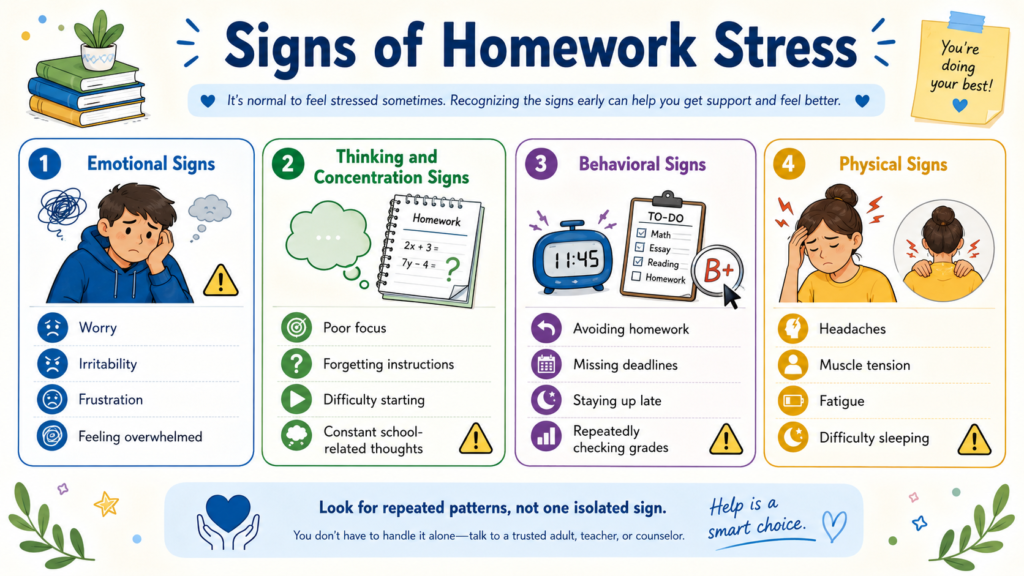
Homework stress can affect emotions, thoughts, behavior, and the body.
One sign alone does not prove that homework is the cause. Look for repeated patterns, especially when symptoms appear before assignments or during heavy academic periods.
Emotional Signs
A stressed student may experience:
- Worry
- Irritability
- Frustration
- Anger
- Helplessness
- Fear of failure
- Embarrassment
- Loss of motivation
- Feeling overwhelmed
- Frequent crying
Thinking and Concentration Signs
Homework stress may make it difficult to:
- Focus
- Remember instructions
- Make decisions
- Prioritize tasks
- Understand readings
- Begin an assignment
- Recognize completed progress
- Stop thinking about schoolwork
The student may sit at a desk for a long time without making meaningful progress.
Behavioral Signs
Watch for:
- Avoiding homework
- Hiding assignments
- Missing deadlines
- Constantly checking grades
- Repeatedly asking for reassurance
- Staying up very late
- Skipping meals or activities
- Copying work out of panic
- Refusing to attend school
- Becoming unusually withdrawn
Physical Signs
Stress can sometimes appear as:
- Headaches
- Muscle tension
- Stomach discomfort
- Fatigue
- Restlessness
- Rapid heartbeat
- Difficulty sleeping
- Changes in appetite
These symptoms can have many causes. Persistent, severe, or concerning physical symptoms should be discussed with a qualified healthcare professional.
How Can Homework Stress Affect Students?
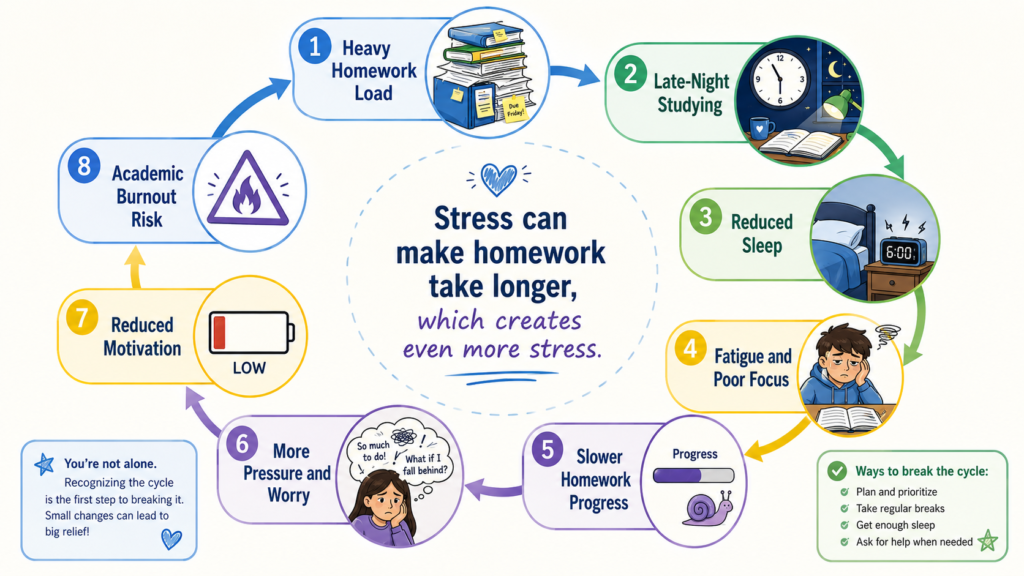
The effects of homework stress can extend beyond one unpleasant evening.
It Can Reduce Concentration
Stress occupies mental attention.
Instead of focusing entirely on the task, the student may think about:
- The remaining workload
- Possible mistakes
- The deadline
- The grade
- Other unfinished assignments
- What will happen if the work is late
This reduces the attention available for learning.
It Can Make Students Work More Slowly
A stressed student may reread instructions, second-guess answers, or switch repeatedly between tasks.
The student then needs more time, which confirms the belief that the workload is impossible.
It Can Harm Sleep
Late homework sessions may reduce sleep duration, while worry can make it difficult to fall asleep even after the work is finished.
Short sleep and academic difficulty can reinforce one another. CDC research has found that students sleeping fewer than seven hours on school nights were more likely to report increased difficulty doing schoolwork in the studied population.
It Can Reduce Motivation
When every assignment feels stressful, students may stop connecting homework with learning.
They begin to focus on:
- Finishing
- Avoiding punishment
- Protecting grades
- Getting through the week
Curiosity is replaced by survival.
It Can Encourage Academic Dishonesty
Students under severe time pressure may copy answers, misuse online tools, or submit work they did not complete independently.
This does not excuse dishonesty. It shows why prevention must include realistic workload, clear instructions, and early access to support.
It Can Contribute to Academic Burnout
Burnout involves prolonged exhaustion, detachment, and reduced confidence connected to ongoing demands.
A student experiencing burnout may say:
- “I do not care anymore.”
- “Nothing I do is enough.”
- “I cannot keep doing this.”
- “I am tired before I even start.”
Research has found relationships between academic stress, anxiety, and academic burnout in adolescent samples, although specific findings should be interpreted within the limits of each study’s population and design.
It Can Affect Relationships
Homework stress may produce arguments with:
- Parents
- Siblings
- Friends
- Teachers
- Group members
A student may appear rude or uncooperative when they are actually exhausted and overwhelmed.
Why Do Some Students Experience More Homework Stress Than Others?
Students respond differently to the same workload.
Factors may include:
- Age
- Learning differences
- Previous knowledge
- Confidence
- Mental and physical health
- Family support
- Home environment
- Financial responsibilities
- Access to technology
- Language proficiency
- Time-management skills
- Course difficulty
- Number of extracurricular activities
A task that takes one student 30 minutes may take another two hours.
Fairness therefore does not always mean giving every student identical conditions. Some students may need approved accommodations, extended time, alternative formats, or additional instruction.
How Much Homework Is Too Much?
There is no single time limit that works for every student, course, or age group.
Two hours of meaningful research for a major project is different from two hours of repetitive exercises. The effect also depends on whether the assignment:
- Matches the student’s level
- Has a clear purpose
- Is spread across several days
- Requires unavailable resources
- Repeats already-mastered material
- Prevents adequate sleep
- Conflicts with multiple major deadlines
Homework may be excessive when it regularly:
- Pushes students past a healthy bedtime
- Prevents meals, movement, or basic self-care
- Causes frequent emotional distress
- Requires substantial adult completion
- Leaves no time for rest
- Exceeds the stated course expectations
- Produces little learning compared with the time required
School pressure is a broader concern as well. A WHO Europe report published in 2024 found that reported pressure from schoolwork had increased among surveyed adolescents, with especially high levels among older girls. The figures came from the Health Behaviour in School-aged Children study across participating countries and regions, so they should not be treated as a universal rate for every student population.
How Can Students Reduce Homework Stress?
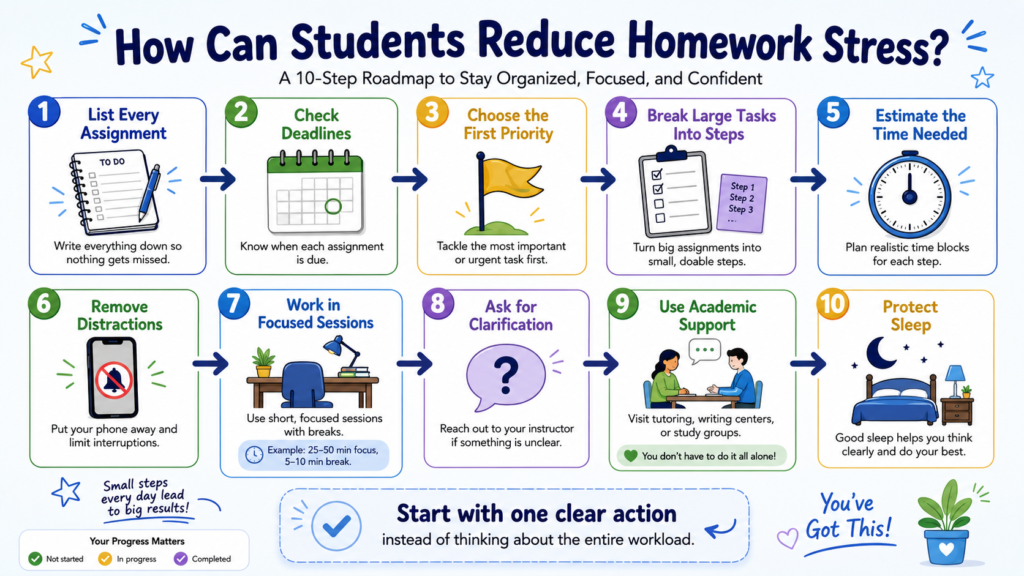
Students cannot control every assignment, but they can make the workload easier to understand and manage.
1. Put Every Assignment in One Place
Use:
- A paper planner
- Calendar
- Task app
- Spreadsheet
- Course dashboard
- Whiteboard
Record:
- Assignment
- Course
- Deadline
- Estimated time
- Required materials
- First action
- Completion status
Do not rely on memory when several courses are involved.
2. Break Large Assignments Into Smaller Steps
“Write a research paper” is too broad.
Break it into:
- Read the prompt.
- Choose the topic.
- Write the research question.
- Find five sources.
- Take notes.
- Draft the thesis.
- Create the outline.
- Write the introduction.
- Draft the first section.
- Add citations.
- Revise.
- Proofread.
- Submit.
Small steps give the student a clear starting point. For a major writing assignment, learning how to write an outline for a research paper can help students divide the project into clear sections, organize sources, and begin drafting without facing the entire paper at once.
3. Choose the First Physical Action
When a student feels stuck, ask:
“What is the smallest visible action I can take?”
Examples:
- Open the assignment page.
- Download the instructions.
- Write the heading.
- Complete question one.
- Search one academic keyword.
- Read the first paragraph.
- Email the instructor.
Beginning reduces some of the uncertainty surrounding the task.
4. Estimate Time Realistically
Students often underestimate how long assignments require.
Instead of assuming an essay will take one hour, estimate each stage:
- Understanding the prompt: 15 minutes
- Research: 90 minutes
- Outline: 30 minutes
- Drafting: two hours
- Revision: 45 minutes
- Formatting: 20 minutes
Add extra time for technical issues or difficult sections.
5. Prioritize by Urgency and Importance
A simple system is:
Do First
Urgent and important tasks, such as tomorrow’s exam preparation.
Schedule
Important tasks with later deadlines, such as a research paper due next week.
Complete Quickly
Small required tasks that take only a few minutes.
Reduce or Remove
Optional activities that do not support current priorities.
The easiest task is not always the best first task.
6. Use Focused Work Sessions
Try a manageable cycle:
- Work for 25 to 45 minutes.
- Take a short break.
- Return for another focused session.
During the work period:
- Close unrelated tabs.
- Silence nonessential notifications.
- Place the phone out of reach.
- Work on one clearly defined step.
The goal is not to study continuously for several hours. It is to create periods of genuine attention.
7. Ask for Clarification Early
Students should not spend hours guessing what an instructor expects.
A useful message is:
Hello Professor, I am reviewing the assignment instructions and want to confirm that I understand the task correctly. Are we expected to compare both positions before presenting our conclusion, or should we defend one position from the beginning?
A specific question is easier for an instructor to answer than:
I do not understand anything.
8. Use Available Academic Support
Possible support includes:
- Instructor office hours
- Teaching assistants
- Tutoring centers
- Writing centers
- Librarians
- Academic advisers
- Study groups
- Disability or accessibility services
- School counselors
Requesting help early is usually more effective than waiting until the deadline. Students struggling with repeated math assignments can also learn how to get better at math by strengthening foundational skills, reviewing mistakes, and practicing difficult concepts consistently.
9. Set a Reasonable Stopping Time
Students need a boundary between schoolwork and rest.
Choose a stopping time that protects enough sleep. When the work cannot reasonably be completed, the next step may be to contact the instructor rather than stay awake indefinitely.
A useful message is:
I have worked on the assignment for two hours but am still having difficulty with the final section. I have attached what I completed. Could you clarify the last requirement or let me know whether a short extension is possible?
The instructor may not always grant an extension, but clear communication is better than disappearing.
10. Replace Perfection With Clear Standards
Before beginning, define what “complete” means.
For example:
- Answer every question.
- Include two credible sources.
- Follow the required structure.
- Proofread once.
- Submit before the deadline.
This prevents endless revision of minor details.
11. Protect Basic Needs
Students often work less effectively when they are hungry, dehydrated, physically inactive, or exhausted.
Helpful habits include:
- Eating regular meals
- Drinking water
- Taking movement breaks
- Getting outside
- Following a consistent sleep routine
- Making time to unwind
- Staying connected with supportive people
The CDC lists practices such as taking breaks, making time to unwind, spending time outdoors, journaling, and connecting with others among healthy approaches to managing stress.
How Can Parents Help With Homework Stress?
Parents can support students without completing the work for them.
Create a Calm Starting Routine
A student may need:
- Food
- A short break
- Movement
- Quiet time
- A clear workspace
before beginning homework.
Immediately asking about assignments the moment the student arrives home may increase tension.
Ask Helpful Questions
Instead of:
“Why are you still not finished?”
Try:
- “Which assignment feels most difficult?”
- “What part is unclear?”
- “What is due first?”
- “Do you need quiet, help planning, or contact with the teacher?”
- “What can be completed tonight without sacrificing sleep?”
Focus on Learning, Not Only Grades
Praise:
- Asking questions
- Beginning early
- Using feedback
- Revising
- Persisting
- Planning
- Recognizing when help is needed
A grade gives information about one performance. It should not define the student’s value.
Avoid Doing the Assignment
Parents can:
- Read instructions
- Help create a schedule
- Check that required sections are included
- Explain a similar example
- Encourage communication with the teacher
They should not write, solve, or complete the assignment on the student’s behalf.
Contact the School When a Pattern Develops
One difficult evening may be temporary. Regular late nights, frequent tears, repeated confusion, or hours of homework may require a conversation with the instructor or counselor.
Bring specific information:
- How long the homework takes
- Which assignments create difficulty
- What the student has already tried
- How sleep is affected
- Whether instructions are unclear
- Whether the pattern occurs in one course or several
How Can Teachers Reduce Homework Stress?
Homework should support learning rather than simply extend the school day.
Teachers can help by:
- Explaining the purpose of each assignment
- Providing realistic time estimates
- Giving clear written instructions
- Sharing grading criteria
- Coordinating major deadlines
- Avoiding unnecessary repetition
- Offering examples
- Allowing questions before the deadline
- Providing feedback students can use
- Considering student access to resources
- Breaking long projects into checkpoints
- Avoiding routine late-night announcements
- Creating reasonable flexibility for genuine difficulties
A shorter assignment with a clear learning goal may be more effective than a long set of repetitive tasks.
When Should a Student Seek Additional Help?
Occasional homework frustration is common. Additional support may be needed when stress:
- Continues for several weeks
- Regularly prevents sleep
- Causes frequent physical symptoms
- Leads to panic or intense fear
- Makes school attendance difficult
- Causes the student to withdraw from normal activities
- Produces persistent hopelessness
- Interferes with eating or daily functioning
- Leads to thoughts of self-harm
A student can speak with:
- A parent or trusted adult
- School counselor
- Teacher
- Academic adviser
- Doctor
- Licensed mental health professional
Homework stress can exist alongside anxiety, depression, learning difficulties, attention challenges, sleep disorders, or other concerns. A qualified professional can help identify what is happening and recommend appropriate support.
Homework Stress Management Plan
Use this practical plan when the workload feels overwhelming.
Step 1: Pause
Take several slow breaths and stop switching between tasks.
Step 2: List Everything
Write down every assignment and deadline.
Step 3: Identify the Immediate Priority
Choose the task that is both urgent and important.
Step 4: Define One Small Action
Decide what can be started within five minutes.
Step 5: Remove Distractions
Silence notifications and close unrelated tabs.
Step 6: Work for One Focused Period
Complete one specific part rather than thinking about the entire workload.
Step 7: Check Progress
Mark what is finished and update the remaining time estimate.
Step 8: Ask for Help
Contact an instructor, tutor, classmate, or family member when the problem cannot be solved independently.
Step 9: Protect Sleep
Set a reasonable stopping point.
Step 10: Review the Pattern
After the deadline, identify what caused the stress and what should change next time.
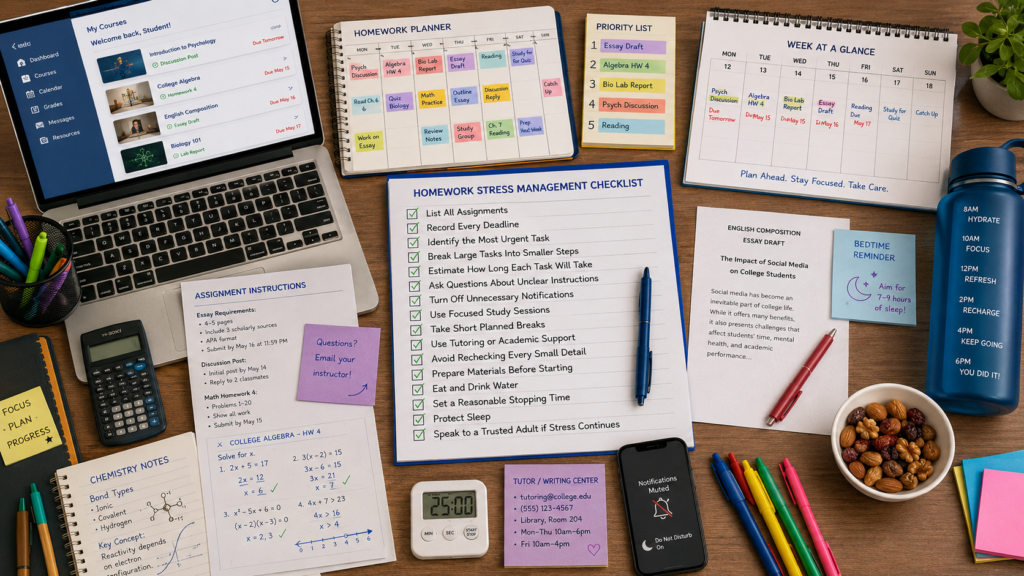
Homework Stress Checklist
Possible Causes
- I have too many assignments due together.
- I do not understand the instructions.
- I need help with the subject.
- I started later than planned.
- I am afraid of receiving a low grade.
- I am trying to make every detail perfect.
- My study space has too many distractions.
- Work or family responsibilities reduce my study time.
- I am not getting enough sleep.
- I do not know which task to complete first.
Actions to Take
- List all assignments and deadlines.
- Break the largest task into smaller steps.
- Choose one immediate action.
- Estimate the time required.
- Ask the instructor a specific question.
- Use tutoring or academic support.
- Turn off unnecessary notifications.
- Take short, planned breaks.
- Set a reasonable stopping time.
- Speak with a trusted adult when stress continues.
Frequently Asked Questions
Why does homework cause so much stress?
Homework becomes stressful when the workload feels greater than the student’s available time, skills, energy, or support. Deadlines, grades, unclear instructions, perfectionism, and insufficient sleep can increase the pressure.
Can too much homework cause anxiety?
A heavy or unpredictable workload can contribute to worry and anxious feelings. However, anxiety can have many causes, and homework alone should not be assumed to explain persistent symptoms. Students experiencing ongoing or severe anxiety should speak with a qualified professional.
Does homework cause students to lose sleep?
Homework can delay bedtime when assignments take longer than expected or several deadlines occur together. Worry about unfinished work may also make it difficult to fall asleep.
Is homework bad for students?
Homework is not automatically bad. Purposeful, manageable assignments can reinforce learning. Problems are more likely when homework is excessive, repetitive, unclear, or regularly interferes with sleep and recovery.
Why do I feel stressed before starting homework?
You may be anticipating difficulty, failure, boredom, confusion, or a large workload. Breaking the assignment into a small first action can make the task feel more manageable.
Why do students procrastinate on homework?
Students may delay homework because it feels difficult, unclear, boring, emotionally uncomfortable, or impossible to complete perfectly. Procrastination can temporarily reduce discomfort but usually increases pressure later.
How can I stop homework from overwhelming me?
Write down every assignment, select the most urgent task, break it into small steps, remove distractions, and work for one focused period. Ask for help early when the instructions or material are unclear.
Should students stay up late to finish homework?
Regularly sacrificing sleep is not a healthy long-term solution. Students should plan early, communicate about unrealistic workloads, and seek support when assignments cannot be completed within reasonable hours.
How can parents tell whether homework stress is serious?
Look for repeated sleep loss, frequent emotional distress, physical complaints, avoidance, declining functioning, or withdrawal from normal activities. Persistent or severe symptoms deserve attention from the school and an appropriate health professional.
How can teachers make homework less stressful?
Teachers can provide clear instructions, reasonable time estimates, coordinated deadlines, meaningful assignments, examples, feedback, and opportunities to ask questions.
What should I do when I do not understand my homework?
Identify the exact point of confusion, review class examples, consult reliable course resources, and ask the teacher, tutor, or classmate a specific question.
Can homework stress lead to burnout?
Ongoing academic pressure without sufficient recovery can contribute to exhaustion, detachment, and reduced motivation associated with student burnout.
Final Thoughts
So, how does homework cause stress?
Homework causes stress when students face more demands than they believe they can manage with their available time, knowledge, energy, and support. The pressure may come from excessive work, clustered deadlines, unclear instructions, difficult material, fear of poor grades, perfectionism, procrastination, or lost sleep.
The solution is not necessarily to remove every assignment. Homework can still support learning when it is purposeful, clear, appropriately challenging, and realistic.
Students can reduce pressure by organizing deadlines, breaking assignments into smaller actions, requesting clarification, using academic support, and protecting sleep. Parents can respond with calm questions and practical help rather than criticism. Teachers can reduce unnecessary stress by assigning meaningful work, coordinating deadlines, and clearly explaining expectations.
Most importantly, students should not assume that constant exhaustion is simply the price of academic success.
Learning matters, but so do sleep, health, relationships, and time to recover. A productive academic routine should make room for all of them. Students balancing several courses, work responsibilities, family demands, and close deadlines may also explore online class help for support with course organization, study planning, difficult concepts, and workload management.