
An online class can look easy on registration day.
There is no daily commute. You may be able to watch lectures from home. Some courses let you study around work, family responsibilities, or other classes.
Then the semester starts.
Your Canvas dashboard shows three assignments due Sunday. A discussion post needs two peer responses. One professor has uploaded a 70-minute lecture. Another course includes a quiz that closes at midnight. You have an unread announcement about a changed deadline and a group project meeting scheduled during your work shift.
This is the point when many students start searching for online class help from experts.
Getting help does not have to mean giving your education away to somebody else. Responsible online class help can include tutoring, course planning, study coaching, concept explanations, feedback, technical guidance, and support with understanding academic expectations.
The right help should make you more capable of managing your class. It should not create a new academic-integrity, privacy, or financial problem.
This guide explains what expert online class help should include, who may benefit, how to identify the type of support you actually need, what warning signs to avoid, and how to stay on track in an online course.
Quick Answer: What Is Online Class Help From Experts?
Online class help from experts is academic and learning support for students taking web-based courses. Depending on the student’s needs, responsible support may include tutoring, subject explanations, study planning, deadline organization, exam preparation, writing feedback, learning-platform guidance, and academic coaching.
The purpose should be to help a student understand course requirements and complete their own academic responsibilities more effectively.
Good online course support may help you:
- Understand a difficult concept
- Organize weekly modules
- Build a study schedule
- Prepare for a quiz or exam
- Interpret assignment instructions
- Review instructor feedback
- Improve study habits
- Navigate an unfamiliar learning platform
- Find appropriate college support resources
It should not involve impersonating a student, taking a proctored exam for them, misrepresenting authorship, or violating a school’s academic-integrity policy.
Key Takeaways
- Online courses provide flexibility, but they still require strong organization and self-management.
- More than half of U.S. postsecondary students were enrolled in at least one distance education course in fall 2024.
- Expert online class help should support learning, planning, and problem-solving rather than replace the student.
- Tutoring, academic coaching, writing feedback, technical support, and success coaching solve different problems.
- Students should diagnose the exact reason they are falling behind before choosing a support option.
- A missed deadline problem is not always a subject-knowledge problem.
- University tutoring, writing centers, advising, disability services, and online student-success programs should be checked first.
- Never share passwords, multifactor authentication codes, or unnecessary financial information with an unknown provider.
- Be skeptical of guaranteed grades and services that promise to impersonate you.
- The best academic support leaves you better prepared to handle the next task independently.
Why Are Students Looking for Online Class Help?
Online education is no longer a small corner of higher education.
According to the National Center for Education Statistics’ IPEDS trend data, 53.8% of students at U.S. postsecondary institutions were enrolled in distance education courses in fall 2024.
That means online learning affects traditional college students, community college students, graduate students, working adults, military-connected learners, parents, and students completing certificates or career training.
The flexibility is valuable.
The flexibility can also hide the amount of self-management required.
Online Classes Move the Schedule Onto the Student
In a traditional class, physically entering a classroom can create a routine.
An online course may require you to create that routine yourself.
You need to decide:
- When to watch lectures
- When to read assigned chapters
- When to start a project
- How to remember discussion deadlines
- How to separate study time from work and home life
- When to ask for help
Oregon State Ecampus specifically recommends setting aside recurring study time and using calendar blocks for coursework and course engagement.
The problem is that knowing you “should manage your time” is not the same as having a workable system.
Online Coursework Is Often Spread Across Several Locations
A student may need to check:
- Canvas
- Blackboard
- Brightspace or D2L
- Moodle
- A publisher platform
- University email
- Course announcements
- Shared documents
- Video-conferencing links
Even when each tool works correctly, students can miss information because the course is distributed across multiple systems.
Asynchronous Does Not Mean Deadline-Free
An asynchronous class usually means students are not required to attend every lesson at the same time.
It does not necessarily mean:
Complete the work whenever you feel like it.
A course may still include:
- Wednesday discussion deadlines
- Friday peer responses
- Sunday assignments
- Timed quizzes
- Group meetings
- Fixed exam windows
A student who treats an asynchronous class as completely self-paced may be surprised by how quickly work accumulates.
Many Online Students Have Responsibilities Outside School
An adult learner may work a full-time shift before opening a laptop at 8 p.m.
A parent may try to study after a child goes to bed.
A traditional-age college student may take four other courses and work part time.
An international student may be adjusting to unfamiliar academic expectations while studying in a second language.
The support needs of these students are different.
That is why “I need online class help” should be treated as the beginning of a diagnosis rather than the final answer.
What Type of Online Class Help Do You Actually Need?
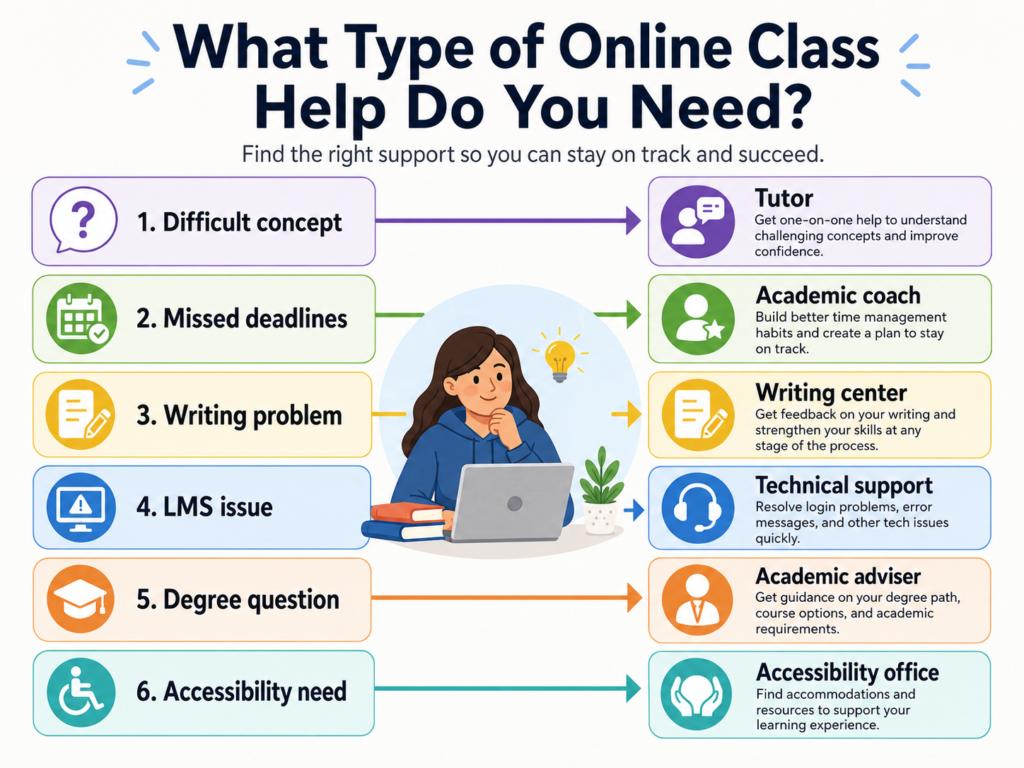
Before hiring a tutor, downloading another app, or paying for a service, identify the problem.
Use this table.
| Your problem | Support that may help |
| I do not understand the subject | Subject tutor or instructor office hours |
| I understand class but keep missing deadlines | Academic coach or time-management system |
| I do not understand assignment instructions | Instructor clarification, tutoring, or academic support |
| My writing is unclear | Writing center or writing tutor |
| I cannot navigate the learning platform | University technical support |
| I feel lost about degree requirements | Academic adviser |
| I have documented accessibility needs | Disability/accessibility services |
| I am anxious about an upcoming exam | Study planning, tutoring, counseling support where appropriate |
| I have fallen several weeks behind | Instructor, adviser, success coach, and recovery plan |
| I do not know how to study online | Online student success coaching |
| English is making academic work difficult | ESL, language, or academic-language support |
| A personal emergency affected my coursework | Instructor and appropriate student support office |
This distinction matters.
Paying for calculus tutoring will not solve a calendar problem.
Buying a planner will not teach organic chemistry.
Watching motivational videos will not clarify an assignment rubric.
The first step is to identify the bottleneck.
The Main Types of Expert Online Class Help
1. Subject Tutoring
A subject tutor helps you understand course material.
This may include:
- Explaining a concept differently
- Working through a similar example
- Asking questions that reveal misunderstanding
- Reviewing prerequisite knowledge
- Helping you build a practice plan
For example, imagine a student in College Algebra who keeps missing exponential-function questions.
A useful tutor might ask the student to explain:
- What the base represents
- How positive and negative exponents behave
- How exponential growth differs from linear growth
- What a graph should look like
The tutor is diagnosing understanding.
Simply giving the student the answer to the current homework question does not necessarily repair the skill.
2. Academic Coaching
Academic coaching focuses on how you manage learning.
Oregon State describes success coaching as individualized support for goals, academic skills, resources, time management, work-life balance, and other challenges affecting online learning.
A coach may help you:
- Build a weekly routine
- Break projects into smaller tasks
- Identify why you procrastinate
- Set realistic goals
- Create accountability
- Find support services
Consider this situation:
A student has a B in psychology, understands the readings, but submits work late every week.
The student may not need a psychology tutor.
They may need a course-management system.
3. Writing Support
Writing centers and writing tutors may help with:
- Understanding the writing process
- Thesis development
- Organization
- Paragraph clarity
- Citation questions
- Revision strategies
- Grammar patterns
Responsible writing support gives feedback.
It does not falsely represent another person’s writing as the student’s own.
A writing tutor may say:
“Your second paragraph introduces evidence, but I cannot see how the evidence connects with your main claim. What relationship are you trying to show?”
That question helps the student revise.
4. Exam Preparation
Exam support should happen before the test.
It may include:
- Building a review schedule
- Identifying tested topics
- Creating practice questions
- Reviewing mistakes
- Explaining weak concepts
- Practicing under time limits
- Managing test anxiety
For quantitative courses, students can use a structured approach similar to a math test study guide: diagnose weak areas, practice without notes, correct errors, and complete timed review.
Exam preparation should not involve another person taking a proctored, identity-verified, or graded exam for the student.
5. Technology and Learning-Platform Support
Sometimes the subject is not the problem.
The student cannot find the quiz.
The assignment upload fails.
The professor says a file is unreadable.
The student cannot locate the grading rubric.
Technical support may help with:
- LMS navigation
- Browser requirements
- File formats
- Video-conferencing tools
- Assignment uploads
- Password recovery
- University software access
Universities commonly separate technical support from academic tutoring because these are different support needs. Oregon State’s online student services, for example, separately identifies online tutoring and technical help among resources available to distance learners.
6. Academic Advising
A tutor should not make degree-planning decisions for you.
Academic advisers are usually the appropriate source for questions such as:
- Does this course satisfy my degree requirement?
- Can I withdraw from this class?
- What happens if I change majors?
- Which prerequisite do I need?
- Will this course transfer?
- How will dropping the class affect my academic plan?
Policies vary by institution, so use the adviser or official school office responsible for the decision.
7. Accessibility Support
Students with disabilities or documented accessibility needs should contact their institution’s accessibility or disability services office.
Appropriate accommodations depend on university procedures and individual circumstances.
Do not assume that an outside academic service can authorize:
- Extended test time
- Alternative-format materials
- Reduced-distraction testing
- Captioning
- Official academic accommodations
Those processes normally need to go through the institution.
How Expert Online Class Help Should Work
Responsible academic support should follow a learning-centered process.
Step 1: Define the Problem
Do not begin with:
“I am bad at this class.”
Be specific.
For example:
“I understand the video lectures, but I miss discussion deadlines.”
Or:
“I can calculate a confidence interval, but I do not know how to interpret it in a statistics answer.”
Or:
“My professor says my papers summarize sources instead of analyzing them.”
Specific problems lead to specific support.
Step 2: Review the Course Requirements
Collect:
- Syllabus
- Course calendar
- Grading breakdown
- Assignment instructions
- Rubrics
- Instructor announcements
- Recent feedback
Do not send private student-account credentials to an unknown tutor or service simply because they ask to “check the course.”
You can usually share the relevant assignment instructions or learning objectives without providing direct access to your personal student account.
Step 3: Set a Support Goal
A good support goal is measurable.
Examples:
- Complete this week’s assignments on time.
- Understand hypothesis testing well enough to solve five practice questions.
- Build a four-week exam review plan.
- Identify three recurring errors in my essays.
- Learn how to use my course calendar correctly.
- Recover from two missed modules.
Avoid vague goals such as:
“Fix my whole semester.”
Step 4: Work Through the Problem
The expert should help you understand:
- What the task requires
- What knowledge is missing
- Which strategy applies
- Where mistakes occur
- What to practice next
Useful support often includes questions.
You may be asked:
What have you tried?
Where did the process stop making sense?
Which part of the rubric is unclear?
Can you explain your reasoning?
A service that never needs your participation may not be supporting your learning.
Step 5: Practice Independently
After receiving guidance, close the example.
Try a similar task yourself.
Math courses often require solving new problems.
A different paragraph may need revision for a writing course.
For a time-management problem, update next week’s calendar independently.
This transfer step shows whether the help actually worked.
Step 6: Review Progress
At the end of the week, ask:
- Did I submit work on time?
- Which concept became clearer?
- What did I still avoid?
- Which support was useful?
- Can I now complete the task independently?
- What is the next problem to address?
The goal is progress, not permanent dependence.
Online Class Help vs. Tutoring vs. Academic Coaching
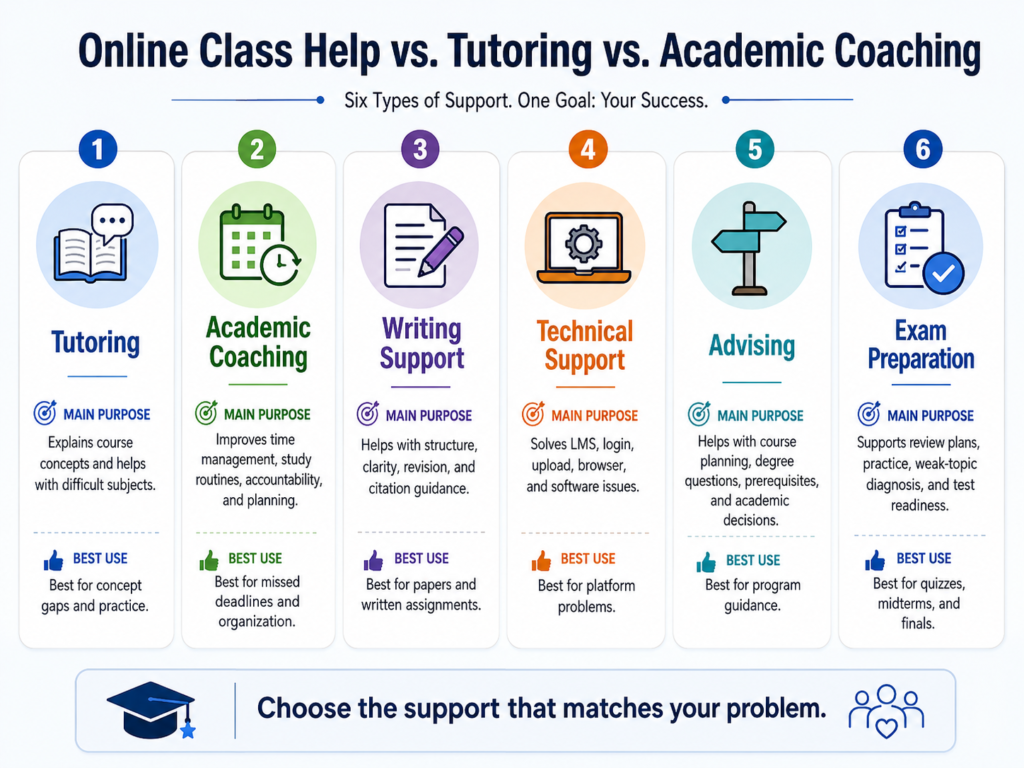
Students often use these terms as though they mean the same thing.
They do not.
| Type of support | Main purpose | Best for |
| Subject tutoring | Explain course content | Difficult concepts and prerequisite gaps |
| Academic coaching | Improve learning management | Time, motivation, routines, accountability |
| Writing support | Improve writing decisions | Organization, arguments, revision, citation guidance |
| Technical support | Solve technology problems | LMS, uploads, access, software |
| Academic advising | Guide program decisions | Majors, requirements, registration, degree plans |
| Exam preparation | Build test readiness | Review plans, practice, weak-topic diagnosis |
| Online class help | Broad support category | Students who need one or several forms of guidance |
Example 1: The Working Adult
Jordan works 45 hours per week and is taking an online business course.
Jordan understands the lectures but forgets smaller assignments.
Best starting support: academic coaching and calendar planning.
Example 2: The Community College Math Student
Maria attends every online lecture but cannot solve factoring problems without copying examples.
Best starting support: subject tutoring and independent practice.
Students with persistent foundational gaps may also benefit from learning how to get better at math instead of preparing only for the next assignment.
Example 3: The First-Year College Writer
Ethan receives comments saying:
“Needs analysis.”
He does not understand what the professor means.
Best starting support: instructor clarification and writing-center feedback.
Example 4: The Student Who Is Three Weeks Behind
Aisha has missed readings, discussions, and two quizzes after a family emergency.
Best starting support: contact the instructor, review institutional options with an adviser where necessary, and build a course-recovery plan.
A tutor alone cannot change closed deadlines or university policy.
Who May Benefit From Online Class Support?
Working Students
Work schedules can conflict with study time.
A student working evenings may need help creating a recurring academic routine around shifts.
Parents and Caregivers
Family responsibilities can make uninterrupted study periods difficult.
These students may benefit from:
- Shorter study blocks
- Weekly planning
- Early assignment starts
- Backup study periods
Community College Students
Community college students may be balancing:
- Employment
- Transfer planning
- Family responsibilities
- Commuting
- Multiple course formats
Support should fit the student’s actual academic pathway.
Adult Learners Returning to School
Someone returning after 10 or 15 years may understand the subject but feel unfamiliar with:
- Learning management systems
- Discussion boards
- Digital libraries
- Online citation tools
- Modern course technology
Technical orientation and academic coaching may be more valuable than basic subject tutoring.
International Students
International learners may need support with:
- Academic vocabulary
- Discussion-board conventions
- U.S. classroom expectations
- Academic writing
- Lecture listening
Students who are still developing English proficiency may first need to understand why English can be difficult to learn and identify whether listening, vocabulary, writing, or academic-language development is causing the problem.
Military-Connected Students
Military schedules, deployments, training, and relocation may affect course participation.
Students should communicate with the appropriate military or university support offices when official policies or benefits are involved.
Students Taking Difficult Prerequisite Courses
A nursing student may struggle with statistics.
A business student may struggle with accounting.
A psychology student may discover that research methods include more quantitative work than expected.
In these cases, targeted tutoring may prevent one prerequisite gap from affecting later coursework.
Why Students Fall Behind in Online Classes
Poor Time Estimation
Students often estimate only the final task.
For example:
“The paper will take two hours.”
But the real process includes:
- Reading instructions
- Choosing a topic
- Finding sources
- Reading sources
- Taking notes
- Building an outline
- Drafting
- Revising
- Checking citations
- Uploading the file
The final draft may take two hours.
The entire assignment may not.
The Planning Fallacy
Students can underestimate how long academic work will take, especially when they imagine an uninterrupted and problem-free study session.
A practical solution is to track actual task times for two weeks.
Write down:
| Task | Estimated time | Actual time |
| Watch lecture | 45 min | 70 min |
| Discussion post | 30 min | 55 min |
| Chapter reading | 60 min | 90 min |
| Quiz review | 45 min | 40 min |
Use the actual numbers when planning the next week.
Procrastination Becomes More Expensive Online
Skipping one lecture may affect a quiz.
Missing the quiz may lower the grade.
The student then spends the next week worrying about the grade instead of starting the next module.
This creates a backlog.
Students who repeatedly feel overwhelmed by unfinished academic work may also need to understand how homework can cause stress and separate workload problems from avoidant study habits.
There Is No Visible Classroom Pressure
In a physical classroom, you may see classmates opening notebooks or hear the instructor remind everyone about an exam.
Online, the course may disappear from your attention until a notification appears.
Create external reminders.
Do not rely on memory.
Students Wait Too Long to Ask for Help
A question from Week 2 can become a major problem in Week 6.
Ask for support when you first notice a repeated difficulty.
For example:
“I missed one assignment because I forgot.”
That is a warning.
Do not wait until:
“I have missed six assignments and stopped opening the class.”
How to Build an Online Class Recovery Plan
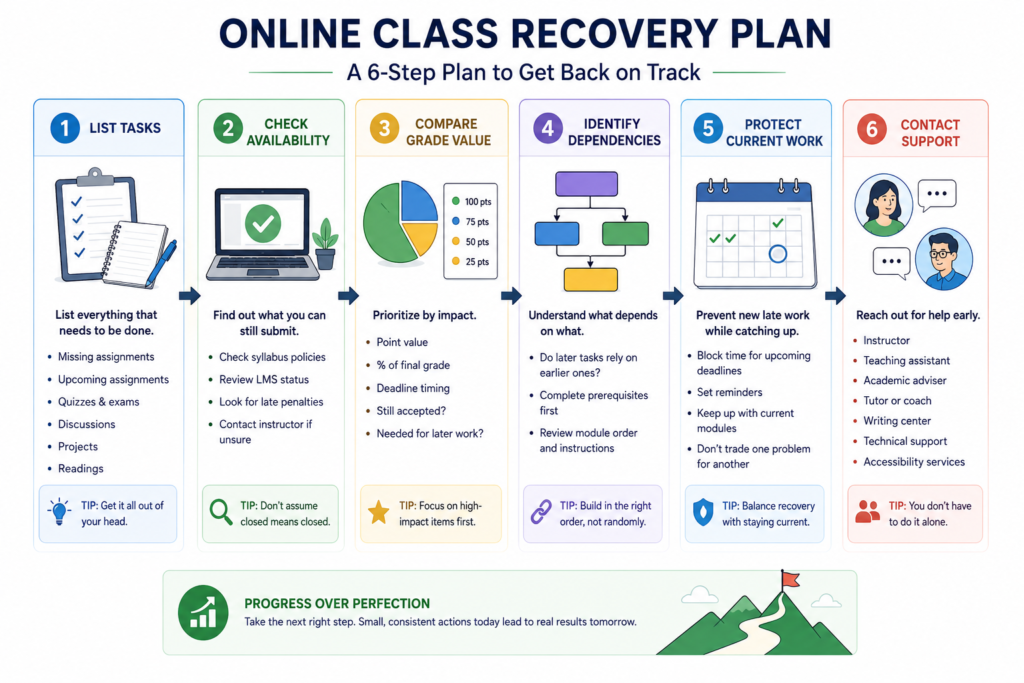
Falling behind does not mean you should randomly start completing the oldest tasks.
Use a triage process.
Step 1: List Every Outstanding Task
Create one list.
Include:
- Missing assignments
- Upcoming assignments
- Quizzes
- Exams
- Discussions
- Projects
- Required readings
Step 2: Check What Is Still Available
Do not assume a closed assignment can be submitted late.
Check:
- Syllabus policy
- LMS status
- Instructor announcements
Contact the instructor when clarification is needed.
Step 3: Calculate Grade Value
Prioritize work based partly on:
- Point value
- Percentage of final grade
- Deadline
- Whether the task is still accepted
- Whether it is required for later work
Step 4: Identify Dependencies
You may need Module 3 before Module 4 makes sense.
A research proposal may be required before the final project.
Complete prerequisite work first when later tasks depend on it.
Step 5: Protect Current Work
A common mistake is spending all week on overdue work and then creating five new late assignments.
Divide time between:
- Preventing new missed work
- Recovering high-value past work
Step 6: Contact Appropriate Support
Depending on the situation, contact:
- Instructor
- Teaching assistant
- Academic adviser
- Success coach
- Tutor
- Writing center
- Accessibility office
- Technical support
Do not hide a serious course problem until the end of the semester.
A Weekly Online Class Management System
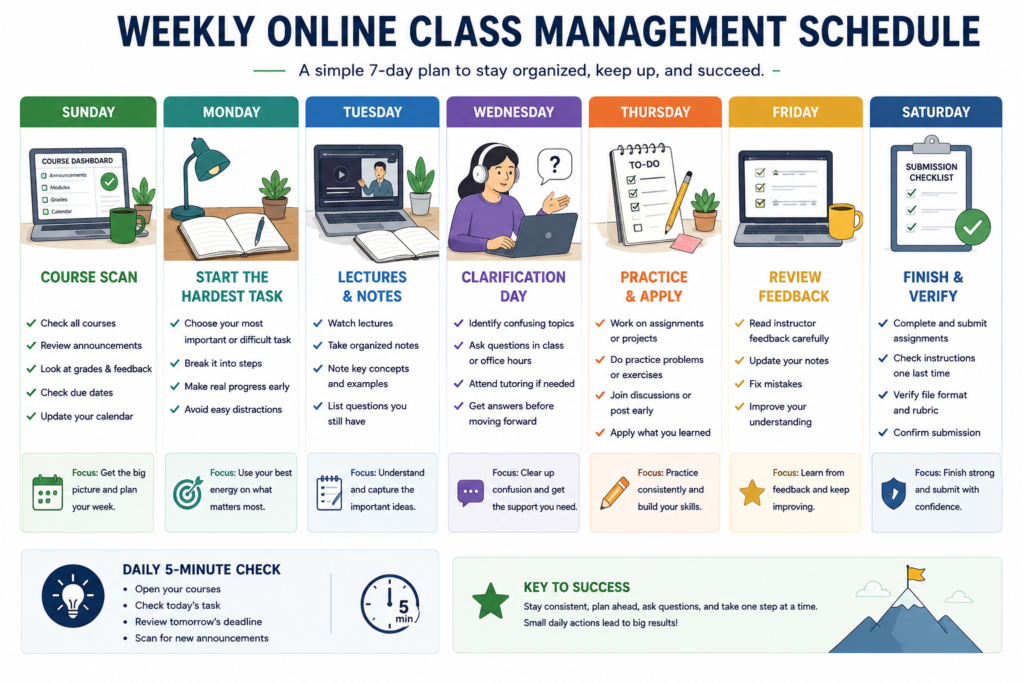
A simple system is often better than an elaborate productivity setup.
Sunday: Course Scan
Open every course.
Check:
- Announcements
- Due dates
- New modules
- Instructor messages
- Grades
- Feedback
Write all deadlines in one calendar.
Monday: Start the Hardest Task
Do not use your best academic energy organizing folders for three hours.
Begin the task most likely to create problems later.
Tuesday: Lecture and Notes
Watch assigned lectures.
Pause only when necessary.
Record:
- Main concept
- Example
- Question
- Next action
Wednesday: Clarification Day
By Wednesday, identify what you do not understand.
Send questions.
Attend office hours.
Schedule tutoring.
Do not wait until Sunday night.
Thursday: Draft and Practice
Work on:
- Assignment drafts
- Practice problems
- Discussion posts
- Project sections
Friday: Review Feedback
Check returned work.
Create a feedback log.
| Instructor feedback | What it means | What I will change |
| “Explain your evidence” | I summarized instead of analyzing | Add why the evidence supports the claim |
| “Show calculations” | Answer lacks process | Write each mathematical step |
| “Use course terminology” | Language is too general | Review module vocabulary |
Saturday: Finish and Verify
Before submitting, check:
- Instructions
- Rubric
- File format
- Citation requirements
- Submission confirmation
Daily Five-Minute Check
Spend five minutes checking:
- Today’s task
- Tomorrow’s deadline
- New announcements
Students who have difficulty maintaining routines may use structured time management activities for high school students and adapt the same calendar exercises for college or adult online learning.
How to Choose an Online Class Help Provider
Start with institutional support.
Your tuition or program fees may already provide access to:
- Tutoring
- Writing centers
- Academic coaching
- Advising
- Library support
- Technical help
Online universities increasingly treat student support as an important part of distance education. Quality Matters specifically identifies learner expectations, technology requirements, and access to learner support services as important elements of online learning support.
When considering outside help, evaluate the provider carefully.
Ask What the Expert Actually Does
A clear provider should be able to explain the service.
For example:
“The tutor provides a one-hour concept review and then gives you practice questions.”
That is specific.
Be cautious of:
“We handle everything. Do not worry.”
Check Subject Fit
A general tutor may help with study habits.
An advanced course may require a subject specialist.
Ask:
- What subject does the tutor teach?
- What level do they support?
- Have they worked with similar topics?
- How is expertise verified?
Do not rely only on a stock photo and a first name.
Review the Academic-Integrity Policy
Ask:
- Does the service provide tutoring?
- Does it take proctored exams?
- Does it log in as students?
- Does it write graded submissions for students?
- Does it have an academic-integrity policy?
University academic-integrity guidance treats online assessments and coursework as student academic work, not exceptions to integrity expectations.
Check Privacy Practices
Avoid sharing:
- Multifactor authentication codes
- Social Security numbers
- Banking passwords
- Unnecessary student records
Read the privacy policy.
Ask what data is stored.
Be especially cautious when a provider demands direct access to your school account.
Test Communication Before Paying
Ask one or two specific questions.
For example:
“I need tutoring for introductory statistics, particularly confidence intervals. What type of tutor would be assigned?”
The answer should address the question.
Repeated generic sales responses are a warning sign.
Understand Pricing
Ask:
- Is pricing hourly or package-based?
- What is included?
- Are there cancellation fees?
- Is unused time refundable?
- Does the price change for urgent sessions?
Keep the written terms.
Look for Learning Evidence
A useful tutoring service should make it possible to answer:
What will I understand or be able to do after the session?
The answer might be:
“You should be able to select and interpret a confidence interval for problems similar to those covered.”
“Guaranteed A” is not a learning outcome.
Red Flags Students Should Avoid
Guaranteed Grades
No legitimate tutor controls:
- Your instructor
- Your course grading
- Your future exam performance
- Your attendance
- Your participation
A promised grade should trigger skepticism.
Requests for Identity Verification Codes
Do not give an unknown person an MFA or two-factor authentication code.
Those codes exist to verify account access.
“We Will Pretend to Be You”
Impersonation creates academic and potentially account-security problems.
No Clear Tutor Information
Be cautious when a website claims every expert is highly qualified but provides no credible process for selecting tutors.
Pressure to Pay Immediately
Statements such as:
“Pay in five minutes or lose your only expert.”
should make you slow down.
No Written Terms
Before paying, understand:
- The service
- Price
- Cancellation terms
- Refund terms
- Privacy expectations
The Provider Refuses to Explain the Material
A tutor who says:
“You do not need to understand it.”
is not solving your learning problem.
What Responsible Expert Help Looks Like
Imagine a student named Ryan taking an online introductory statistics course.
Ryan’s grade has fallen from a B to a C.
He says:
“Statistics makes no sense.”
A poor support process immediately begins solving Ryan’s graded work.
A stronger process asks for the course topics and identifies the pattern.
Ryan’s recent mistakes involve:
- Null and alternative hypotheses
- P-values
- Statistical significance
- Writing conclusions in context
The tutor asks Ryan to explain a p-value.
Ryan cannot.
Now the problem is clearer.
The tutor:
- Reviews the meaning of a p-value.
- Compares incorrect and correct interpretations.
- Gives Ryan three ungraded practice examples.
- Asks Ryan to explain each conclusion aloud.
- Corrects one repeated misconception.
- Gives Ryan a new problem to complete independently.
Ryan still completes his own classwork.
But he now understands the concept that was affecting several assignments.
That is the standard students should look for.
Can AI Be Used for Online Class Help?
AI tools can support studying, but students should use them carefully.
Possible learning uses include:
- Generating practice questions
- Explaining a concept in simpler language
- Creating a study schedule
- Quizzing you on vocabulary
- Comparing two ideas
- Suggesting questions to ask a tutor
However, AI output can be inaccurate, and course policies on AI-assisted work vary.
A 2026 Purdue design case on a course-aligned AI tutor emphasized an assessment-aware “tutor, not solver” approach, with guardrails intended to scaffold learning rather than simply produce homework answers.
Better AI Prompt
Instead of:
“Do my statistics homework.”
Try:
“I am learning confidence intervals. Ask me one question at a time to check whether I understand what a 95% confidence level means. Do not give the answer until I attempt it.”
Or:
“Create five practice problems similar in skill to solving linear equations. Do not solve them. After I answer, explain my first incorrect step.”
Check your institution’s AI policy before using generated material in graded work.
How to Get More Value From Tutoring or Expert Support
Prepare Before the Session
Bring:
- Course topic
- Specific question
- Attempted work
- Instructor feedback
- Relevant rubric
Do not spend half the tutoring session searching for the assignment.
Show Your Attempt
Your mistakes help a tutor diagnose the problem.
An incorrect attempt is useful information.
Ask “Why” Questions
Ask:
Why is this method appropriate?
How would I recognize this problem on an exam?
What mistake do students usually make here?
How can I check my answer?
Take Your Own Notes
Writing the explanation in your own words forces you to process it.
End With an Independent Task
Before the session ends, complete one new problem or explain the concept without help.
Schedule a Retest
Try the skill again 24 to 72 hours later.
You may understand something during tutoring and forget it afterward.
Retrieval reveals whether the learning remained available.
What to Do When You Are Overwhelmed by an Online Course
Sometimes the problem is bigger than one difficult chapter.
LMS access issues can happen unexpectedly.
Using a university email may not always be preferred.
You may have several missing assignments and no idea where to begin.
Start with a ten-minute reset.
Minute 1–2: Open the Course
Do not attempt an assignment yet.
Log in.
Minute 3–5: Write the Next Three Deadlines
Ignore the entire semester.
Record only three deadlines.
Minute 6–7: Identify the Smallest Starting Action
Examples:
- Download Chapter 4.
- Email the professor.
- Open the rubric.
- Watch the first 10 minutes of the lecture.
- Schedule tutoring.
Minute 8–10: Complete the Action
Then choose the next step.
When a student’s workload is affecting several classes, they may seek an online course help service for legitimate tutoring, study planning, course organization, and academic support. The student should still confirm that any outside assistance follows the rules of the course and institution.
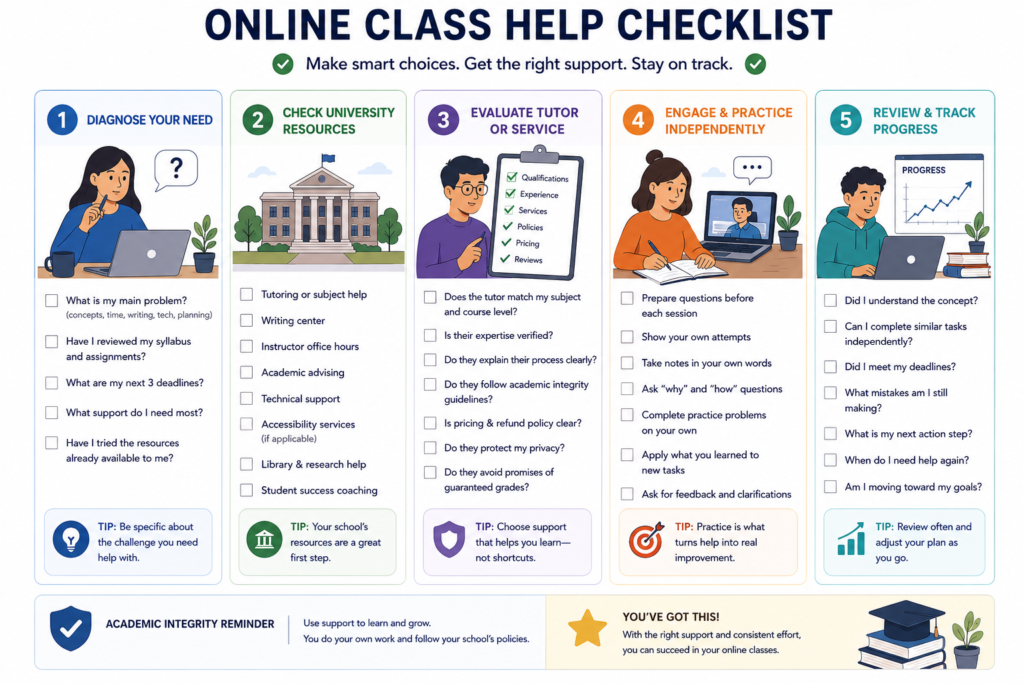
Online Class Help Checklist
Diagnose the Problem
- I can explain why I need help.
- I know whether my main problem is subject knowledge, time, writing, technology or course planning.
- I have reviewed my syllabus and current grades.
- I know my next three deadlines.
- I have identified missing work.
Check School Resources
- I checked tutoring options.
- I checked the writing center.
- I reviewed instructor office hours.
- I know how to contact technical support.
- I contacted advising when a program decision is involved.
- I contacted accessibility services when appropriate.
Evaluate Outside Support
- The provider clearly explains what support it offers.
- The expert matches my subject and course level.
- I understand the pricing.
- I have read the terms.
- I understand the privacy policy.
- The service does not require unnecessary account access.
- The service does not promise to impersonate me.
- The service does not guarantee a specific grade.
During Support
- I bring specific questions.
- I show my own attempt.
- I take notes.
- I ask why the method works.
- I complete independent practice.
- I record repeated mistakes.
After Support
- I can explain what I learned.
- I can complete a similar task independently.
- I know my next study action.
- I reviewed instructor feedback.
- I updated my weekly schedule.
- I know when to ask for help again.
Final Thoughts
Online class help from experts should solve a learning or course-management problem—not simply make the student disappear from their own education.
Extra guidance from a statistics tutor is sometimes necessary.
Many students benefit from scheduling a writing center appointment.
Sometimes the real problem is that five course deadlines are stored in four different places and you do not have one weekly calendar.
The smartest first step is diagnosis.
Open your online course and write down three things:
- The next deadline
- The biggest academic problem
- The person or resource most qualified to help with that problem
Then take one action today.
Book tutoring. Email your instructor. Build the calendar. Review the feedback you have been avoiding.
The earlier you identify the actual problem, the easier it is to choose online class support that helps you move forward.
FAQS
Online class help is a broad term for support given to students taking online courses. Responsible services may include subject tutoring, academic coaching, exam preparation, writing feedback, technical guidance, course organization, and help locating appropriate student resources.
An expert may explain difficult course concepts, help you build a study plan, identify knowledge gaps, review mistakes, clarify general academic skills, or help you organize weekly coursework. The exact support should depend on the reason you are struggling.
Not always. Tutoring focuses mainly on subject knowledge. Online class help can also include academic coaching, course planning, technical guidance, writing support and exam preparation.
Seek help when you notice a repeated problem. Examples include missing several deadlines, repeatedly misunderstanding one concept, receiving the same instructor feedback, or avoiding the course because you do not know where to begin.
Appropriate tutoring and academic support may help you improve skills, organization, and preparation, but no tutor can legitimately guarantee a particular course grade. Your results also depend on course requirements, your own participation, and instructor evaluation.
Look for relevant subject knowledge, clear explanations, transparent pricing, professional communication, an academic-integrity policy, and a tutoring process that includes student participation and independent practice.
Be very cautious. A tutor can usually work from assignment instructions, learning objectives, or materials you are permitted to share. Do not provide multifactor authentication codes or unnecessary direct access to a personal student account.
Start with your college or university. Many institutions provide tutoring, writing centers, academic advising, success coaching, library support, accessibility services, and technical support for online students.